
🔥 A company best known abroad for tractors and farm machinery says it has destroyed some of the most stubborn chemicals humans have ever made: the kind designed to last more or less forever. In recent tests, Kubota's waste-melting furnaces broke down three regulated PFAS compounds at rates above 99.999 percent. The interesting question isn't whether it worked. It's whether "destroying forever chemicals" is really the breakthrough the headline makes it sound like.
Why "forever" was the whole problem
PFAS (per- and polyfluoroalkyl substances) are a family of more than 10,000 synthetic chemicals prized for one trait: they barely react with anything. That made them perfect for non-stick pans, waterproof sprays, firefighting foam and semiconductor manufacturing. The same trait is also the problem. The bond between carbon and fluorine is one of the strongest in organic chemistry, so once PFAS reach soil or water, they essentially don't break down. Hence the nickname: forever chemicals.
A subset of them, including PFOS and PFOA, has been linked to cancer, liver damage and immune and thyroid effects, and is now classed internationally as a persistent organic pollutant. The United States has set a drinking-water limit of 4 nanograms per liter each for PFOS and PFOA. For scale, Kubota's own write-up likens it to a single teaspoon dissolved in a baseball stadium filled with water. In Japan, what used to be a non-binding target became an enforceable tap-water standard in April 2026.
The catch is that regulating concentrations in drinking water doesn't make the chemicals disappear. They get filtered out and concentrated into sewage sludge, spent activated carbon and other waste. In the U.S., some of that sludge used to be spread on farmland as fertilizer, until several states restricted the practice over contamination fears. That left a growing pile of PFAS-laden waste with nowhere to go, and a simple question: how do you actually get rid of something built to never break down?
A farm-equipment maker's answer: the furnace it already had
Kubota's route into this problem came from an overseas call for help. According to the company's in-house feature on the project, its U.S. subsidiary flagged the sewage-sludge problem in the summer of 2022 and asked whether Kubota's furnaces could break PFAS apart.
The reason a machinery company had a plausible answer is that Kubota has run waste-melting furnaces in Japan for more than 40 years. These rotary surface melting furnaces don't just burn trash. They melt incineration ash and sludge into a liquid at very high heat, then separate out reusable material as it cools. A typical incinerator runs at roughly 850 to 1,100°C. Kubota's furnaces sit at 1,250 to 1,400°C in normal operation, comfortably above the 1,100°C that researchers recommend for tearing apart the toughest PFAS.
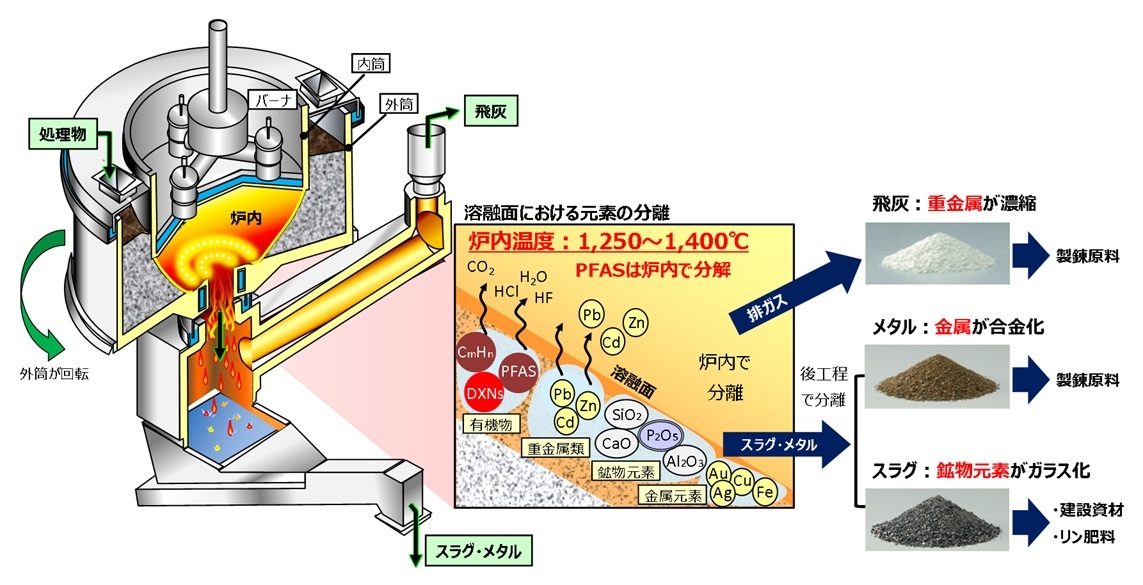
Source: Kubota Press
The engineering team, working with Japan's National Institute for Environmental Studies (NIES), leaned on an unlikely piece of prior experience: after the 2011 Fukushima disaster, the same partners had used melting technology to shrink and concentrate radioactive cesium waste. Kubota's feature describes that earlier collaboration as the reason the two sides trusted the approach would transfer from cesium to PFAS.
Getting test samples was its own hurdle. Because PFOS and PFOA are already banned, they're hard to obtain for experiments. So the team first ran a trial with PFNA, a close chemical cousin of PFOA that differs by a single carbon atom, reporting a destruction efficiency above 99.99993 percent when it published those results in January 2026. In parallel it secured genuine PFOS from a maker of firefighting foam slated for disposal. The main test ran in August 2025 at a small five-ton-per-day furnace in Osaka.
What "99.999%" actually means
The headline result, announced on June 16, 2026: decomposition efficiency of 99.9992 percent for PFOS, 99.9994 percent for PFOA and above 99.9994 percent for PFNA. Measured on the exhaust gas alone, the figure for all three topped 99.9999 percent. Those numbers matter because they map onto an international yardstick. The Basel Convention treats 99.999 percent as the threshold for environmentally sound destruction of persistent pollutants, and 99.9999 percent for the stricter gas-only measure. PFAS levels in the slag, fly ash and exhaust all came in under Japan's reference control values, and the Environment Ministry, along with experts it convened, confirmed the results met the requirements in its technical guidance on PFOS- and PFOA-containing waste.
But a high destruction rate has a known loophole. A PFAS molecule "disappearing" is not the same as it being destroyed. At insufficient temperatures, the original compound breaks into smaller fluorinated fragments that are themselves persistent, and sometimes potent greenhouse gases. Experts call these products of incomplete decomposition, and they are why a single number doesn't tell the whole story.
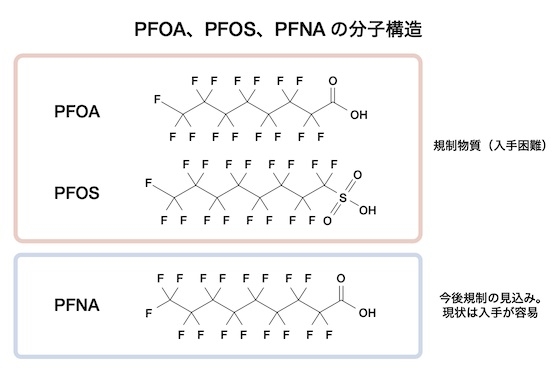
Source: Kubota Press
To check for that, the team ran U.S. EPA gas-sampling methods (OTM-45 and OTM-50) alongside Japan's standard tests. The key finding, as NIES researchers describe it, was that C2F6, a potent greenhouse gas that signals incomplete breakdown, came in below the detection limit. In other words, the evidence points toward the PFAS being mineralized, broken down toward simple inorganic end products, rather than merely vanishing from the original count.
So, is it actually a breakthrough?
Here's the honest answer: it depends on what you thought the breakthrough was.
If the claim is "high-temperature heat can destroy PFAS," that isn't new. In the U.S., Clean Harbors hit destruction efficiencies between 99.95 and 99.9999 percent for nine PFAS in EPA-coordinated incinerator tests, results published in 2025. A 2026 Minnesota study found municipal waste incineration destroyed an average of 99.6 percent. Thermal destruction is, at this point, a fairly well-studied path.
What's more distinctive about Kubota's result is the framing around it. The company stresses that it hit these numbers in existing furnaces under normal operating conditions, with no new facility required, and that the same process recovers usable material: metals for smelting, and phosphorus from sewage sludge that can be registered as fertilizer. Kubota pitches this as part of a "deep recycle" model rather than pure disposal.
It's worth keeping the skepticism in view too. PFAS incineration remains contested elsewhere. The U.S. Department of Defense and states including New York and Illinois have imposed moratoriums on burning certain PFAS waste, precisely over fears that incomplete combustion lets fluorinated compounds escape into the air. High-temperature disposal also isn't cheap, running roughly 1,000 to 2,000 dollars per ton, and alternatives like electrochemical oxidation and hydrothermal treatment are competing to do the job without combustion at all.
So "forever chemicals are no longer forever" is half right. The chemistry to break them apart exists and keeps improving, and Kubota's verified mineralization is a solid data point. What hasn't been solved is the harder logistics: collecting the world's accumulated PFAS waste, paying to process it, and proving, every single time, that destruction is complete rather than just out of sight.
Japan tightened its tap-water rules in April 2026, but treatment and destruction are a separate, quieter problem. Where you live, does anyone actually account for PFAS-laden waste, or does it just end up buried somewhere? Do you even know?
References
- https://www.kubota.co.jp/kubotapress/technology/pfas.html
- https://www.kubota.co.jp/news/2026/20260616-001204.html
- https://www.wastedive.com/news/clean-harbors-pfas-incineration-999999-destruction-test-epa/760856/
- https://www.waste360.com/industry-insights/the-nuanced-reality-of-incinerating-pfas
- https://www.barr.com/insights/emerging-pfas-destruction-technologies/









Global Discussion
4 comments