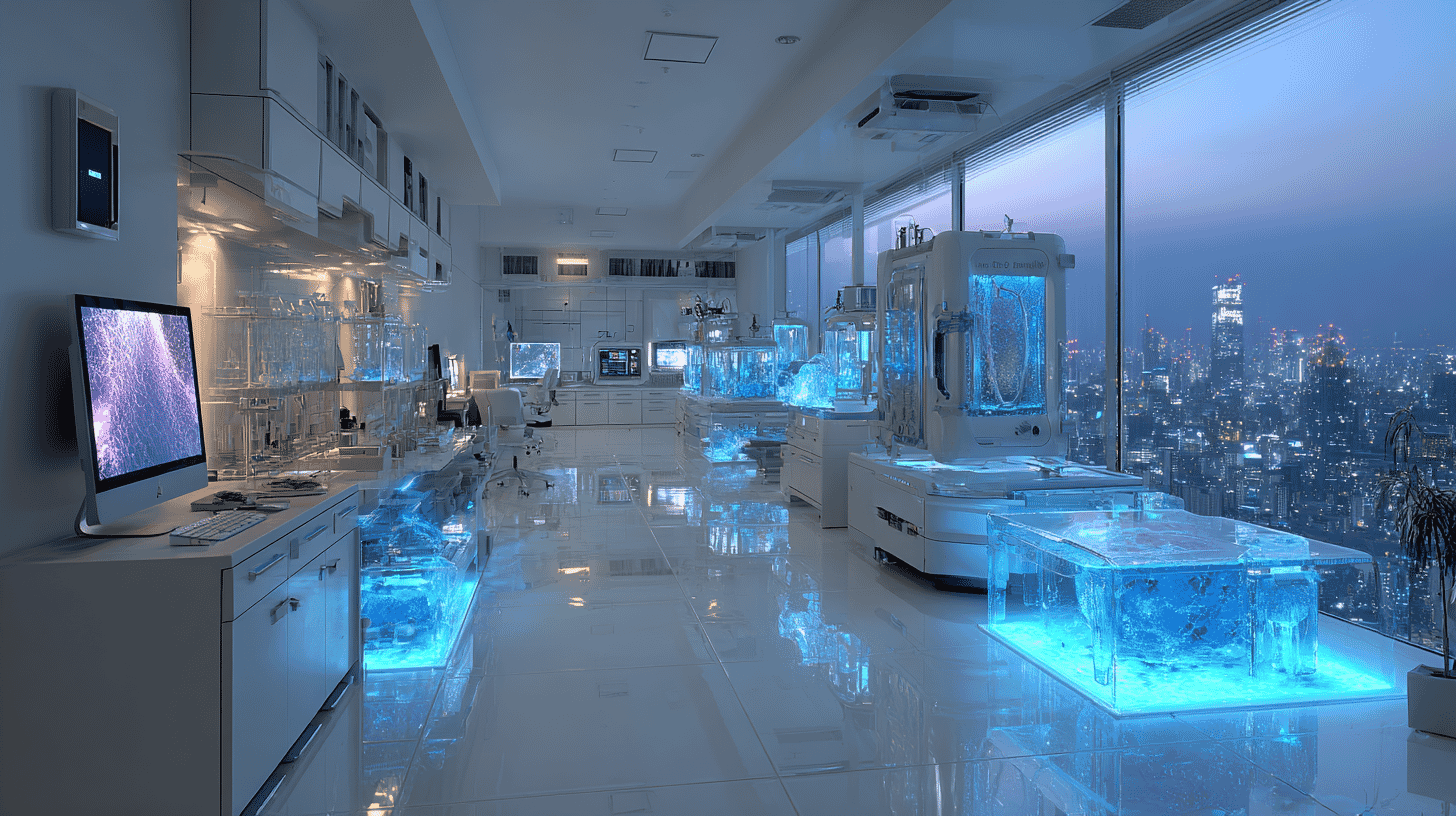
A Japanese consumer electronics giant may hold a key to the future of regenerative medicine. In April 2026, Panasonic Holdings began a proof-of-concept trial in Osaka that could finally demolish the "tens of millions of yen per patient" cost wall that has blocked iPS cell therapy from becoming a real medical option. Fourteen years after Professor Shinya Yamanaka's Nobel Prize, Japan's homegrown stem cell technology is entering its "factory production" phase.
A Home Appliance Maker Growing Stem Cells? Panasonic's Unexpected Move
On April 20, 2026, Panasonic Holdings announced it had begun full-scale proof-of-concept trials of a device that fully automates the iPS cell "establishment" (jyuritsu) process. The location: the "my iPS Research Lab" operated by Kyoto University's iPS Cell Research Foundation, inside the Nakanoshima Cross international medical hub in Osaka. In other words, Panasonic's machinery has been installed inside the lab of the foundation chaired by Professor Yamanaka himself.
"Establishment" refers to the pipeline that takes cells from a patient's blood, inserts specific genes to reprogram them, and stabilizes them as iPS cells that can be reliably expanded. Until now, this work has been done by hand by highly trained technicians in cleanrooms. It's time-consuming. Quality varies between operators. And above all, it costs tens of millions of yen per patient.
Panasonic's entry into this space is significant. The company is better known for appliances, cars, and home equipment, but it's also one of Japan's top players in factory automation and precision control. Now it's aiming that muscle at cutting-edge medicine.
What Are iPS Cells? A Five-Minute Primer
Induced pluripotent stem cells (iPS cells) are ordinary body cells, from skin or blood, for example, that have been reprogrammed by inserting specific genes, restoring their ability to turn into any cell type in the body.
In 2006, Professor Shinya Yamanaka of Kyoto University achieved the world's first iPS cell creation using mouse cells; in 2007, he repeated it with human cells. He received the Nobel Prize in Physiology or Medicine in 2012 for the achievement.
Unlike embryonic stem cells (ES cells), which require fertilized eggs, iPS cells raise far fewer ethical concerns. Crucially, they can be made from a patient's own cells, dramatically lowering the risk of immune rejection after transplant. That was the revolutionary promise: use someone's own cells to grow replacement tissue, retinas, heart muscle, neurons, blood, and repair the body with matched "parts."
But there's a stubborn problem.
The Multi-Million Dollar Wall
Nearly twenty years after iPS cells were discovered, they still aren't widely used. The biggest reason is cost.
Current iPS cell manufacturing happens in dedicated cleanrooms, performed manually by skilled technicians. Producing one patient's iPS cells runs in the tens of millions of yen, roughly $130,000 to $250,000 before differentiation into treatment cells, the transplant procedure itself, and hospital stays are even added. Even with Japan's national health insurance, the economics don't work.
As a workaround, most iPS cell therapies in clinical trials today use allogeneic transplants, tissue grown from someone else's iPS cells. That lowers costs, but brings back the immune rejection problem and the need for immunosuppressants.
For the original dream, using your own cells, grown into tissue, transplanted back into you, to become affordable, automation has been essential.
The "my iPS Project": Aiming at 1 Million Yen per Patient
This is where the iPS Cell Research Foundation's "my iPS Project" comes in.
The goal is simple: establish a system that can deliver one patient's worth of iPS cells for around one million yen (approximately USD $6,300). That's roughly one-fiftieth of today's cost. If it works, the economics of regenerative medicine change fundamentally.
In April 2026, the foundation opened the clinical-grade iPS cell manufacturing facility "Yanai my iPS Factory" on the sixth floor of Nakanoshima Cross. (The name honors Tadashi Yanai, chairman of Uniqlo parent Fast Retailing, who donated to the project.) The facility operates 13–14 German-made closed-system automated culture devices and can produce iPS cells roughly one month after receiving a blood sample. If scaled to 100 devices, the facility could produce iPS cells for 1,000 patients per year.
The foundation's roadmap targets the start of clinical trials using autologous iPS cells by fiscal year 2028.
Panasonic's Piece: The Hardest Step
Within the foundation's automation pipeline, Panasonic is tackling the "establishment" step, arguably the most difficult part.
The iPS manufacturing flow roughly goes: (1) draw blood from the patient, (2) separate cells, (3) introduce reprogramming genes, (4) select good iPS cell colonies, (5) stable expansion. Steps (3) and (4) are "establishment," where a technician has to read the character of each colony and cherry-pick the healthy ones. Traditionally, this has depended on experience and intuition.
Panasonic HD has identified "therapeutic cell manufacturing solutions" as a key theme in its "2040 Technology Vision," and this trial is the first concrete step. The company is combining its expertise in precision control, image analysis, and sterile environment management to replace what once required expert human eyes and hands.
For now, the device is installed at the my iPS Research Lab inside Nakanoshima Cross, where engineers will validate its usefulness and optimize it for stable operation.
The American Rival: Cellino's Laser-and-AI Approach
The same race is underway in the US. The most prominent challenger is Cellino, based in Cambridge, Massachusetts.
In May 2025, Cellino received the FDA's Advanced Manufacturing Technology (AMT) designation, a breakthrough regulatory status for an iPSC manufacturing platform. Its system, called Nebula, uses a combination of laser optics and AI to identify and select iPS cell colonies, fully automating the manual "passaging" and "colony picking" steps.
In February 2025, Cellino partnered with Massachusetts General Hospital (a Harvard-affiliated hospital) to launch the world's first hospital-based iPSC Foundry. The concept is point-of-care biomanufacturing, making a patient's cells inside the hospital treating them. So far, Cellino has raised $80 million in Series A funding and won a $25 million contract from ARPA-H, the US government's advanced health research agency.
The contrast between the two approaches:
| Panasonic × iPS Foundation (Japan) | Cellino (US) | |
|---|---|---|
| Base | Nakanoshima Cross, Osaka | Mass General Hospital, Boston |
| Core technology | Precision control, sterile environment, automated culture | Laser optics, AI image analysis |
| Cost target | ¥1M per patient (~$6,300) | Not disclosed (point-of-care) |
| Clinical timeline | FY2028 | Not disclosed |
| Regulatory progress | Preparing for PMDA review | FDA AMT designation (May 2025) |
| Funding | Foundation (Yanai donation etc.) + Panasonic | $80M Series A + $25M ARPA-H |
What's fascinating is that the goal is similar but the strategies run in opposite directions. Cellino is going for small units distributed across hospitals; Panasonic × iPS Foundation is centralizing large-scale production in Osaka. Which wins will depend on how regulation, insurance, and logistics play out.
Why Japan Has an Edge: The "Inventor's Bonus" and Universal Healthcare
iPS cells were invented in Japan. Professor Yamanaka; CiRA (Kyoto University's iPS Cell Research Institute), one of the world's largest research hubs; and the iPS Foundation as a public-interest entity, from basic research through applied science to social implementation, the ecosystem is connected. No other country has this stack integrated into one national project.
Japan also has universal health insurance. If efficacy is proven, insurance coverage tends to follow relatively quickly. Unlike the US market, which depends heavily on individual ability to pay, the logic "if we can make it cheap, many people can use it" simply holds.
There are downsides. Japan's regulator (PMDA) is cautious on safety reviews, and there's a persistent fear of falling behind the US on speed. The iPS Foundation itself is a public-interest entity and depends on partners for business-scale execution. Today's Panasonic partnership can be read as bringing in the "scaling muscle" the foundation needs.
Regenerative Medicine Enters the "Factory Era"
This trial isn't just a tech story. It marks a symbolic inflection point, iPS cells moving from "lab dream" to "factory product."
From a patient's blood, through fully automated equipment, at consistent quality, at a reasonable price, the industrialization of tailor-made regenerative medicine is beginning. If Panasonic's proof-of-concept goes smoothly, "creating and banking your own iPS cells" could become a realistic option by around 2028.
In Japan, research institutions, public-interest foundations, and major manufacturers are teaming up as a national project. What's it like in your country? Is regenerative medicine "industrialization" led by the state, or by private competition? Or does it happen entirely inside hospitals? We'd love to hear.
References
- https://prtimes.jp/main/html/rd/p/000006702.000003442.html
- https://news.panasonic.com/jp/press/jn260420-1
- https://www.cira-foundation.or.jp/j/about/project/myips/
- https://www.nikkei.com/article/DGXZQOUF11ANO0R10C25A3000000/
- https://www.nikkan.co.jp/articles/view/00745986
- https://www.businesswire.com/news/home/20250519682444/en/
- https://www.pharmamanufacturing.com/industry-news/news/55291441/






Global Discussion
14 comments