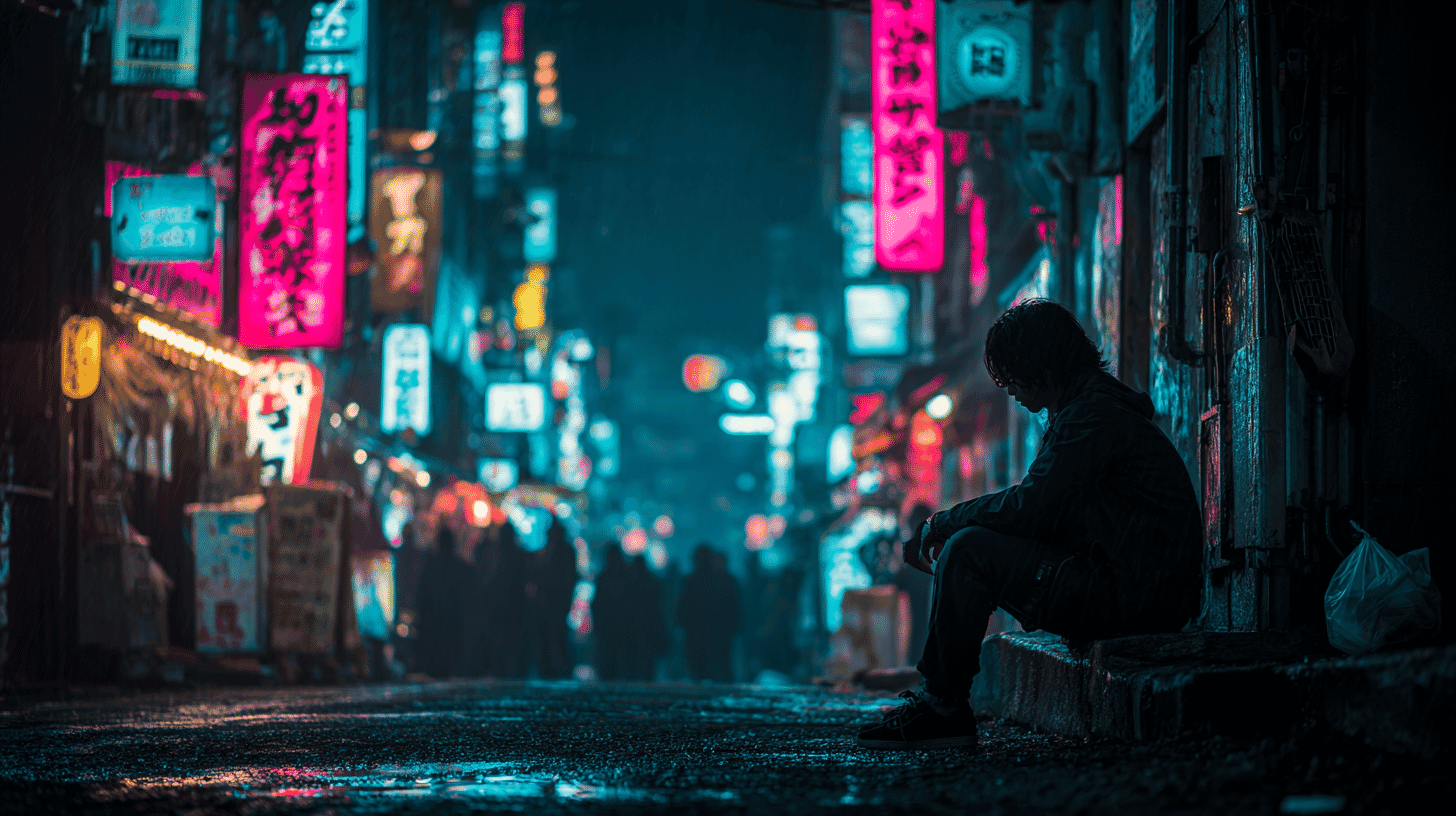
Medicines available over the counter at any Japanese drugstore are sending teenagers to emergency rooms across Tokyo. According to NHK reporting, teen overdose ER transports in the capital have roughly tripled in five years.
The substance behind this crisis isn't methamphetamine or street fentanyl. It is ordinary medicine sold without a prescription, combined with deepening social isolation. Tokyo's Kabukicho "Toyoko" plaza and Osaka's "Guri-shita" are where runaway teens from across the country gather. Set against America's fentanyl epidemic and Britain's harm-reduction approach, what does Japan's version reveal about its social structure?
⚠️ This article discusses mental health and substance abuse. Specific drug names, ingredients, and methods of misuse are deliberately withheld. Resources for those affected are listed at the end.
What the numbers show
According to Tokyo Fire Department data reported by NHK, emergency transports of teenagers for overdose within Tokyo's jurisdiction have roughly tripled over the past five years. That puts the problem on a scale comparable to heatstroke or traffic injuries, a public-health crisis unfolding largely out of public view.
The national picture is just as stark. According to a joint survey by the Fire and Disaster Management Agency and the Ministry of Health, Labour and Welfare (reported by Kyodo News and Nikkei), suspected over-the-counter (OTC) drug overdose transports rose from 9,595 in 2020, to 10,016 in 2021, to 10,682 in 2022. Among teenagers alone, cases jumped roughly 1.5× from 2020 to 2022. According to Asahi Shimbun reporting, teen cases reached 1,494 incidents in 2022, a 47% increase from 2020.
A National Center of Neurology and Psychiatry (NCNP) survey shows the share of OTC medicines as the "primary substance" among teenage drug-dependence patients surged from 0% in 2014 to 65% in 2022 (Medical DOC interview with Dr. Go, 2023). The pre-2014 era dominated by methamphetamine and synthetic "dangerous drugs" has been completely overturned.
The most recent data shows the situation deepening further. A Ministry of Health, Labour and Welfare research group survey conducted in 2024 across 29 specialized addiction treatment institutions nationwide found that, among 294 reported cases, the average patient age was 29.1 years (37.4% in their 20s, 24.5% teens, 21.1% in their 30s), with women accounting for over 70% of all cases (Jiji Press, April 2026). Family relationships were cited as background by roughly 40% and friend relationships by roughly 30%; SNS was identified as the main information source for misuse.
A separate MHLW research-group study involving Saitama Medical University Hospital, examining 122 cases over a 20-month period through December 2022, reported an average patient age of 25.8, the youngest just 12 years old, and 79.5% female (Medical DOC, 2023).
What's being misused, "ordinary drugs from any pharmacy"
The substances driving this crisis are not illegal. They are over-the-counter cold medicines, cough suppressants, painkillers, antihistamines, and anti-drowsiness pills, products sold without prescription at any drugstore.
Used as directed, these medications are safe. Taken in large quantities or repeatedly, they can cause loss of consciousness, seizures, respiratory depression, and irreversible damage to the liver and kidneys.
Since April 2023, Japan's Ministry of Health had tightened sales rules on products containing ingredients deemed at risk of abuse: no multi-pack purchases by anyone under 20, mandatory verification of purchaser name and age. Those measures sat at the level of ministry guidance rather than binding law.
That changed on May 1, 2026, when amendments to the Pharmaceutical and Medical Device Act took effect. The category was elevated into a statutory class of "designated abuse-prevention pharmaceuticals," and the number of covered ingredients expanded from six to eight. Anyone under 18 can now buy only a single small package; large-volume products and multiple units are barred. Name and age must be verified in writing, and staff are expected to ask about the reason for purchase and whether the customer has bought elsewhere. Display rules changed too: these products must sit in locked cases, behind the counter, or under equivalent supervision, out of customers' direct reach. What used to be a best-effort obligation is now legally binding, with administrative penalties running from improvement orders up to revocation of a store's licence.
But the gap between regulation and reality is wide. Teens hop between multiple drugstores, transactions move to flea-market apps and SNS direct messages, and arrests of young people in Kabukicho for unlicensed OTC medicine sales have been increasing.
"Toyoko" and "Guri-shita", children searching for somewhere to belong
In Tokyo, beside the Toho cinema complex in Kabukicho, lies a plaza known as "Toyoko" (literally "next to Toho"). In Osaka, beneath the famous Glico billboard in Dotonbori, is "Guri-shita" (under Glico). These have become destinations for teenagers nationwide who feel they have no place at home or at school.
Sweep operations by the Metropolitan Police have repeatedly turned up teens carrying large quantities of OTC medicines for overdose purposes. Cheap business hotels near Toyoko reportedly host as many as ten minors per room, sharing pills among themselves (Tokyo Shimbun reporting).
A 2025 peer-reviewed paper published on PMC (the U.S. National Library of Medicine) shows the gravity of the situation. Researchers examined eight runaway girls aged 12–16 transported to emergency care in Tokyo for impaired consciousness. All were female. 85.7% had a history of self-harm, about seven times the rate among Japanese adolescent girls in general. 62.5% had misused OTC medicines, roughly forty times the average rate among Japanese high school students. Most came from single-parent households, and over half had a history of school refusal.
"Having no place to belong" sounds abstract. In Japan, it has become a literal crisis.
Why now, SNS, COVID, and the structure of "ikizurasa"
Specialists point to a convergence of factors.
The COVID-19 effect. Research by Dr. Toshihiko Matsumoto, a leading authority on drug dependence, shows OTC overdose ER transports rose 2.3× during the pandemic compared to pre-COVID levels. Reporting in The International notes that during stay-at-home periods, abuse and family stress surged inside households, and once restrictions lifted, teens already at the breaking point flocked back to street gathering spots.
The SNS information environment. The MHLW 2024 research-group survey identified SNS as the main information source for misuse. A Kyoto University research team has empirically documented a sharp rise in posts about OTC misuse on Yahoo! Chiebukuro and similar consumer-generated platforms. Teens learn methods, sourcing, and effects through anonymous online channels, actively avoiding face-to-face consultation while connecting with others in similar pain.
The architecture of "ikizurasa." The MHLW 2024 survey identified family relationships (~40%), friend relationships (~30%), and school/work troubles as background factors for the start of misuse. An NCNP survey of high-schoolers nationwide also found OTC misuse statistically associated with "dissatisfaction with school life" and "limited time spent with parents." Family, school, community, every traditional refuge for teenagers has thinned out.
One observation is especially telling. Many teens who misuse OTC drugs have a prior history of self-harm. Dr. Matsumoto argues that self-harm and overdose share a common function: immediate escape from pain that feels unbearable right now. This is not recreational drug use. It is emergency self-medication to survive the next hour.
Different from America's fentanyl crisis, different deaths
For international readers, it is essential to understand that Japan's situation differs structurally from the U.S. fentanyl epidemic.
In the United States, fentanyl alone killed 73,838 people in 2022, a rate of 22.2 per 100,000. Deaths from fentanyl and other drugs among people under 35 exceeded 31,000 in 2021. The driver is illicit synthetic opioids manufactured by Mexican cartels, often consumed unwittingly through counterfeit prescription pills.
The American crisis is defined by a contaminated illegal market and immediate lethality. Japan's situation is different. Direct mortality from acute toxicity is far lower. Instead, the danger appears as long-term dependence and elevated suicide risk. Japan's 2025 White Paper on Suicide Countermeasures recorded 529 suicides among elementary, junior high and high school students in 2024, the highest figure on record, and noted that overdose accounts for a large share of suicide attempts among young people.
Death in Japan arrives more slowly, but the accumulated suffering and social loss are no less real. In some ways, the very fact that "no one drops dead immediately" makes the crisis harder to see, and policy responses easier to delay.
Compared with Britain's public-health approach, Japan's mental health gap
England and Wales recorded only 60 fentanyl-related deaths in 2024, about 0.1 per 100,000 people, less than 1/200th of the U.S. rate. However, deaths involving the emerging synthetic opioid class "nitazenes" jumped to 195 in 2024, roughly four times the previous year, and policymakers are on alert.
Britain's debate increasingly centers on Portugal-style decriminalization and harm reduction: needle exchanges, drug-checking strips, widespread availability of naloxone (the opioid-reversal drug), frameworks that prioritize keeping users alive over criminalizing them.
In American schools, 77% now stock naloxone on campus and 52% provide fentanyl education to students (KFF 2024–25 School Pulse Panel data).
Japan, by contrast, still tends to frame substance issues as matters of individual morality and law enforcement. School-based mental health education is limited. Child psychiatrists are scarce nationwide. The Showa-era "drugs are absolutely evil" awareness campaign does not reach teenagers who use OTC medicine as an escape hatch.
In March 2025, the Tokyo Metropolitan Government released awareness videos featuring former addiction patients and specialists, attempting a shift from "danger messaging" to an empathy-based approach. But the underlying infrastructure, counseling hotlines, child psychiatric care, child welfare offices, youth shelters, has not kept pace with surging demand.
A uniquely Japanese structure, "isolation in a wealthy country"
Despite Japan's economic status, a Cabinet Office survey released in March 2023 estimated that approximately 1.46 million people in the working-age population (15–64) are in hikikomori (acute social withdrawal), about 2% of that age group. The hikikomori rate among ages 15–39 rose from 1.57% in the previous survey to 2.05%, with younger generations driving the increase. Bullying, school refusal, broken family relationships, weakening neighborhood ties, Japanese teenagers are critically short of "third places" to turn to.
A March 2024 statement by the Takarazuka City Council in Hyogo Prefecture put it bluntly: "Behind youth overdose lies social isolation and ikizurasa. The problem must be reframed as one of loneliness and isolation, and policies for creating youth gathering places must be advanced."
In other words, Japan's overdose crisis is not really a "drug problem." It is the phenomenon of teenagers who have lost any sense of belonging, numbing their pain with the most accessible legal means available. Unlike the U.S. fentanyl crisis with its clear "enemy" (cartels, illegal supply), here the enemy is embedded in the social fabric itself.
What's needed, regulation alone won't reach them
Sales restrictions are an important symptomatic treatment, but not a cure. Specialists consistently point to:
- Expanded counseling channels that teenagers can actually use, anonymous, free, available at night
- Real mental health education in schools, not just "drugs are bad" but how to handle difficult emotions
- Training and regional placement of child psychiatrists
- Youth shelters and "third places" built through government-NGO collaboration
- Cooperation with SNS platforms to filter harmful content and route users to support
And above all: society needs to face the fact that there are teenagers for whom drugstore medicine has become a last-resort safety net. Toyoko and Guri-shita cannot be viewed only through a law-enforcement lens, the real question is what these children are running away from.
What's it like in your country?
In Japan, "ordinary medicine you can buy at any drugstore" has come to function as a kind of last-line emotional safety net for vulnerable teenagers, a structure shaped by easy legal access, thin mental health support, deep social isolation, and SNS culture all converging.
How does youth substance abuse manifest in your country? Is it the U.S.-style illegal opioid crisis? The U.K.-style harm reduction debate? Or a quieter crisis still below the surface? Are the systems supporting teen mental health actually working where you live?
Please share what's happening in your country in the comments.
💛 If you or someone close to you is struggling
Please don't carry it alone. Confidential help is available through phone, chat, and SNS-based services. Many countries have 24-hour crisis lines staffed by trained counselors. In Japan, services such as Inochi no Denwa (Lifeline), Yorisoi Hotline, and the Tokyo Metropolitan Mental Health Hotline operate around the clock.
References
- https://news.yahoo.co.jp/expert/articles/511b671a20f31422a8bfd541a282044bc9598499
- https://www.tokyo-np.co.jp/article/263757
- https://www.tokyo-np.co.jp/article/312875
- https://news.yahoo.co.jp/articles/0ca22c96789d2e7954209fe7920075064ec1e68f
- https://www.jiji.com/jc/article?k=2026042600293&g=soc
- https://pmc.ncbi.nlm.nih.gov/articles/PMC12589716/
- https://jcptd.jp/wpsystem/wp-content/uploads/2025/04/matsumoto_2024.pdf
- https://www.metro.tokyo.lg.jp/information/press/2025/03/2025031913
- https://www.nikkei.com/article/DGXZQOUE31BPU0R30C23A3000000/
- https://isshinternational.org/11154/features/abuse-of-otc-cold-medicine-is-consuming-vulnerable-youth/
- https://www.toxicology.abbott/gb/en/knowledge-insights/viewpoints/uk-fentanyl-crisis.html
- https://www.kff.org/mental-health/how-schools-have-responded-to-the-youth-fentanyl-crisis/
- https://www.kyoto-u.ac.jp/en/research-news/2023-12-22



Global Discussion
14 comments