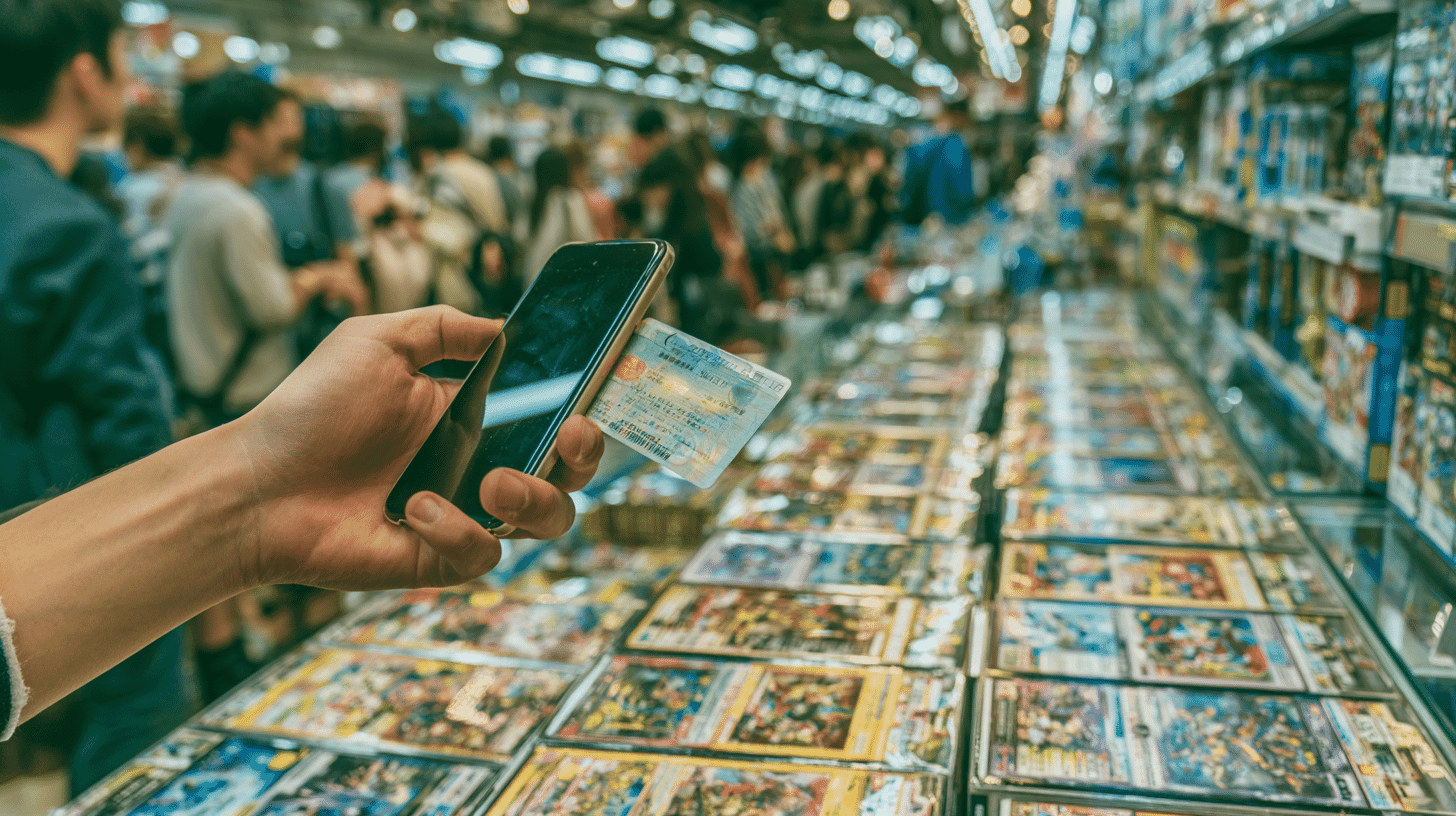
🎴 To buy a hyped Pokemon TCG product from Japan's official online store, you'll soon need to wave a government-issued ID chip at your phone.
Starting around August 2026, The Pokemon Company will use Japan's My Number Card, the country's national ID, to gate lotteries on Pokemon Center Online and to register for select official tournaments. The goal: lock out scalpers, bots, and the "stand-in" players who've been gaming championship age brackets.
The side effect: overseas collectors who've quietly relied on Japanese phone numbers and forwarding services may find the door to Japan-exclusive drops closing for good.
What's actually changing in August
The Pokemon Company published the notice on its official site on May 21, 2026. The new identity-verification system will apply to two things: priority lotteries and sales for some products on Pokemon Center Online (the Japanese-language official store), and entry applications for certain official tournaments held inside Japan. Rollout is targeted for around August 2026, with exact products, events, and age-tier rules to be announced later.
Mechanically, it works through Japan's existing public-key infrastructure. A user taps their My Number Card against a smartphone's NFC reader through a third-party service. That reads two specific functions on the card, the "user certification electronic certificate" and the "card-face item input assistance," to confirm the person is who they say they are, and to link that verified identity to their Pokemon "Player's Club" account.
One detail Pokemon emphasized in the announcement: the company will not collect or store the actual My Number itself. The system uses the card as a verification token, not a database hand-off. That distinction matters in Japan, where the My Number number is treated as legally sensitive data; the card-as-key approach lets Pokemon prove "one person, one account" without ever touching the underlying ID number.
So what is a My Number Card, exactly?
For overseas readers, a quick primer is in order, because there isn't really a clean US or European analogue.
Japan's My Number system, launched in 2016, assigns a 12-digit number to every resident: Japanese citizens, long-term foreign residents, and even Japanese nationals who've moved abroad after enrollment. The physical My Number Card is an optional but increasingly important IC-chip card that proves identity, doubles as a health-insurance card under recent reforms, and is required for things like opening tax-advantaged investment accounts (NISA) or filing taxes online.
The card holds a photo, an address, and digital certificates that can be read by a phone over NFC. Critically, you cannot get one if you do not have a Japanese address on the resident registry. Tourists can't apply. Overseas fans without a Japanese address can't apply. That single technical fact is why the new Pokemon rule reads, to a North American or European collector, less like a verification step and more like a hard geographic gate.
Applications also take time. Pokemon's own notice flags that My Number Card processing typically runs one to two months from request to issuance, and the company is announcing now so domestic fans have time to apply before August.
Why now: the breaking point inside Japan
This didn't come out of nowhere. Japanese fans have been calling for something, anything, to stop the scalping and impersonation pattern that's grown around Pokemon TCG releases.
The shorthand on Japanese social media is "Pokeka senso," or "the Pokemon Card War": the predictable scramble around each new expansion, with bots draining online lotteries, "fukugou" (multi-account) fraud, and resale listings going up at 3-5x retail within hours. In September 2025, organizers had to publicly discipline players at Champions League 2026 Yokohama after several were caught using stand-ins to game age-tier brackets that fed into bigger prize pools. That incident in particular, adults posing as juniors or vice versa to enter softer brackets, is part of why the new ID check covers tournament entry, not just product purchases.
There's also been a parallel mess in promotional tie-ins. A 2025 McDonald's Japan Happy Meal promotion with limited Pokemon cards collapsed into early shutdowns, abandoned food, and littered streets as resellers cleaned out stores for the cards inside. A Toys"R"Us Japan lottery saw its winners' list leak from multiple stores and get exploited by impersonators. Each of these incidents has chipped away at the goodwill of fans who actually want to play the game, and built pressure on the publisher to do something heavier than per-customer limits.
The My Number Card check is the heavier thing. Because the card maps one-to-one to a real person under a national registry, it makes "buy a SIM, spin up 50 accounts, win every lottery" a structurally harder play.
Source: AUTOMATON / The Pokemon Company
How Japanese fans are responding
Reaction inside Japan has been overwhelmingly positive, almost surprisingly so given how politically charged the My Number system has been in other contexts. Threads on X have called the move "kamitaiou" (a "god-tier response") and explicitly asked other publishers and toy companies to copy it. A common framing: anyone opposed to this is either a scalper or a My Number ideologue, neither of whom is the audience the official store is trying to serve.
The dominant reasoning among supporters is that multi-account fraud is the real bottleneck. SIM cards are cheap, email aliases are free, and the existing phone-number verification at Pokemon Center has been routinely defeated. The My Number Card is the first verification step that physically can't be duplicated at scale, because there is exactly one card per person, and applying for a replacement involves a municipal office and a few weeks of waiting.
The countervailing concerns from inside Japan are practical, not ideological: minors under 15 need a guardian's help to apply, the card itself takes weeks to arrive, and people who simply don't have one yet will be cut out of August's first wave of verified drops. Those are real frictions, but they're being absorbed by most fans as an acceptable cost.
The overseas problem nobody's talking about, except overseas
Here's the part that doesn't show up in the Japanese-language coverage: there is a sizable, mostly invisible international collector market that has, for years, been buying directly from Pokemon Center Online.
The workaround is well-known on Reddit's r/pkmntcgcollections and similar communities. You acquire a Japanese mobile number, either through services that lease real Japanese SIMs or through specialized SMS-verification storefronts that have popped up specifically to serve overseas Pokemon Center buyers, and you pair the account with a Japanese parcel-forwarding address. The forwarder receives your lottery win and ships it internationally. The whole stack typically costs less than the markup a North American or European reseller would charge for the same Japan-exclusive product.
That stack stops working in August. SMS verification can be bought; My Number Card verification cannot. Without a Japanese resident registry entry, there is no card to scan, no certificate to present, no path through the gate. Forwarding services and SIM rentals don't fix this; they sit on the wrong side of the wall.
For the international market, the practical outcome is twofold. First, Japan-exclusive Pokemon Center drops, the kind of items that have historically commanded the biggest markups on eBay and Mercari Shops international, become structurally harder to source at retail. Second, the secondary-market price for those same items abroad may actually rise, at least short term, because the supply pipeline narrows even as Western demand stays high.
This is not an accident the way it might look. Japan's official position is that Pokemon Center is a service for the domestic market, and overseas demand has always been technically out-of-scope. The My Number rule just makes the implicit explicit.
How this stacks against North American scalper countermeasures
Different markets have tried different things, and none have really worked.
In North America, the Prismatic Evolutions launch in January 2025 became the textbook case of how badly a release can go: empty Pokemon Center US shelves, fights breaking out in stores, fans gathering for hours to be told nothing was left. The Pokemon Company International issued a public statement promising reprints and more allocation, which is a supply-side fix rather than a buyer-side one. "The Pokémon center is basically empty when it comes to TCG. This shouldn't be the case for a main distributor," one Pokemon Forums user wrote that spring, with retailers and customers blaming a middle-of-the-chain bottleneck rather than end-buyer behavior.
Pokemon Center Singapore went the other direction, toward physical countermeasures, by quietly removing the plastic shrink wrap from products at the point of sale, on the theory that sealed-product scalpers lose their resale premium if the box is opened in the store.
Japan's My Number approach is a third philosophy: not "more product" and not "alter the product," but "verify the buyer is a real, unique, Japanese-resident human." It's the most invasive of the three, and the one with the cleanest theoretical effect on bots and multi-account fraud. Whether it actually clears Pokemon Center inventory at retail prices for Japanese fans, or whether it just routes scalping into different channels, like physical store lines and gray-market resale of verified accounts, won't be clear until September at the earliest.
What's still unclear
Update since publication: on 8 June 2026 The Pokemon Company named the first targets, the four Pokemon Center Online lottery items tied to Pokemon Card Game MEGA "30th CELEBRATION" (the expansion pack box at 7,200 yen, the FUTURISTIC BOX at 27,500 yen, the Espeon and Umbreon premium deck set at 6,200 yen, and the nine-piece card set at 10,800 yen, all tax included). The design matters: this is not a hard requirement. Unverified accounts can still enter, but the majority of winning slots are reserved for verified ones, so verification buys better odds rather than access. On 13 July the company added that the check will run through the Digital Agency’s Digital Authentication App, and urged fans to register before the August draw. Both of the open questions flagged below, which products and which method, have since been answered.
What remains open is the treatment of under-15 players, who legally can hold a My Number Card but need a guardian's involvement to apply. The tournament side is also still vague; the announcement says only "some" events, leaving room for the policy to scale up or down based on how the August rollout goes.
The wider question is whether other Japanese hobby and entertainment companies follow. Concert ticket scalping, Gunpla rare-release scalping, retro game console drops, and limited anime merchandise all share the same fundamental scalper economics. A My Number-verified path has been openly floated in Japan for years as a possible fix; Pokemon, with its scale and pain level, is the highest-profile company to actually move on it. If August goes well, the "Pokemon model" becomes the template a lot of other companies will start quietly testing.
For overseas Pokemon collectors, the practical advice is the same regardless: if there is a 2026 Japan-exclusive product you've been planning to buy from Pokemon Center Online, the window to do it through the old workarounds is closing. After August, the path runs through Japanese friends, official international Pokemon Center stores in countries where they exist, or the secondary market, which is, of course, exactly what this rule is trying to shrink.
Japan is about to test whether national ID infrastructure can fix what per-customer limits and bot-detection couldn't. Other countries have tried supply increases, store-side anti-scalping measures, or just accepted that hyped drops will sell out in seconds. How does your country handle scalping on hyped products? And would you be comfortable showing a government ID to buy a pack of trading cards? Let us know in the comments.
References
- https://automaton-media.com/articles/newsjp/20260521-444391/
- https://www.itmedia.co.jp/news/articles/2605/21/news107.html
- https://news.yahoo.co.jp/articles/0f5805f5714adba82b33095bfb77de36a613567b
- https://kai-you.net/article/95467
- https://coki.jp/article/column/81805/
- https://www.pokebeach.com/2026/05/pokemon-japan-to-implement-government-id-verification-for-pokemon-tcg-purchases-on-pokemon-center-online
- https://community.pokemon.com/en-us/discussion/17623/scalping-situation
- https://www.notebookcheck.net/McDonald-s-Pokemon-TCG-promotion-in-Japan-ends-in-chaos-with-scalpers-leaving-wasted-food.1084160.0.html







Global Discussion
0 comments