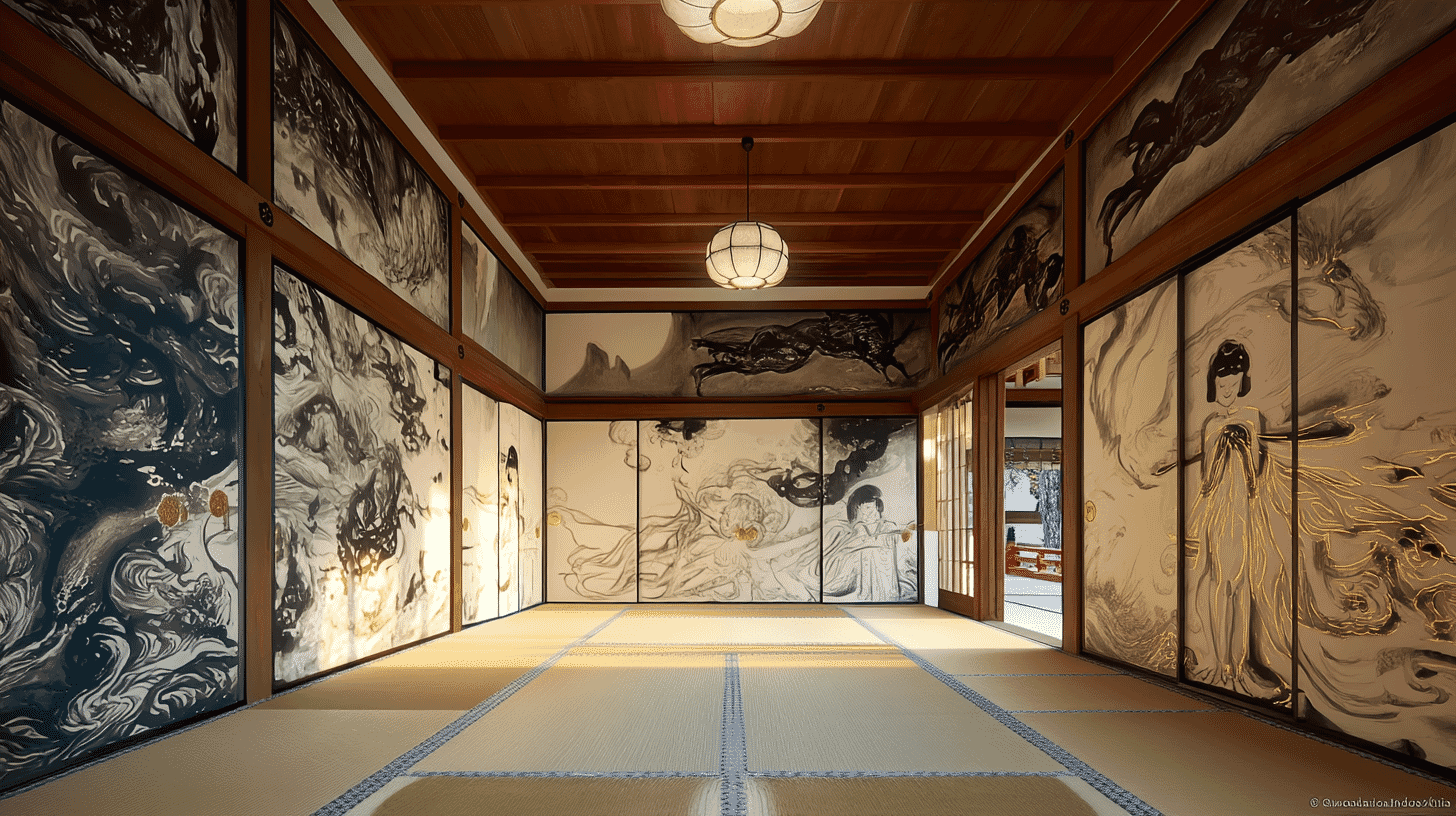
At the Fushimi Inari Shrine in Kyoto (home to the world-famous corridor of vermilion torii gates), a brand-new collection of fusuma (sliding-door) paintings is about to be unveiled to the public for the first time. The artist? Yoshitaka Amano, the man whose dreamlike characters defined the look of Final Fantasy. The theme? "Light and Darkness." The window? Just 16 days, from April 25 to May 10, 2026. A new pilgrimage spot for JRPG fans has been born.
What's Happening: A Final Fantasy Legend Has Donated Art to a 1,300-Year-Old Shrine
Fushimi Inari Taisha, the head shrine of all 30,000+ Inari shrines in Japan, will hold a special public viewing of fusuma paintings personally donated by the master illustrator Yoshitaka Amano. The unveiling runs from Saturday, April 25, 2026 through Sunday, May 10, 2026, a 16-day window, as part of the Spring Special Public Viewing of Hidden Cultural Properties of Kyoto organized by the Kyoto Cultural Properties Preservation Foundation.
The viewing also opens up several normally-off-limits buildings: the Ochaya tea house (Important Cultural Property), the Shamusho-shoin reception hall (its first-ever public viewing), the historic former residence of Edo-period scholar Kada no Azumamaro, and the Matsu-no-Shitaya pavilion.
The big draw is the Shoin (reception hall). Amano's freshly donated fusuma paintings, themed "Light and Darkness," were installed in 2025 and have never been shown to the public until now. According to the shrine, the works fill the entire prayer space with a fantastical, sweeping vision of the world of the Inari deity.
Who Is Yoshitaka Amano? Final Fantasy Fans Already Know This Name
Yoshitaka Amano, born March 26, 1952, is one of Japan's most internationally celebrated illustrators. He's now 74 years old.
Amano started at the legendary anime studio Tatsunoko Productions at age 15, where he designed iconic characters for shows like Speed Racer, Gatchaman, Tekkaman, and Honeybee Hutch. But his global breakthrough came in 1987, when Square (now Square Enix) hired him as the concept and character designer for a brand-new role-playing game called Final Fantasy, a title chosen because the studio expected it to be their last project before going under.
The game, of course, became a phenomenon. Amano designed the main characters of Final Fantasy I through VI, and to this day he continues to draw the iconic logo art for every mainline Final Fantasy title.
His style, soft watercolor lines, generous white space, a fusion of Eastern aesthetic and Western fantasy, became the visual DNA of the franchise. Even as later FF games moved to 3D modeling and photo-realism, Amano's illustrations have remained the spiritual face of the series.
Beyond gaming, Amano illustrated Neil Gaiman's award-winning The Sandman: The Dream Hunters, the Vampire Hunter D novels, and Michael Moorcock's Elric of Melniboné. He has worked as a costume and stage designer, exhibited at galleries from New York to Paris to Hong Kong, and in 1996 was reportedly the world's highest-earning artist based on print sales. Recent major retrospectives at Lucca Comics & Games (Italy) and Palazzo Braschi in Rome confirm his international stature only continues to grow.
Why Fushimi Inari? Foxes, "Eastern Fantasy," and a Long-Standing Connection
Amano and Fushimi Inari go back further than most people realize.
When working on The Sandman: The Dream Hunters with Neil Gaiman, Amano visited Fushimi Inari to research fox spirits, the messengers of the Inari deity. He has spoken in interviews about his fascination with the shrine's pre-Meiji-era blend of Shinto and Buddhism, calling it a uniquely Japanese willingness to "take the best of both worlds."
According to Famitsu, Amano described creating votive art for a sacred site as something with "special meaning even within over 40 years of artistic career." BS Nittele, a Japanese broadcaster, aired a documentary on New Year's Day 2026, Paintings of the Gods: Fushimi Inari vs. Yoshitaka Amano: A Thousand-Year Fusuma Project Recorded in Full, that followed the entire project from sketch to installation.
A 1,300-year-old shrine and a master of modern fantasy art may seem like an odd pairing, but Amano, who has spent decades depicting "Eastern mystery through a Western fantasy filter", is arguably the perfect artist to render the world of Inari faith for a contemporary audience.
Also On Display: A Veteran Painter and a Historic Chess (Shogi) Match Room
Alongside Amano's work, fusuma paintings by Taisuke Hamada (born 1932) will also be shown. Hamada's panels were donated in 2011 to commemorate the 1,300th anniversary of the shrine's founding. He's a heavyweight of contemporary Japanese painting whose work also adorns Kamigamo Shrine, Iwashimizu Hachimangu, and To-ji Temple, so seeing both artists' fusuma in one shoin is a rare treat for fans of contemporary nihonga.
This year's viewing also opens the Seicho-no-Ma, the room used for Game 2 of the 74th and 75th Osho-sen, one of Japan's seven major shogi (Japanese chess) title matches. For Japanese shogi fans, this is the room where Sota Fujii defended his crown.
Visitors can also see a courtyard garden designed by the same landscape gardener responsible for the Kyoto State Guest House, plus the historic former home of Kada no Azumamaro, an Edo-period kokugaku (national-learning) scholar from a prominent Inari priestly lineage.
Practical Information for Visitors
Dates: April 25 (Sat) – May 10 (Sun), 2026, 16 days only.
Hours: 9:00 AM – 4:00 PM (last entry).
Admission:
- Adults: ¥1,000 (about $6.30 USD at ~159 yen to the dollar)
- Junior high & high school students: ¥500 (about $3.15 USD)
Important schedule changes for the Shoin (where the fusuma are displayed):
- May 1 (Fri): opens at 11:00 AM
- May 4 (Mon): opens at 12:00 noon
- May 8 (Fri): opens at 11:00 AM
These changes are due to scheduled rituals; check the latest information at the reception desk in front of the Kada no Azumamaro residence.
Special goshuincho (stamp book): During the viewing period, a limited-quantity goshuincho designed by Yoshitaka Amano himself is available. The cover incorporates motifs from the fusuma paintings, a must-have for FF and Amano fans.
The shrine grounds themselves remain free to enter 24/7 as always, only this special viewing area requires the ticket.
A Hidden Pocket of Quiet, Even During Golden Week
Fushimi Inari is famously one of the most-visited tourist sites in Japan, regularly topping international visitor rankings for Kyoto. The Senbon Torii (thousand torii gates) corridor and the Mt. Inari hike route are typically packed.
But the special-viewing zone is different. The Shoin and Ochaya tea house aren't on the standard tourist path, Japanese cultural-property bloggers describe them as "surprisingly quiet" even when the shrine grounds are mobbed.
So if you're going to be in Kyoto during Golden Week (Japan's late-April-to-early-May holiday cluster) and were planning to skip Fushimi Inari because of the crowds, this might actually be the moment to go. The chance to sit in front of an Amano fusuma in a quiet, sacred shoin only comes around once.
A Note for International Final Fantasy Fans
Information about this viewing is largely available only in Japanese, even the official cultural-properties foundation website is Japanese-only. That means international fans probably haven't heard about it yet. If you're planning a Kyoto trip for late April or early May 2026 and you have any attachment to Final Fantasy, this is one of the most distinctive things you can do that you'll never see anywhere else.
Amano's original artwork has appeared in galleries worldwide. But seeing his work installed inside a sacred Shinto space, surrounded by 1,300 years of Inari faith, is a fundamentally different experience from a museum visit.
In your country, would it be conceivable for a famous video-game or pop-culture artist to donate their work to a sacred religious site? In Japan, contemporary artists donating art to ancient shrines and temples isn't actually that unusual, there's a long, easy back-and-forth between pop culture and traditional religion that often surprises overseas visitors.
How would your country react to a collaboration like this? Let us know in the comments.




Global Discussion
15 comments