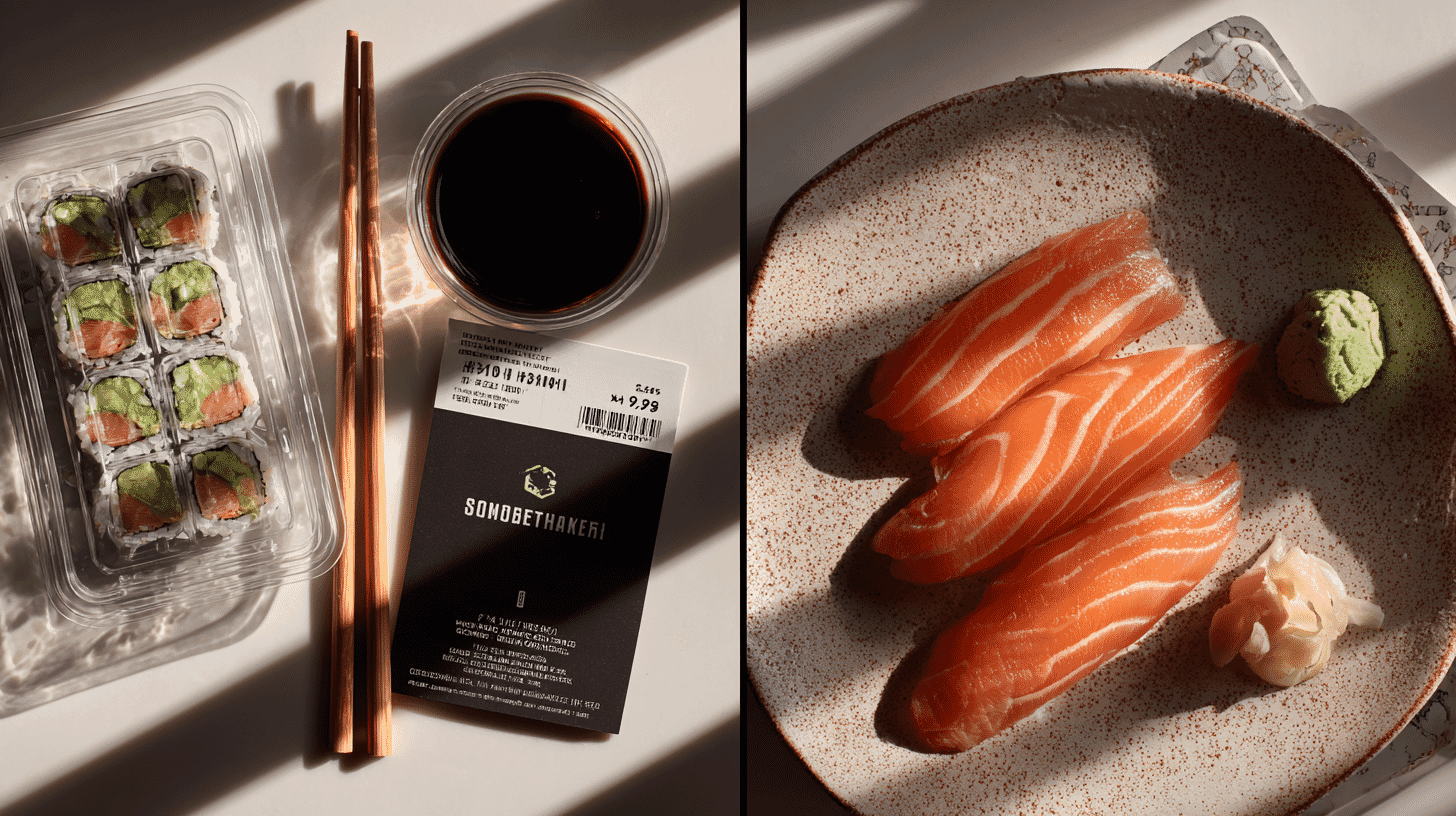
Sushi is exploding in American supermarkets. A $10 pack of California rolls for lunch has grown into a $2.8 billion market. Meanwhile, in New York City, ultra-premium omakase restaurants charge over $1,000 per person, and they're fully booked. How did Japan's signature dish split into two completely different worlds in America?
The Rise of the $10 Supermarket Sushi Pack
Walk into a major American supermarket, and you'll likely find a colorful sushi display near the entrance. California rolls, spicy tuna rolls, dragon rolls, packaged in plastic containers and priced between $9 and $15. None of these would look out of place at an American lunch table, even though most wouldn't be recognized at a traditional sushi bar in Tokyo.
The numbers behind this trend are staggering. According to reports from the New York Times and other outlets, takeout sushi sales at U.S. supermarkets reached $2.8 billion in 2024, up 7% from the previous year and a massive 63% increase since 2020.
Leading the charge is Kroger, America's largest supermarket chain. Headquartered in Cincinnati, Ohio, with over 2,700 stores nationwide, Kroger sells more than 40 million sushi items per year. According to data from research firm Circana Group, Kroger became the nation's largest sushi seller in 2020. Roughly two-thirds of its stores feature dedicated sushi counters, moving over one million units every week.
What makes American supermarket sushi fascinating is how it has adapted to local tastes. West Coast locations offer poke bowls (a Hawaiian raw fish dish), while Ralphs stores in Southern California sell Latin-inspired rolls topped with sweet mango sauce and Tajín, a popular Mexican seasoning. Sushi in America isn't a copy of Japanese sushi; it's a localized product shaped by the diversity of American food culture.
Families are even packing sushi in school lunchboxes. At under $10, it's become a go-to snack for kids after school. Sushi has fully transitioned from "exotic Japanese food" to an American everyday staple.
At the Other Extreme: $1,000 Omakase Experiences
While sushi goes mainstream in supermarket aisles, an entirely different sushi economy thrives at the top. In Manhattan, ultra-premium sushi restaurants are pushing prices to unprecedented levels.
At Masa, a three-Michelin-star Japanese restaurant, the omakase course at the counter runs $950 per person. Add drinks and the customary 20% tip, and you're easily past $1,000 (roughly ¥160,000 or €920). Some high-end spots require a $500 credit card deposit just to secure a reservation.
This extreme pricing reflects New York's unique economics. Sky-high Manhattan rents force even restaurants that would be casual and affordable in Japan to adopt luxury positioning in the U.S. On top of that, the cost of airfreighting premium fish from Japan's Tsukiji and Toyosu markets, rising labor costs, and shortages of California-grown sushi rice have all driven prices upward.
Yet demand from wealthy diners remains rock-solid. Young foreign investors sponsor Japanese sushi chefs to open exclusive counters, confident that New York's affluent clientele will pay whatever is asked. This is the reality of the city's high-end sushi scene.
From 3,000 to 23,000: The Japanese Restaurant Explosion
The sushi boom is part of a much broader story: the explosive growth of Japanese restaurants across America.
According to a JETRO (Japan External Trade Organization) survey, the number of Japanese restaurants in the U.S. grew from 3,051 in 1992 to 23,064 in 2022, roughly a 7.6-fold increase over three decades. California leads with 4,995 restaurants, followed by New York (1,936) and Texas (1,197, up 49% from 2018).
Globally, Japan's Ministry of Agriculture, Forestry and Fisheries counted approximately 187,000 Japanese restaurants overseas in 2023, up about 20% from 159,000 in 2021.
Some estimates suggest America's sushi market has grown to approximately 1.6 times the size of Japan's own market. In 2024, Japanese trading house Sojitz acquired Sushi Avenue, a takeout sushi operation serving supermarket deli sections across more than 20 U.S. states, signaling that major Japanese corporations see this as a growth market worth investing in.
The California Roll: Where America's Sushi Story Began
The catalyst for sushi's spread in America was the California roll, born in Los Angeles in the 1960s. Made with avocado, imitation crab, and cucumber, and wrapped "inside-out" (uramaki) with the rice on the outside and seaweed hidden within, it removed the two biggest barriers for American diners: raw fish and visible seaweed.
From there, a uniquely American creative roll culture took off: dragon rolls, rainbow rolls, spicy tuna rolls, and countless variations that don't exist in Japan. American sushi evolved into something genuinely distinct from traditional Edomae sushi (the Tokyo-style tradition of hand-pressed nigiri with carefully prepared fish).
In the 1980s, Japan's economic boom elevated sushi to a symbol of "healthy, sophisticated cuisine," embraced by Hollywood celebrities and trend-setters. By the 1990s, supermarkets began selling ready-made sushi (Vons is credited with opening the first in-store sushi bar in 1986), and sushi spread from fine dining rooms to family kitchens.
Today, the evolution continues with plant-based (vegan) sushi and sustainable seafood options. Japanese sushi and American sushi have arguably become two distinct food cultures that share a name.
How Japanese Sushi Chefs View the Divide
So how do Japanese sushi professionals feel about supermarket rolls sharing the "sushi" label with their craft?
Tatsuya Sekiguchi, a fourth-generation sushi chef at Tatsu Dallas in Texas, takes a generous view. Anything made with vinegared rice qualifies as sushi, he says, and affordable supermarket options are actually a positive thing because they keep people interested in sushi. His own restaurant serves a different clientele (just 10 seats, $185 per person, traditional Edomae-style), and he sees no conflict.
Japan's conveyor-belt sushi chains have also found success stateside. Kura Sushi USA went public in 2019 at $14 per share; by early 2024, the stock had risen sixfold, with market capitalization briefly surpassing $1 billion. Using touchscreen ordering and automation to keep prices accessible, Kura demonstrates that the Japanese model of affordable, quality sushi can work in America too.
For many Japanese people, watching sushi evolve in unexpected ways overseas stirs mixed emotions. Some insist that mango-topped rolls aren't "real sushi." Others celebrate the fact that a food culture stays alive only by changing and adapting.
What's sushi like in your country? Can you grab a pack at the supermarket, or is it still a special-occasion splurge? We'd love to hear about sushi culture where you live.
References
- https://news.yahoo.co.jp/articles/1359679edd08b72066d052c9b9c50a057cb68a5f
- https://www.businessinsider.jp/article/274199/
- https://www.jetro.go.jp/biznews/2023/03/e59c0562f8443f3a.html
- https://www.sojitz.com/jp/news/article/20240730.html
- https://ysandpartners.com/jp/blog/california-roll-when-and-how-did-sushi-become-popular-in-america/








Global Discussion
14 comments