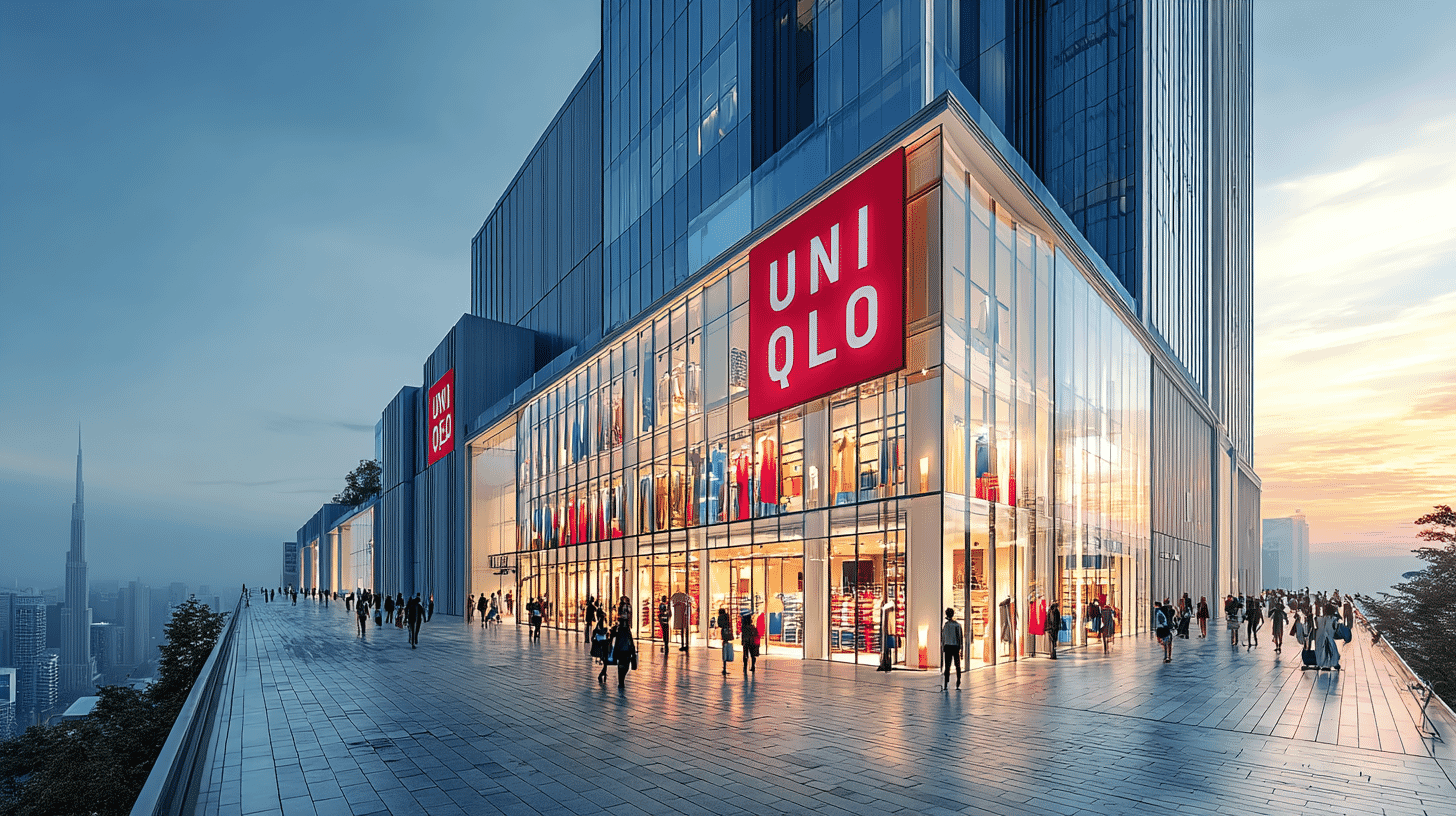
Uniqlo once closed 16 of its 21 stores in London, and its New Jersey outlets were drowning in unsold inventory. "Uniqlo doesn't work in the West," people said. Fast forward to 2025: Uniqlo is the world's 47th most valuable brand, overseas revenue exceeds 56%, and its Western sales now match China's. This is the remarkable turnaround story of Japan's biggest clothing brand.
Uniqlo Breaks Into the World's Top 50 Brands
In October 2025, global branding giant Interbrand released its "Best Global Brands 2025" ranking, and for the first time ever, Uniqlo made the list, landing at number 47 with an estimated brand value of $17.7 billion. Among Japanese companies, it trails only Toyota (6th), Honda (29th), and Sony (34th). No Japanese retailer had ever cracked the top 100 before.
Earlier that year, Uniqlo also debuted on Kantar's "Most Valuable Global Brands Top 100" and took home the "Breakthrough Brand" award for achieving rapid global growth through meaningful differentiation. The message was clear: Uniqlo has arrived on the world stage.
The Numbers Behind the Boom
Fast Retailing, Uniqlo's parent company, posted record-breaking results for fiscal year 2025, revenue of approximately $22.7 billion and operating profit of about $3.8 billion, marking a fourth consecutive year of all-time highs. Overseas Uniqlo did the pulling: its ¥1.91 trillion in revenue was 56.2% of the group total, and its segment profit hit a record ¥305.3 billion.
The sharpest shift is in Europe and North America. In Q1 of fiscal 2026 (September–November 2025), those Western markets grew fast enough to pull level with Greater China as a revenue engine. While the Chinese market has slowed due to cautious consumer sentiment, the West has become Uniqlo's primary growth engine.
Looking at North America alone, fiscal year 2024 saw revenue of approximately $1.45 billion (up 32.8% year-on-year) and operating profit of $232 million (up 65.1%). Store count is set to exceed 100 in fiscal 2025, with expansion into Texas joining the established presence on the East and West Coasts.
The Dark Days: When the West Rejected Uniqlo
To truly appreciate this turnaround, you need to understand how badly Uniqlo struggled in its early Western ventures.
Uniqlo's overseas journey began in 2001 with stores in London. The launch was promising, lines formed outside the doors. But an aggressive target of 50 stores in three years led to a proliferation of money-losing locations. Of 21 stores opened, 16 had to be shuttered, leaving just 5 in central London.
The mood among local staff was grim. Hiring conservative retail veterans from traditional British department stores had created an organizational culture that was the opposite of Uniqlo's flat, action-oriented Japanese ethos. The prevailing sentiment was blunt: "Uniqlo doesn't work here."
America was no different. In 2005, three stores opened in suburban New Jersey shopping centers. Sales flatlined, and inventory piled up.
The Soho Turning Point and the Flagship Strategy
The breakthrough came from an unexpected discovery born out of failure. To clear the mountain of unsold inventory from New Jersey, Uniqlo set up a small temporary shop in Manhattan's Soho district. Astonishingly, this tiny outlet outsold all three suburban stores combined.
Seizing on this insight, Uniqlo opened a massive 3,300-square-meter global flagship store in Soho in November 2006. Featuring a new logo co-designed by renowned Japanese creative director Kashiwa Sato, with both English and katakana scripts, the store represented a bold pivot: instead of adapting to Western retail norms, Uniqlo would bring its authentic Japanese identity to the world.
What followed was a string of flagship openings in the world's most prestigious shopping districts: London's Oxford Street (2007), Paris's Opéra district (2009), and New York's Fifth Avenue (2011) with a record-breaking 4,600-square-meter store.
The key insight was counterintuitive: rather than localizing, Uniqlo doubled down on being Uniqlo. The towering stacks of perfectly folded clothes in every color, the immaculately organized displays, the attentive service, these Japanese retail hallmarks struck Western consumers as something entirely new and refreshing.
LifeWear: How Uniqlo Differentiates from ZARA and H&M
At the heart of Uniqlo's success lies "LifeWear," a brand philosophy that deliberately distances itself from fast fashion. While ZARA competes by rapidly translating runway trends into affordable pieces, and H&M focuses on trend-driven low prices, Uniqlo offers something fundamentally different: basic clothing elevated by cutting-edge technology.
HeatTech (heat-generating innerwear), AIRism (cooling moisture-wicking fabric), and Ultra Light Down are proprietary innovations that competitors find difficult to replicate. These aren't fashion items, they're engineered solutions for everyday life, and that's precisely the point.
Europe, the birthplace of Western fashion, has proven particularly receptive. According to Fast Retailing, there is strong alignment between European cultural values and the LifeWear concept. Consumers who appreciate quality materials like cashmere and linen have increasingly embraced Uniqlo's functional innovations as well. The European operation achieved revenue of approximately $1.84 billion in fiscal 2024, up a remarkable 44.5% year-on-year, the highest growth rate among all Fast Retailing businesses.
Sustainability further strengthens Uniqlo's positioning. Its in-store clothing recycling program and expanding use of recycled materials resonate powerfully with environmentally conscious Western consumers, offering a meaningful contrast to the disposable ethos of traditional fast fashion.
The Swedish Olympic Partnership: Sports as Brand Amplifier
One of Uniqlo's most ingenious brand-building moves has been its partnership with the Swedish Olympic and Paralympic Committees. After opening its first Nordic store in Stockholm in 2018, Uniqlo signed on as Sweden's official clothing partner in January 2019.
Here's the remarkable part: Sweden's Olympic team had previously been outfitted by H&M, Sweden's own global fashion giant. Uniqlo effectively took the deal away from H&M on its home turf.
Since then, Uniqlo has supplied official uniforms for four consecutive Games: Tokyo 2020 (held 2021), Beijing 2022, Paris 2024, and the Milan-Cortina 2026 Winter Olympics. At the 2022 Beijing Winter Games, Sweden's team wearing Uniqlo won a record 18 medals, providing powerful validation of the brand's functional credentials.
For the Milan-Cortina 2026 Games, Uniqlo's official wear incorporates Toray's waterproof breathable fabric "Dermizax®" in ceremony jackets, supplies competition wear for freestyle skiing, snowboard, and curling, and features expanded use of recycled materials. A pilot QR-code transparency label system, allowing athletes to scan product origin and recycling information, showcases the brand's commitment to supply chain openness.
Crucially, Uniqlo translates these elite athletic innovations into consumer products through collections like the "Uniqlo × Swedish Athlete Collection," sold in 50+ stores worldwide. This pipeline from Olympic performance to everyday LifeWear represents a uniquely Uniqlo approach to sports marketing.
From Asian Clientele to "MADE FOR ALL"
A key indicator of Uniqlo's Western breakthrough is the evolution of its customer base. In North America, shoppers were once predominantly Asian and Asian-American. Today, stores attract a genuinely diverse mix of ethnicities and backgrounds. Fast Retailing says this shift brings the brand closer to its founding principle: "MADE FOR ALL."
This transformation was driven by strategic merchandising. Uniqlo identified products with strong Western appeal, bra tops, linen shirts, wide-leg pants, and committed to sufficient inventory and aggressive marketing. Customer feedback from Europe and North America has also begun driving global product development, creating a virtuous cycle where Western consumer preferences shape products sold worldwide.
Lessons for Japanese Brands Going Global
Uniqlo's journey offers invaluable lessons for any Japanese brand aspiring to global success.
Don't over-localize. The 2000s failures stemmed from trying too hard to adapt to Western retail conventions, diluting Uniqlo's identity. The turnaround came from confidently bringing the authentic Uniqlo experience abroad. The lesson: your Japanese identity can be your greatest asset.
Fail fast, learn faster. From London's devastating store closures to the serendipitous Soho discovery, Uniqlo's story is defined by rapid course corrections. Founder Tadashi Yanai titled his autobiography "One Win, Nine Losses" (一勝九敗), a philosophy that embraces failure as the price of ambitious experimentation.
Compete on substance, not trends. In a world increasingly skeptical of fast fashion's environmental and social costs, Uniqlo's focus on timeless quality and functional innovation has become its strongest competitive advantage.
In Japan, Uniqlo is such an everyday presence that its global rise can be easy to overlook. But abroad, its distinctive red logo now stands proudly on Fifth Avenue in New York, Oxford Street in London, and the Champs-Élysées in Paris. How is Uniqlo perceived in your country? Do you have Uniqlo stores nearby? We'd love to hear your thoughts!
Update: Fast Retailing's results for the first nine months of fiscal 2026 (September 2025 to May 2026), released on July 9, 2026, showed revenue of ¥3.065 trillion, up 17.1% year on year, and operating profit of ¥614.3 billion, up 36.2%. The company raised its full-year guidance to ¥3.97 trillion in revenue, ¥730 billion in operating profit and ¥500 billion in net profit. Every Uniqlo region posted higher sales and profit. (Added August 2026)
References
- https://www.fastretailing.com/jp/group/news/2510231700.html
- https://www.fastretailing.com/jp/group/strategy/tactics.html
- https://www.fashionsnap.com/article/2025-10-16/best-global-brand-25/
- https://www.uniqlo.com/jp/ja/contents/feature/ambassador/team-sweden/
- https://prtimes.jp/main/html/rd/p/000000127.000068741.html





Global Discussion
15 comments