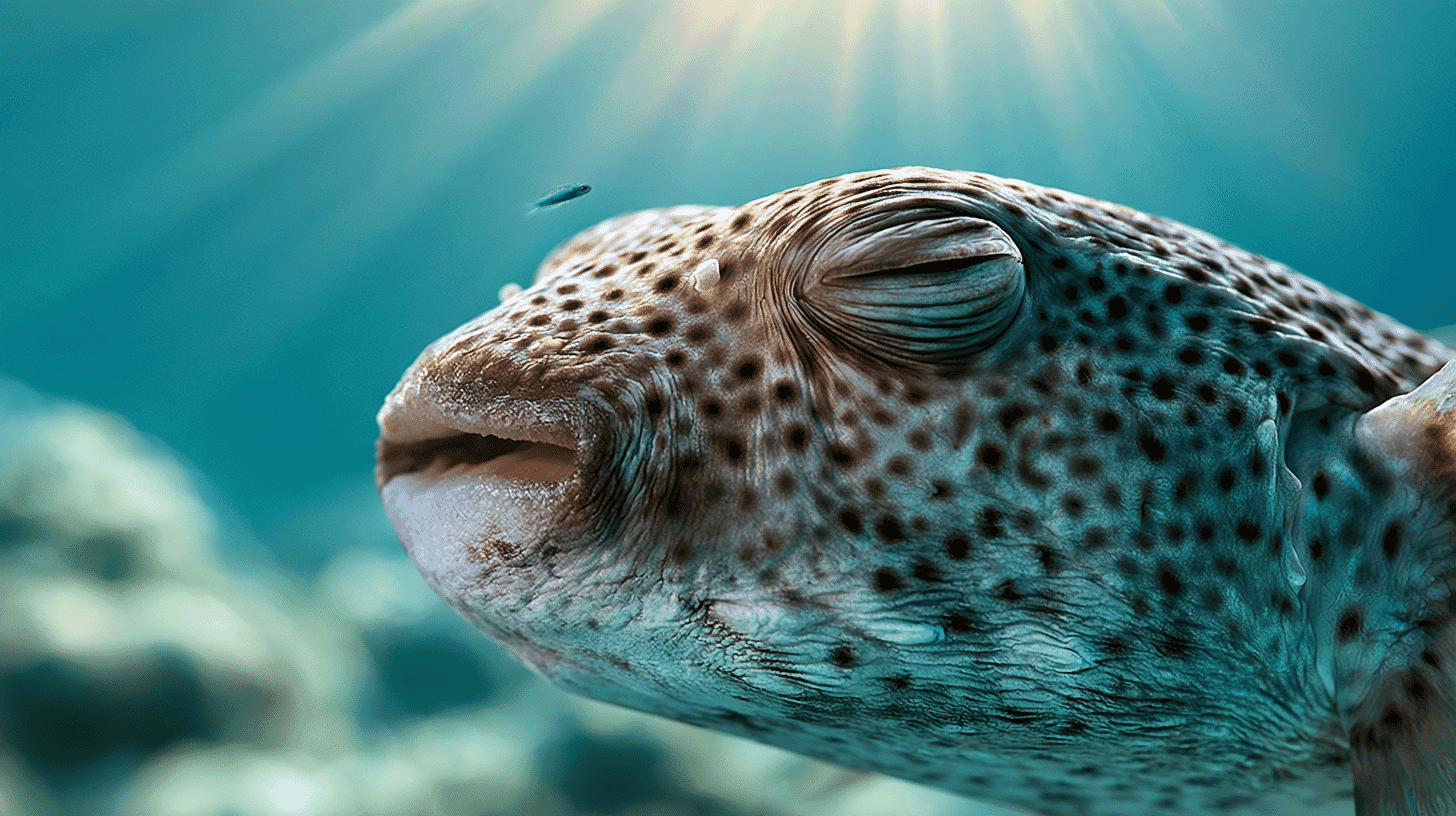
Fish don't have eyelids. Pufferfish close their eyes anyway, cinching the skin around each eye shut like a drawstring bag. An aquarium in Shimonoseki, Japan, has now worked out where that trick came from: the muscle that shuts the eye started life as the muscle that deflates a puffed-up puffer.
A fish that closes its eyes
Watch a pufferfish in a tank long enough and you may catch it "blinking." No upper and lower lid comes down. Instead, the rim of skin around the eye tightens toward the center and covers the eyeball, the way a camera aperture stops down. The researchers call it iris-like eye closure.
Land vertebrates close their eyes to keep them moist and free of debris. Fully aquatic fish have no such need. Some sharks and rays can cover their eyes, but among bony fishes, which run to tens of thousands of species, the 2021 Kaikyokan paper notes that the pufferfish family is the only known exception. That puffers do it had been mentioned in passing in Japanese ichthyological literature for decades. What the 2021 paper from Kaikyokan, the Shimonoseki city aquarium, added was a measurement of the movement and an explanation of what drives it.

Source: Kaikyokan press release
Solved in 2021 with a homemade stimulator
That 2021 study was led by Keisuke Ogimoto, an exhibit keeper at Kaikyokan who did a master's in the comparative anatomy of sharks and rays at Hokkaido University and kept doing research on top of his day job looking after the tanks.
The method was refreshingly low-tech. First, he filmed fine-patterned pufferfish (Takifugu flavipterus) and measured how the eye's height and width changed from the moment it began to close until it reopened. Both shrank at the same time and recovered at the same time, which meant the skin was contracting in concentric rings.
Next came the question of whether the thin, sheet-like muscle under that skin was actually doing the work. Ogimoto removed the tissue, bathed it in saline, and ran a current through it. In an essay for the Japanese science site academist he admits the rig was homemade: a commercial electric massager, insect pins and copper wire. When the current flowed, the tissue bunched toward the spot where the eye had been. The closing motion had been reproduced on the bench.
Kaikyokan staff had already been watching the behavior for years. A summer observation project in 2016 found that the aquarium's puffers tended to close their eyes when parasites were on the surrounding skin, when they burrowed into sand, or when an eye bumped the tank wall. It isn't rhythmic blinking. It looks like protection.
Fifty-one species under the scalpel
So the mechanism was known. Why only pufferfish have it was not. A new paper published in the Journal of Morphology on August 12, 2026, answers that with phylogenetics.
Ogimoto is first author again, joined by Kaikyokan colleagues Teppei Kushimoto and Hideaki Shindo, Takayuki Sonoyama of Enoshima Aquarium, Western Australian underwater photographer Wade Hughes, and Taketeru Tomita of the Okinawa Churashima Foundation Research Center. Together they dissected the head musculature of 51 species spanning every family in the order Tetraodontiformes, the group that includes puffers, porcupinefish, boxfish, triggerfish and ocean sunfish.
Two findings came out. The thin sheet of "cutaneous muscle" just under the skin exists only in true puffers (Tetraodontidae) and porcupinefish (Diodontidae). The ring-shaped specialization around the eye, the "cutaneous muscle orbicularis," exists only in true puffers. Boxfish, sunfish and the rest have neither.
The team then mapped those presences and absences onto six previously published family trees of the order. Every tree gave the same answer. The cutaneous muscle appeared a single time, in the ancestor shared by puffers and porcupinefish. The orbital ring arose later, in the common ancestor of true puffers alone.
A deflating muscle repurposed as an eyelid
Recall what the cutaneous muscle is for. Within the order, only true puffers and porcupinefish can blow themselves up, pumping water into an expandable stomach. The cutaneous muscle is known to do the opposite job: once the threat passes, it contracts the stretched skin and pulls the fish back to normal size.
The scenario the paper lays out runs like this. The cutaneous muscle appeared alongside inflation. Later, the portion of that muscle around the eye differentiated into a ring and picked up a new function, closing the eye. No new muscle had to be invented. An existing one was co-opted.
The authors frame this as an independent evolutionary solution to protecting the cornea. Mammalian eyelids, a shark's nictitating membrane and a pufferfish's orbital ring have different origins but ended up doing the same job, which biologists call convergent evolution.
What researchers abroad had already found
Inflation itself was worked out in the United States in the 1990s. A 1994 paper, in the same Journal of Morphology, showed that the balloonfish Diodon holocanthus can swell to about three times its normal volume by taking water in through the mouth and holding it in the stomach. Peter Wainwright and Ralph Turingan, then at Florida State University, argued in the journal Evolution in 1997 that inflation was built on mouth-pumping behaviors these fish already had: a cough-like flush, and jets of water blown from the mouth to dig prey out of the sand. The idea that puffers build new tricks by repurposing old machinery has been a thread in the field for three decades. The Shimonoseki work extends it from the stomach to the eye.
Eye protection underwater has drawn other researchers lately too. A 2023 study in PNAS by a mostly US-based team on blinking in mudskippers noted that in fully aquatic fish, the trick of pulling the eyeball inward to cover the cornea has arisen on at least three separate occasions: in guitarfish, in whale sharks and in pufferfish. The whale shark case came from Tomita, a co-author of the new paper, whose 2020 PLOS ONE study found the animal's eyeballs are armored with tiny tooth-like scales and can be retracted deep into the socket. That carcharhinid and hammerhead sharks cover their eyes with a nictitating membrane at the moment they bite has been known for far longer.
Why a fugu town's aquarium turned into a research hub
Shimonoseki is Japan's fugu capital, home to the country's only wholesale market dedicated to pufferfish and to a concentration of licensed fugu handlers. Kaikyokan leans into that identity and collects tetraodontiform fish from around the world for its exhibits. The order has 10 families and at least 440 known species. Assembling specimens from 51 of them, family by family, was possible because that living collection already existed.
Notice what isn't on the author list: a university lab. An exhibit keeper spotted a puzzle while watching the tanks, tested a hypothesis on the animals in his care, and teamed up with researchers at another aquarium and a foundation to get it into an international journal. Fugu usually reaches overseas readers through tetrodotoxin and chef licensing. This time it arrived as a piece of evolutionary biology.
Some questions only occur to the person who looks at the same animals every day. Does the aquarium in your country turn those questions into published research, or does it stop at the exhibit label?
References
- https://www.kaikyokan.com/cms/r8ogimotoronbun/
- https://onlinelibrary.wiley.com/doi/10.1002/jmor.70159
- https://www.kaikyokan.com/cms/2021fuguheigankoudouronbun/
- https://academist-cf.com/journal/?p=16036
- https://doi.org/10.1002/jmor.1052200304
- https://doi.org/10.1111/j.1558-5646.1997.tb02438.x
- https://pmc.ncbi.nlm.nih.gov/articles/PMC10160996/
- https://journals.plos.org/plosone/article?id=10.1371/journal.pone.0235342
- https://www.kaikyokan.com/fugu.php









Global Discussion
3 comments