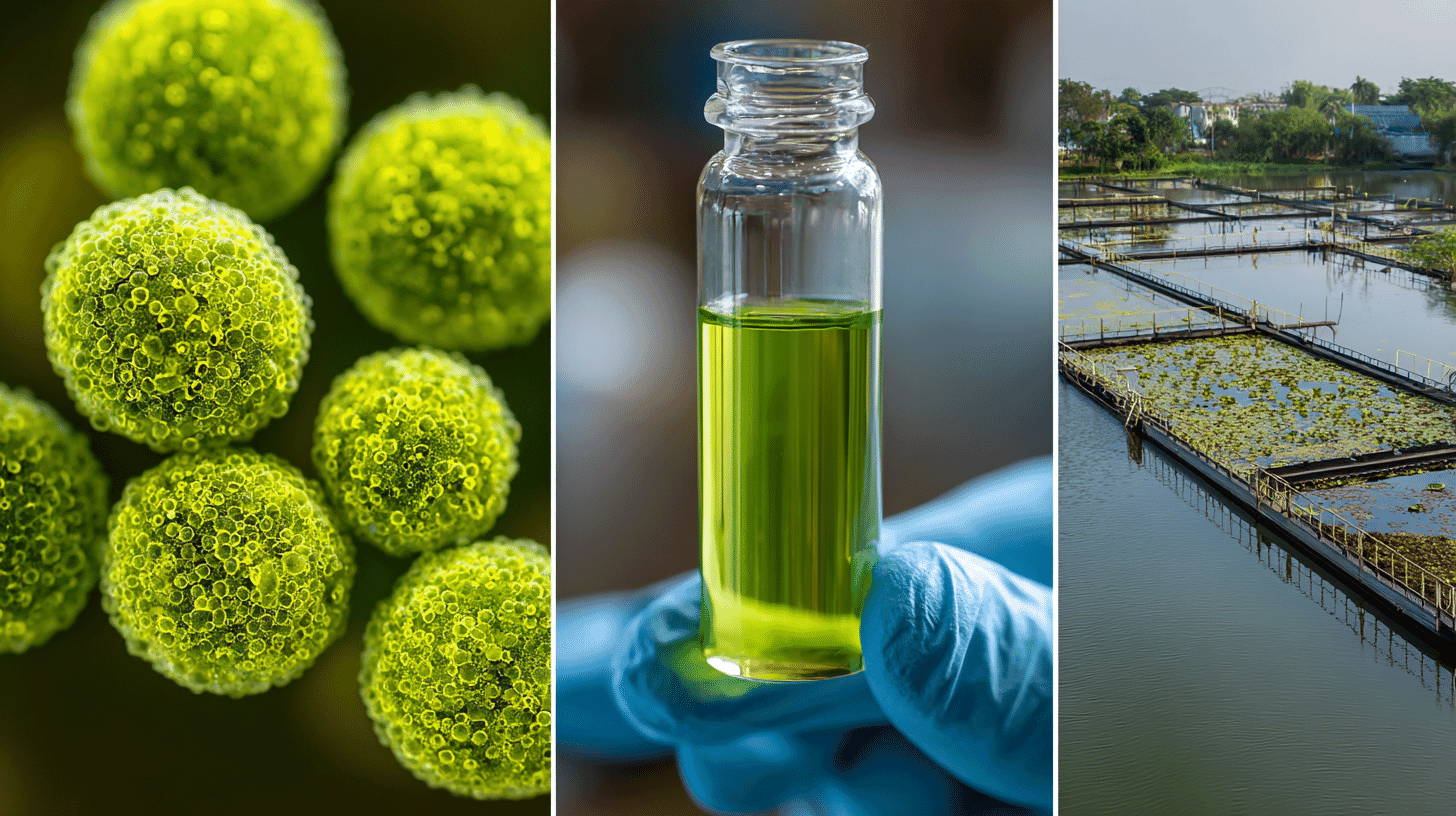
🌿 In November 2012, a Japanese newspaper made an extraordinary claim: Japan was about to become an oil-producing nation.
The hero was a single-celled green alga called the Enomoto strain. According to IHI, it grows to roughly 1,000 times the volume an ordinary Botryococcus manages in a month, and the oil it makes is chemically equivalent to heavy fuel oil. The price was 1,000 yen per liter, about $12.50 at the exchange rate of the day, twenty times the cost of crude. The CEO of the company commercializing it made a bold promise: cut that price to one-tenth within ten years.
It is now May 2026. The ten years are up, plus four for good measure. So what happened?
The short answer: the promise was broken, but the dream did not die. It mutated.
What was being promised in 2012
The original archive article, published November 4, 2012 in the Sankei Shimbun, focused on a strain held by a Kobe University spin-off. Botryococcus braunii is a small green alga that has long fascinated scientists because it produces hydrocarbon oil, not vegetable oil but actual hydrocarbons very similar to crude petroleum, as a natural byproduct of photosynthesis. Gene & Gene Technology (G>), a Kobe University venture, bred a hyper-growth strain of it under the guidance of Professor Taira Enomoto of the university's Faculty of Human Development. The result was named the Enomoto strain.
The problem with regular Botryococcus is its sloth. A typical strain divides once every several days. IHI's announcement put the Enomoto strain at roughly 1,000 times the volume of an ordinary Botryococcus after a month, with enough robustness to be cultivated in the open, where other microbes are present.
In 2011, three parties formed a joint venture to commercialize it. IHI Corporation, one of Japan's heavy-industry giants and a major aircraft engine maker, brought plant engineering muscle. Neo-Morgan Laboratory (NML), a biotech startup led by Tomohiro Fujita, brought the cultivation expertise. G> held the strain; Enomoto served as its adviser and later became head of the company, now GGT Inc. The new entity was called IHI NeoG Algae, and IHI committed 400 million yen over the first two years.
The 2012 article carried Fujita's signature line: "I want to make the price one-tenth in ten years. It's not impossible."
What happened next, in three acts
Act 1: The breakthrough that wasn't (2011–2017)
The early progress was real. In May 2015, the team unveiled a 1,500-square-meter outdoor cultivation pond at Nanatsujima in Kagoshima Prefecture, at the time the largest single-strain Botryococcus mass cultivation operation in the world. Same year, Neo-Morgan Laboratory rebranded itself as Chitose Laboratory, signaling that algae fuel was no longer the only thing on its mind.
Then in March 2017, IHI NeoG Algae was quietly dissolved. The headline-grabbing joint venture from 2011 was gone in less than six years. IHI continued the algae fuel work in-house. Chitose continued separately. The original three-company alliance had cracked, even though no one had publicly given up.
Act 2: The world record nobody talks about (2020–2021)
While venture capital narratives moved on, IHI was quietly chasing a different prize. In May 2020, ASTM International, the body that certifies aviation fuels, approved a new annex to its sustainable aviation fuel (SAF) specification, ASTM D7566 Annex 7. The annex covered SAF produced from Botryococcus braunii oil. IHI had independently applied for the standard and obtained it in 2020. It was the first time microalgae had been recognized as a sole feedstock under a global jet fuel standard.
On June 17, 2021, ANA Flight NH31 took off from Tokyo Haneda for Osaka Itami on a blend that included SAF made from IHI's hyper-growth Botryococcus (HGBb). It was the first flight anywhere to fly on fuel meeting ASTM D7566 Annex 7. The same day, Japan Airlines Flight JL515 from Haneda to New Chitose carried the same algae-derived SAF alongside a wood-waste-derived SAF.
The 1,000-yen-per-liter algae oil of 2012 had not become 100-yen-per-liter. But it had become certified jet fuel and it had carried real passengers. Not the deal that was promised, but a deal nobody else in the world had pulled off.
Act 3: New center of gravity (2021–2026)
After IHI NeoG Algae dissolved, Tomohiro Fujita kept building. By 2021, he had created an industry consortium called MATSURI ("festival") around Chitose Group, with major Japanese partners including ENEOS, Shiseido, NGK, NSK, Mitsui Sumitomo Bank, and over 50 others.
In March 2023, the consortium brought a 5-hectare algae cultivation facility called CHITOSE Carbon Capture Central (C4) online in Sarawak, Malaysia, with the opening ceremony held on April 4. It is the largest single-site algae production facility in the world. The site sits next to a thermal power plant and uses the plant's CO2 emissions as feedstock. The location was chosen for equatorial sunlight, low land cost, and abundant water, three things Japan does not have. C4 targets fixing 700 tonnes of CO2 a year while producing 350 tonnes of dry algae biomass. It was built as a NEDO commissioned project under Japan's Green Innovation Fund, a roughly 50-billion-yen program of which NEDO covers about 40 billion yen.
C4 has since produced the world's first 100% bio-based PET resin made from microalgae, and in July 2025 Mitsubishi Kakoki won the contract to build its component extraction and separation test equipment.
The plan now stretches far beyond 2022. Chitose targets 100 hectares in 2027, then 2,000 hectares by 2030 at a production cost of 300 yen (about $1.91) per kilogram of dry algae biomass and 140,000 tonnes a year. By 2050, the target is 10 million hectares, roughly one-twentieth the current global corn-growing area, at 60 yen (about $0.38) per kilogram and 700 million tonnes.
One caveat on the comparison: the 1,000 yen of 2012 was a price per liter of oil, while the 60 yen of 2050 is a production cost per kilogram of dry biomass. Different units, different things. Still, the curve points the same direction Fujita pointed it in 2012.
The original cost target was missed
To be clear about what did not happen: the 1,000-yen-to-100-yen promise from 2012 was not achieved. Industry reports indicate microalgae jet fuel still costs several times conventional jet fuel. The companies that bet exclusively on algae as a fuel feedstock, most famously the American firms Solazyme and Sapphire Energy, went bankrupt or pivoted away. Chitose itself has said that companies focused exclusively on algae biofuel went under because production costs remain too high. Its own answer is a two-track strategy: sell higher-value products like food and pigments now, and use that business to fund the scale-up toward fuel.
The Chitose group's published roadmap is candid about this. The company sells algae-based food (under the Tavelmo brand), cosmetic ingredients (in partnership with Shiseido), and pigments today. SAF is the long-tail goal, not the day-job.
There is also an important pivot at IHI itself. In January 2026, the company announced it had successfully synthesized SAF directly from CO2 and hydrogen using a catalyst developed jointly with Singapore's A*STAR institute, with commercial production targeted for the 2030s. A test sample was evaluated at Washington State University's Bioproducts, Sciences and Engineering Laboratory, where the institute's director Joshua Heyne said IHI's new fuel sample met or exceeded all the test specifications required of an early-stage SAF candidate, with particularly favorable hydrocarbon composition and low-temperature flow properties. This is a parallel route rather than a replacement, since IHI's algae work continues, but it signals that the company is no longer betting only on photosynthesis.
Three ways to read the last 14 years
There are three honest readings of the last 14 years.
Reading 1: A failure with consolation prizes. The economics never worked. The original joint venture collapsed. The cost gap is still enormous. Fujita's prediction was wrong by an order of magnitude on both price and timing.
Reading 2: A success with the wrong scoreboard. Japan now holds a world-first ASTM standard for algae jet fuel. A Japanese consortium operates the largest algae cultivation facility on Earth. ANA flew the world's first commercial flight on this fuel. None of these existed in 2012. The dream was reframed from "replace petroleum" to "decarbonize aviation," and on the new scoreboard, Japan is winning.
Reading 3: An unfinished bet that just got bigger. The 2050 target of 10 million hectares globally at 60 yen per kilogram is many times more ambitious than what was promised in 2012. If it works, "Japan as oil producer" becomes "the global algae industry was built by Japan." If it doesn't, the consolation prizes from Reading 2 still stand.
Which reading is correct depends on whether you measure technology by promises kept or by direction of travel. In Japan, where engineering culture tends to value persistence over splashy pivots, the third reading is the one most insiders quietly endorse.
Why this matters beyond Japan
The wider question algae biofuel poses is whether photosynthesis can ever beat petroleum. Crude oil is, in a real sense, the result of photosynthesis run for hundreds of millions of years, then concentrated by geology. Asking modern algae to compete on cost with that geological accumulation, at industrial scale and within a decade, was always unfair.
What changes the equation now is that aviation has no other zero-carbon answer. Battery-electric flight is range-limited; hydrogen aircraft are decades away from commercial deployment; synthetic fuel needs vast amounts of green hydrogen that doesn't exist yet. SAF, whether algae-derived, waste-oil-derived, or CO2-synthesized, is the only drop-in option for long-haul flight. That regulatory pressure is what gives the Enomoto algae story a second life it did not have in 2012, when the comparison was just oil prices.
Japan is the rare country that has both the engineering depth (IHI) and the biotech persistence (Chitose) to push this forward across multiple decades and corporate generations. Whether that proves to be foolish dedication or far-sighted patience will be settled around 2027, when the 100-hectare scale-up either delivers cost-competitive biomass or doesn't.
In aviation circles, there is a quiet observation: the people who scoffed at "Japan becomes an oil producer" in 2012 are the same people who now have to find a way to fly the world without burning crude. The algae has not won. But it has stayed in the race longer than its critics.
What's the state of biofuel research in your country? Are there long-running national bets like this, projects everyone wrote off ten years ago that are quietly still going? We'd love to hear about them.
References
- Sankei Shimbun archive article (November 4, 2012), from the "Tanbo" series, on algae biofuel
- IHI Corporation. (2015). "Public unveiling of large-scale outdoor cultivation facility for biofuel-producing microalgae." https://www.ihi.co.jp/ihi/all_news/2015/other/1190355_1671.html
- IHI Corporation. (2021). "Microalgae-derived biojet fuel supplied to domestic scheduled flight." https://www.ihi.co.jp/all_news/2021/other/1197433_3355.html
- ANA Holdings. (2021). "ANA Conducted a Flight Using Sustainable Aviation Fuel Produced from Microalgae." https://www.anahd.co.jp/group/en/pr/202106/20210618.html
- Honeywell UOP. (2021). "Honeywell Technology Enables First Jet Flights with Sustainable Aviation Fuel Produced by Microalgae." https://uop.honeywell.com/en/news-events/2021/november/honeywell-technology-enables-first-jet-flights-with-sustainable-aviation-fuel-produced-by-microalgae
- NEDO. (2020). "Bio-jet fuel from microalgae newly certified under ASTM international standard." https://www.nedo.go.jp/news/press/AA5_101314.html
- Nikkei Bio Tech. (2017). "IHI NeoG Algae dissolved at end of March 2017." https://bio.nikkeibp.co.jp/atcl/column/16/021500017/042700059/
- Chitose Bio Evolution. "About, Group history and timeline." https://chitose-bio.com/jp/about/
- Chitose Bio Evolution. "World's largest 5ha algae production facility C4 starts operation." https://chitose-bio.com/jp/news/5124/
- IHI Corporation. (January 9, 2026). "Successful synthesis of SAF from CO2 in test equipment." https://www.ihi.co.jp/all_news/2025/technology/1201798_13760.html
- Chitose Bio Evolution. "Why algae biofuel-focused companies fail." https://journal.chitose-bio.com/algaebiofuel_faq/







Global Discussion
14 comments