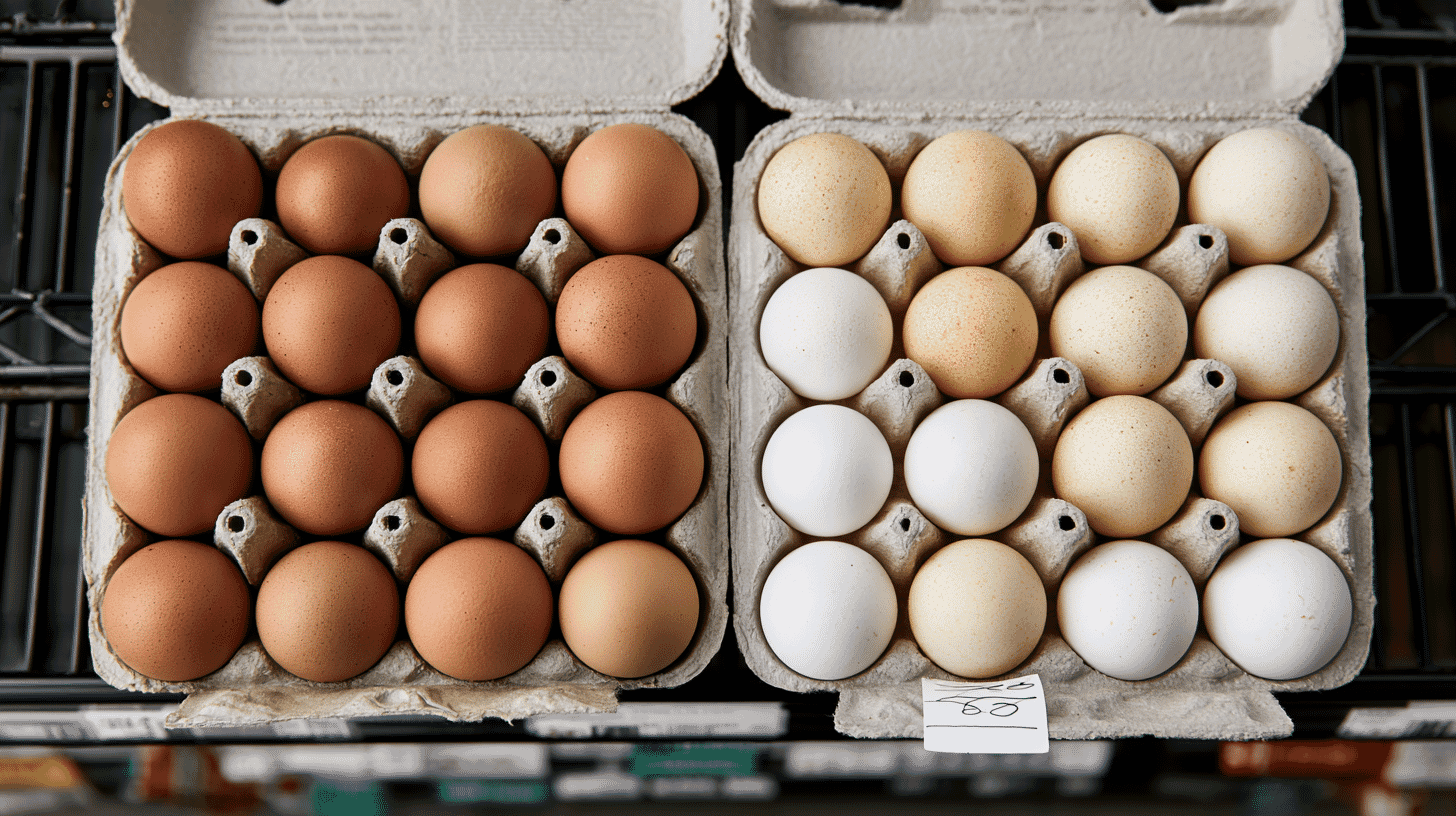
🥚 Give two flocks the same feed in the same windowless room, and the eggs still come out tasting different. A Japanese team spent five years proving it, and what came out is a split rather than a winner.
Feed held constant, housing changed
The work came out of the lab of Tsuyoshi Shimmura, a professor at Tokyo University of Agriculture and Technology, with Kyoto University, Kagoshima University, Azabu University and the Nippon Veterinary and Life Science University. It ran in npj Science of Food on August 27, 2026, and the university announced it on August 31, 2026.
Cage and cage-free eggs have been compared before, but the birds were usually eating different things, so the results never settled much. Hens with outdoor access peck at grass and insects; that alone can shift what ends up in the yolk. Here both flocks lived in the same windowless climate-controlled room at 23 degrees Celsius plus or minus 1, on a 14-hour light and 10-hour dark cycle, with identical feed.
On the caged side, 15 hens lived five to a cage measuring 96 by 40 by 42 centimeters, which works out to 755 square centimeters per hen. On the cage-free side, 12 hens shared a 4.6 by 2.5 meter pen floored with wood shavings, with a nest box and a pair of wooden perches, giving 0.95 square meters each. The whole thing was repeated four times over five years, averaging 37 weeks per trial.
The Japanese term hiragai, which the paper renders as cage-free, means birds kept loose on a floor indoors. It is the equivalent of barn-raised, not free-range. No bird in this experiment went outside.
563 metabolites, two directions of flavour
Untargeted mass spectrometry picked up 563 metabolites in total. In the yolk, 107 differed between systems, 64 higher in cage eggs and 43 higher in cage-free. In the white, 49 differed, 14 higher in cage and 35 higher in cage-free.
Oleic, palmitic, arachidonic and linoleic acids, all linked to creaminess, were consistently higher in cage egg yolks. So were bile acids such as taurochenodeoxycholic acid, along with hypoxanthine, both tied to bitterness. Meanwhile glutamate and aspartate, the two compounds that carry umami, were higher in the whites of cage-free eggs in both brown and white strains, and so were glycine, alanine, serine and threonine, which read as sweetness and body.
RNA sequencing found 469 genes expressed differently, and the pathway most strongly enriched was primary bile acid biosynthesis, with CYP7A1, CYP8B1 and AKR1D1 expressed more highly in cage-free hens. Caged birds move less, their lipid metabolism runs harder, and long-chain fatty acids accumulate in the yolk. Birds that walk around burn through amino acids instead, and the oviduct builds those into the white.
The tasting was done by 107 untrained consumers using an eight-point hedonic scale plus a check-all-that-apply test with 24 descriptors, on two dishes: custard pudding and chawanmushi, the savoury steamed egg custard. In the correspondence analysis, umami clustered with chawanmushi made from cage-free eggs and creaminess clustered with pudding made from cage eggs. That pairing is what the university's announcement led with.
Pudding outscored chawanmushi overall, and the pudding made with cage-free eggs scored particularly high. Creaminess sitting near cage-egg pudding says which words panellists checked, not which sample they preferred.
The study's cage was roomier than Japan's average
The EU minimum for an enriched cage is 750 square centimeters per hen. The cages in this study gave 755. In Japan, the most common commercial allowance per hen falls between 370 and 490 square centimeters, according to an industry survey from fiscal 2014.
So the cage in the experiment was roughly EU-legal and close to twice the room a typical Japanese layer gets. The cage-free side was generous in the other direction: 0.95 square meters per hen is about one bird per square meter, where the EU ceiling for non-cage systems is nine.
The paper is upfront about it: both systems were built small so individual birds could be watched and sampled, and neither was designed to represent commercial production. The same caution applies to the finding that daily feed intake and egg production showed no significant difference between groups. That is a result from 27 hens, not a claim about what happens across a commercial shed.
The durable finding is the mechanism: housing changes egg composition through the hen's own metabolism, independent of feed. How far that gap widens at commercial densities is still open.
A country that eats eggs raw has a different rulebook
Japan eats 327 eggs per person per year, fourth in the world as of 2024. Eating them raw is normal here, and the agriculture ministry treats Salmonella control as critical for that reason. The two obvious cases are tamago kake gohan, a raw egg stirred into hot rice, and sukiyaki, where cooked beef is dipped in beaten raw egg.
That habit built a regulatory system around a different question than welfare. Since a 1998 revision of the food hygiene rules, shell eggs must carry a best-before date, and eggs intended for raw consumption must be labelled as such and must also state that they need heating once that date has passed. The date is not a freshness suggestion. It is the window in which raw is considered safe. Grading and packing centers work to a hygiene code covering intake, storage, washing and candling.
"Egg quality" in Japan has meant microbiology and shelf life. How the hen lived barely entered the conversation.
What flavour costs in a 96.6 percent country
Japan's laying flock is 96.6 percent caged. Cage-free accounts for 3.4 percent, and that splits into 3.3 percent barn and 0.1 percent free-range. Those are estimates reported to the World Egg Organisation, since Japan publishes no official statistic broken down by housing system. In the United States, 39.3 percent of hens are cage-free. The EU27 banned battery cages outright on January 1, 2012, after a twelve-year transition, and now sits at 38.1 percent enriched cage, 39.3 percent barn, 15.8 percent free-range and 6.7 percent organic.
Japan does have a general standard for keeping farm animals, issued under its animal welfare law, but no legal provision says which housing system laying hens may be kept in. National guidelines were issued for the first time in July 2023, and they carry no penalties. Close to 70 percent of Japanese consumers surveyed said they had never heard the term animal welfare.
The economics explain the inertia better than the culture does. A 2022 simulation in Poultry Science put the retail price of a barn-raised egg in Japan at 48.53 yen, about 31 US cents, against 24.68 yen, about 16 cents, for a battery-cage egg. Sellable eggs come to 68 percent of the battery figure in barn systems. Building the farm costs about 16 million dollars instead of about 3.2 million. For comparison, the agriculture ministry's September 2026 survey put an ordinary ten-pack at 309 yen, roughly two dollars, already 119 percent of the five-year average for that month.
In February 2026, the National Diet Library published a brief arguing that Japan cannot have a serious policy debate on hen housing because almost all the evidence is Western and may not transfer to Japanese conditions. It cited, as support, a 2024 review co-written by Nonoko N. Shimura. Six months later, Shimura was joint first author on this paper. The taste study is exactly the domestic evidence the Diet's own library said was missing.
Does your egg have a number on it?
If you live in the EU, your eggs are stamped. A 0 means organic, 1 free-range, 2 barn, 3 enriched cage. You can read the hen's housing off the shell before you crack it. Brussels has been reviewing the laying hens directive with a cage phase-out as one focus, though as of January 2026 no amendment had actually been proposed.
Japan requires no comparable code. What a Japanese carton carries is a best-before date, which tells you how long the egg is safe to eat raw. Two countries, two things worth printing on an egg.
So what does a cage-free pack cost where you shop, how far is that from the cheapest carton on the shelf, and does the box say anything at all about how the hen lived?
References
- https://doi.org/10.1038/s41538-026-01108-8
- https://www.tuat.ac.jp/outline/disclosure/pressrelease/2026/20260831_02.html
- https://dl.ndl.go.jp/pid/14632280
- https://doi.org/10.1016/j.psj.2022.102194
- https://doi.org/10.2508/chikusan.95.157
- https://www.maff.go.jp/j/zyukyu/anpo/kouri/k_gyuniku/index.html
- https://www.maff.go.jp/j/study/risk_kanri/r2-2/attach/pdf/index-2.pdf
- https://www.mhlw.go.jp/web/t_doc?dataId=00ta5686&dataType=1&pageNo=1
- https://www.kewpie.com/newsrelease/2025/3884/
- https://www.env.go.jp/nature/dobutsu/aigo/1_law/baseline.html






Global Discussion
4 comments