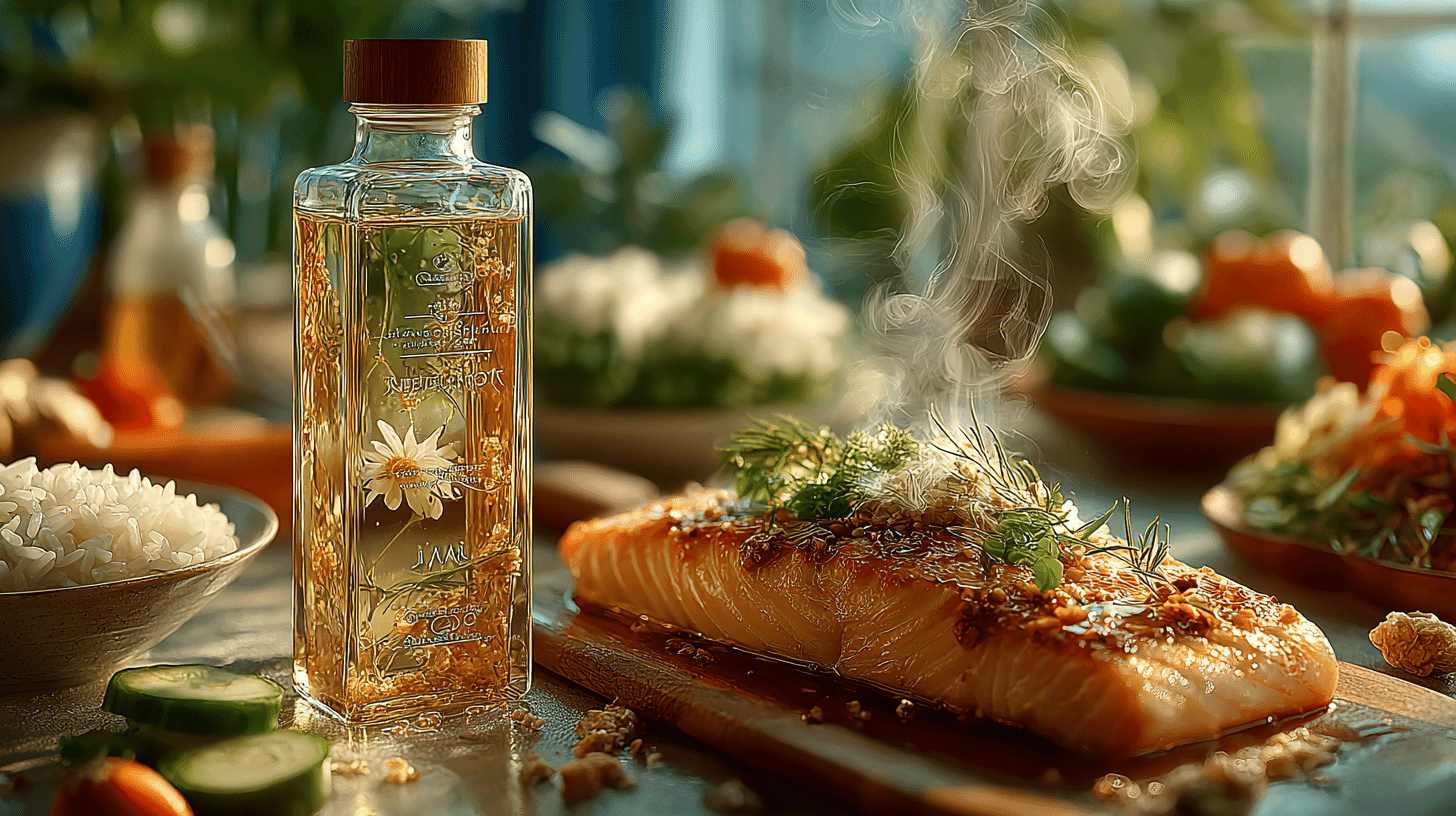
🍶 A Japanese miso maker is going after shelf space in American supermarkets. Not with miso. Its weapon is liquid shio koji: rice koji, salt and water, fermented and then pressed into a gold-colored liquid. Overseas, the stuff has only ever been sold to restaurants and food manufacturers. Hanamaruki now wants it in home kitchens, and it planted the flag in Anaheim this March.
A Miso Company Goes After the Retail Shelf
Natural Products Expo West 2026 ran March 3 to 6 in Anaheim, California. It is one of the largest health and organic trade shows anywhere: more than 3,600 exhibitors, roughly 90,000 visitors, and buyers from every major American supermarket chain alongside chefs from around the world.
Hanamaruki showed up. The company is based in Ina, Nagano, run by president Shuichiro Hanaoka, founded in 1918, and known in Japan mostly for a miso jingle that has been running for decades. What it brought to Anaheim was its flagship liquid shio koji. What was different this time was the target.
Until now, liquid shio koji abroad has been a business-to-business product. The rebrand is the setup for a move onto retail shelves, meaning ordinary households. The label was redesigned along minimal Western lines, and a new tagline appeared: "Cultured Umami Essence." Cultured as in fermented, and cultured as in culture. Alongside the existing 500 ml bottle, two 210 ml sizes were introduced for home cooks, one of them organic-certified. For now, the organic version is US-only.
What Shio Koji Actually Is
Rice koji, which is steamed rice colonized by koji mold, plus salt, plus water. That is the entire ingredient list.
The work is done by enzymes. Proteases break protein into amino acids and produce umami. Amylases turn starch into sugar and add a faint sweetness. Marinate meat or fish and the tissue loosens and softens while off-flavors recede. Use it in place of salt and you get salinity with something layered underneath it.
Koji itself has underpinned Japanese sake, miso and soy sauce for centuries. Shio koji as a household staple is much newer. It caught fire in a boom that started in late 2011, which is when Hanamaruki launched its own paste-style shio koji, in April 2012.
Press the Paste and Gold Comes Out
Paste shio koji is a nuisance in a working kitchen. It scorches. It is hard to measure. It does not mix cleanly. Some people simply dislike the texture of the grains.
According to Nobuyuki Hirata, Hanamaruki's board director for marketing, the whole thing started with customers asking for a liquid version. Engineering turned it around fast: liquid shio koji shipped in October 2012, six months after the paste. It sold 400,000 bottles in its first month.
Pressed into liquid, it doesn't come out clear. It comes out gold. Hirata says it picked up the nickname GOLDEN LIQUID abroad. Because the proprietary process never heats the product, the enzymes stay alive. The pressing method is patented in Japan (patent no. 6068068) and subsequently in the US, Taiwan, Indonesia and China, covering five countries including Japan. Sales grew roughly tenfold in the decade after launch.
What Happened at the Tasting Table
The booth was built as a sequence: learn, understand, want to use, trust. What koji is, why liquid instead of paste, how professionals actually use it.
Grand chef Ryusaku Akiyama ran the tasting. He served grilled salmon, Schweinshaxe, and grilled vegetables, three dishes with nothing Japanese about them, specifically to demonstrate the three effects Hanamaruki claims: tenderizing, umami, and deodorizing.
Akiyama says people frequently assumed from the look of it that it was some kind of oil, and that after tasting, the common reaction was that the umami was intense. What surprised people varied by ingredient. On salmon, the fishiness receded and the juiciness stood out. On pork, tenderness and umami. On vegetables, the earthy note in potato disappeared and the vegetable itself came forward. The most frequent comment, he says, was the blunt one: it tastes good.
Restaurant owners and chefs told the booth that koji had been on their radar lately, and that a liquid version looked like something they could fold into their own menus without much fuss.
Can It Follow Miso and Soy Sauce?
Two Japanese fermented seasonings have gone global as words: miso and shoyu. Whether shio koji becomes the third is an open question. Its raw material does give it an angle. Miso and soy sauce are built on soybeans; shio koji is built on rice. No wheat, so it carries GFCO gluten-free certification, obtained in 2017, and there is no soy allergen issue. Halal is handled by a separate product, HA liquid shio koji, launched in 2021 using a method that skips the alcohol normally needed for fermentation control. The standard bottle does not clear every standard by itself. The company builds different versions for different certifications.
There is some foothold abroad already. In Paris, Christian Le Squer, head chef at the three-star Le Cinq, built original dishes around it. Hanamaruki Thailand was set up in 2015, and a dedicated liquid shio koji plant in Thailand started up in 2020. Overseas sales roughly doubled over five years, per the company's 2024 accounting. In an in-house survey of American chefs in August 2022, Hanamaruki reported that 72% knew of shio koji and 82% said they wanted to try the liquid version.
So the professional kitchens are aware. The bet now is whether it moves to the door of the family refrigerator. Soy sauce took decades to make that trip.
What fermented seasoning sits in your kitchen as though it has always been there? And if someone handed you a bottle of shio koji, what would you put it on first?
References
- https://www.hanamaruki.co.jp/news/details/natural-products-expo-west-2026.html
- https://prtimes.jp/main/html/rd/p/000000102.000094394.html
- https://www.ssnp.co.jp/soy/664839/
- https://news.nissyoku.co.jp/tie-up-free-page/hanamaruki04
- https://shokuhin.net/143831/2026/05/01/kakou/choumi/
- https://prtimes.jp/story/detail/BdN2q6S2jJr
- https://www.hanamaruki.co.jp/shiokouji.html
- https://www.hanamaruki.co.jp/en/shiokoji/









Global Discussion
15 comments