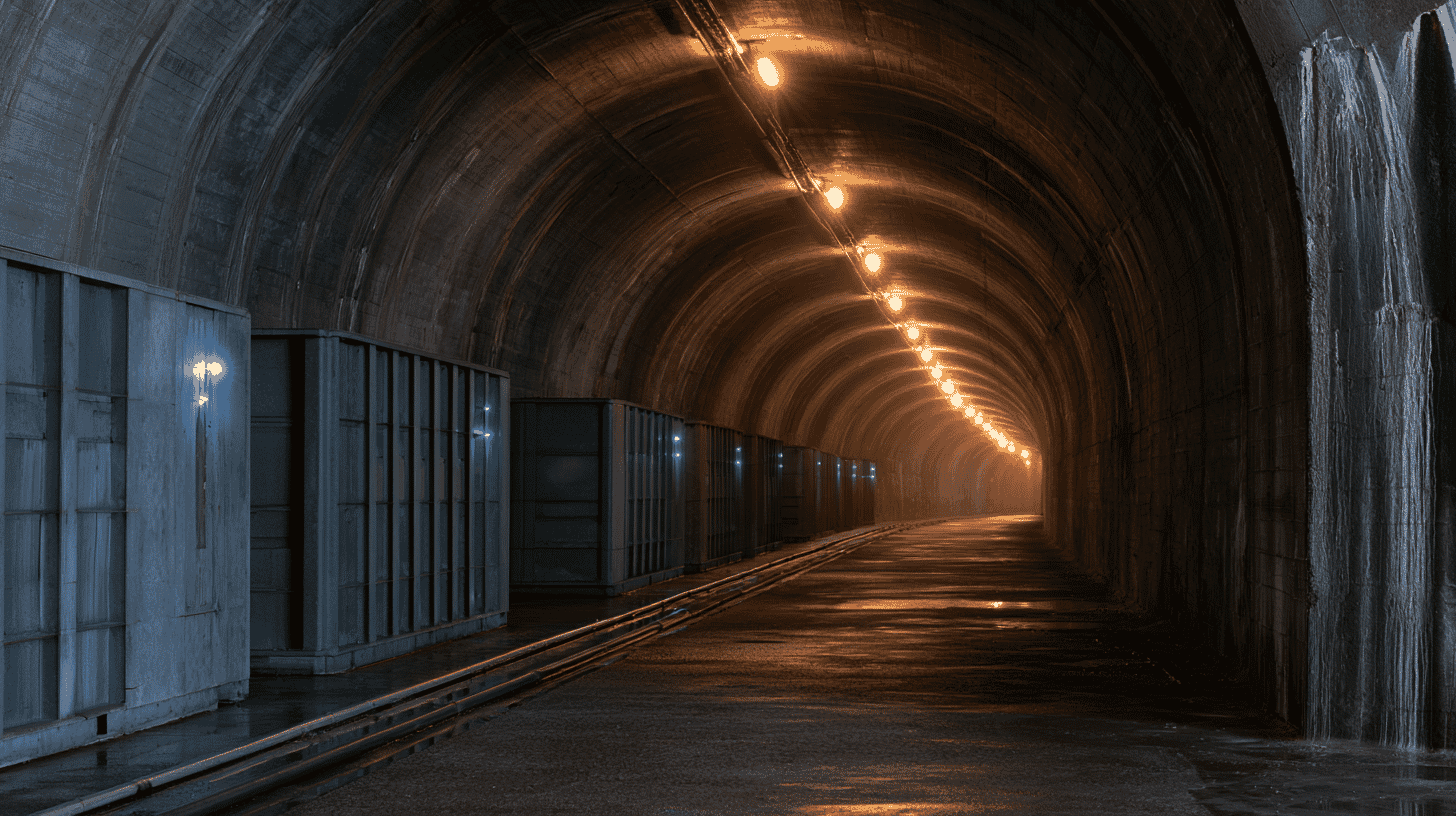
⛰️ For 41 years, a conveyor belt running through the hills west of Kobe carried mountains to the sea. Part of its tunnel will now house AI servers.
On October 6, 2026, Mitsui Fudosan, the construction firm Kumagai Gumi and the data center operator Getworks announced that they will build a data center inside the disused tunnel, with the first phase planned to open at the end of 2027 (as of October 2026). A data center needs power, cooling and land. A hole dug decades ago may answer two of those: cooling and land.
The tunnel that moved mountains
Kobe is squeezed into a thin strip between the Rokko mountains and the sea. After the war it adopted a policy nicknamed "mountains go to the sea": cut down hills, use the soil to reclaim land from the bay, then build housing on the flattened hilltops.
The conveyor moved that soil. It started running in 1964, stretched about 14.5 km in total, and stopped in September 2005. In those 41 years it carried about 578 million tonnes of soil, according to the city, creating 1,700 hectares of reclaimed land, including Port Island, Rokko Island and the site of Kobe Airport. Kumagai Gumi helped build the tunnel in the first place.
After the belts were removed, Kobe asked companies what they would do with the empty tunnels. In a market survey from November 4 to December 24, 2025, six companies or groups put forward ideas such as plant factories and storage vaults. The city then tendered about 3 km of the tunnel, roughly 17,000 square meters, on a lease of 10 to 20 years. Mitsui Fudosan and Kumagai Gumi won on September 4, 2026, with a bid of ¥7,572,000 a year (about $48,000).
Underground, it stays 15 to 20°C
Most of the tunnel lies more than 40 meters below ground, and the companies say the space stays at 15 to 20°C year-round. Above ground, Kobe's average August daily high is 32.2°C and its average January temperature is 6.2°C, according to Japan Meteorological Agency normals.
Cooling eats a large share of a data center's electricity. The Uptime Institute's 2026 global survey, published in July, put the average PUE, a ratio of a data center's total power to the power its IT equipment uses, at 1.52. That means about a third of the electricity goes to something other than computing, mostly cooling.
In my reading, cool rock alone will not be enough. GPU servers run hot, and a closed tube of rock cannot soak up a growing heat load forever. That is likely why the plan does not rely on cool air: it will use water cooling that circulates groundwater.
No digging required
Building a new underground facility means excavation, usually the slowest and most expensive part of the job. Here that work was finished decades ago, and little has to be built on surface land. The companies say reusing existing space can cut both the environmental impact of construction and the time to launch.
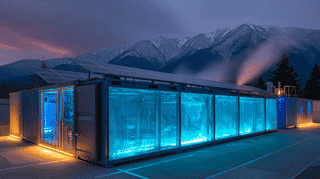
The tunnel is narrow, though. Spread 17,000 square meters along about 3 km and the average width comes to under 6 meters. The leased section belongs to the conveyor's D line, and the city's drawings give the D-line tunnels a cross-section of 13.0 to 17.4 square meters, roughly a quarter to a fifth of a double-track Shinkansen tunnel at 65.6 square meters. There are wider spaces, such as the old D3 machine room at 146.1 square meters in cross-section, but narrow tunnels link them, and a conventional data center building will not fit. So the servers will go into container data centers lined up inside the tunnel. Getworks, which will run the site, says it has built 380 units since 2013 (as of September 2026). Incoming power is set to grow to up to 20 megawatts eventually, and Getworks plans to link Kobe with its sites in Yuzawa, Kagoshima and Hokkaido over NTT Docomo Business's IOWN APN optical network.
Twenty megawatts is one-twentieth of the up to 400 megawatts JERA plans for its AI data center at the Chiba thermal power plant. In recent weeks Japan has weighed data centers in Fukui's nuclear-plant region, a concept for floating data centers moored at port quays, and AI servers on the grounds of a power station (we covered those in our piece on the Chiba plant). Kobe adds a fourth place: underground.
The same idea, 19 years earlier
On November 14, 2007, Sun Microsystems, IIJ and others, 12 organizations in all, announced a plan to place container data centers 100 meters underground at a former mine site, cooled with groundwater, with service due to start in April 2010. Swap the mine for a tunnel and it is almost Kobe's plan. An NTT Data presentation from April 2011, a year after the planned opening, still listed it as a proposal from Hida, Gifu Prefecture, alongside underground cloud data center ideas from Utsunomiya and Otsuki. I could find no report that it ever opened.
Mitsui's "Japan first" comes with conditions: the first commercial data center for outside customers in an existing tunnel, as of September 2026, according to its own research.
The 2007 plan also promised lower power use and high security, so the pitch is nearly the same. The context is not. Uptime's records put the average PUE at 2.50 in 2007, meaning about 60% of the power went to overhead. Today it is about a third. In my reading, cool rock buys less than it would have in 2007, because surface data centers have learned to cool themselves better. Demand has changed too: Kobe's announcement leads with the rapid growth in GPU servers for generative AI.
Strong against what, exactly?
The companies point to the tunnel's resistance to earthquakes and the limited ways in. Getworks will also bring its shelter-type container technology, designed to withstand earthquakes and impact and to guard against EMP, an electromagnetic pulse that can wreck electronics. Kobe knows earthquakes: on January 17, 1995, a magnitude 7.3 quake struck, with the top intensity of 7 on Japan's scale in parts of the city.
The announcement leaves several questions open. Start with water. The cooling plan circulates groundwater, so water is clearly present, but the release does not say how inflow will be kept from the servers or what happens in a record downpour. Then access. The leased stretch runs about 3 km, and nothing is said about emergency exits, ventilation or a blocked entrance. And power. Up to 20 megawatts has to be brought underground, the release does not say from where, and it gives no investment figure. Whether the site deserves the word "resilient" depends on those answers.
Other countries went underground first
In Norway, Lefdal Mine Datacenter sits in a former olivine mine, 60 meters below ground and 700 meters into the mountain. It is cooled with fjord water, and its first phase of 45 megawatts opened in May 2017. Like Kobe, it fills an old excavation with containers.
In Helsinki, a 2-megawatt data center 30 meters below Uspenski Cathedral was cooled with seawater, and its waste heat was fed into the city's district heating network. In the United States, Iron Mountain has run data center space in what was once a limestone mine in Pennsylvania, about 67 meters (220 feet) down, with an underground lake used for cooling.
Kobe has found cool space and groundwater. It has not yet said whether the heat from up to 20 megawatts of servers will be put to use, as in Helsinki, or simply thrown away.
Where are the data centers in your country? And is there an old mine or tunnel near you that could be next?
References
- https://www.mitsuifudosan.co.jp/corporate/news/2026/1006/
- https://www.city.kobe.lg.jp/a26136/business/recruit/kobe_beltconveyor.html
- https://www.city.kobe.lg.jp/documents/26560/gaiyou.pdf
- https://www.city.kobe.lg.jp/documents/85318/ichizu.pdf
- https://www.city.kobe.lg.jp/documents/26560/20260609202056.pdf
- https://www.city.kobe.lg.jp/i73375/kuyakusho/sumaku/syokaitorikumi/sumanewtown/nthistory.html
- https://www.data.jma.go.jp/stats/etrn/view/nml_sfc_ym.php?prec_no=63&block_no=47770&year=&month=&day=&view=
- https://datacenter.uptimeinstitute.com/rs/711-RIA-145/images/UptimeInstitute.GlobalDataCenterSurvey.2026.pdf?version=0
- https://www.jera.co.jp/news/information/20261001_2535
- https://www.bk.mufg.jp/info/pdf/20260901_dc_concept.pdf
- https://www.fukuishimbun.co.jp/articles/-/2684537
- https://www.itmedia.co.jp/news/articles/0711/14/news097.html
- https://www.intellilink.co.jp/business/platform/-/media/8692a1182aae4738afa0e414d4fd14c3.ashx
- https://www.data.jma.go.jp/eqev/data/1995_01_17_hyogonanbu/gaiyo.html
- https://www.datacenterdynamics.com/en/news/lefdal-mine-datacenter-officially-opens/
- https://www.sigma2.no/node/62
- https://datacenterknowledge.com/business/video-helsinki-s-underground-data-center
- https://www.datacenterknowledge.com/business/iron-mountain-is-taking-the-data-center-underground





Global Discussion
4 comments