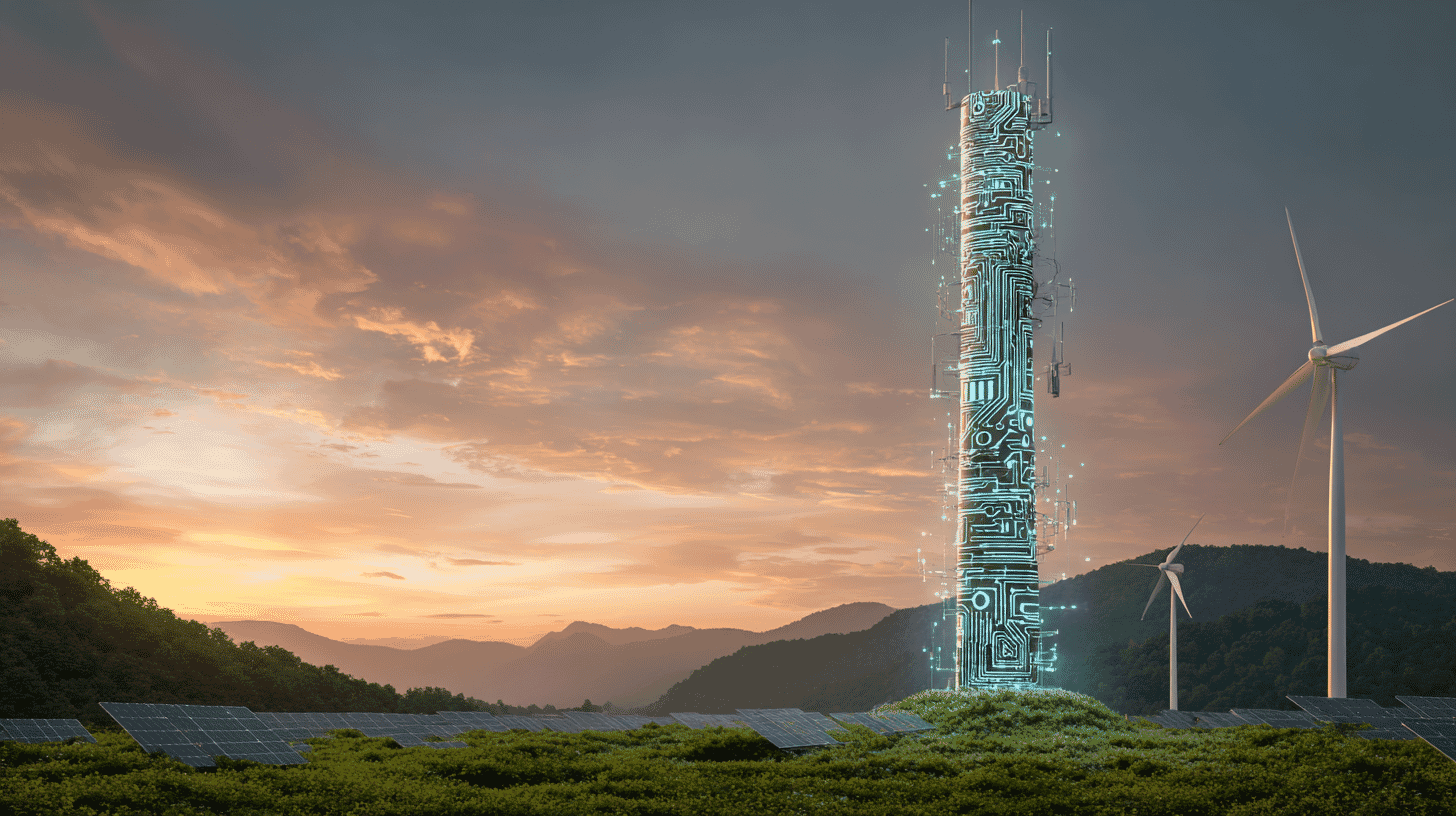
SoftBank is tackling telecom decarbonization from both directions at once: AI that puts base stations to sleep when traffic is thin, and hybrid solar-wind systems that generate their own power. Together the two efforts are expected to save 5 million kWh of electricity a year.
SoftBank's Bold "Net-Zero" Commitment
SoftBank has committed to achieving "net-zero" greenhouse gas emissions across its entire supply chain by 2050. This isn't just about reducing the company's direct emissions. It encompasses the full scope of business activities, including suppliers and partners.
As a mobile telecommunications giant, SoftBank's own operational greenhouse gas emissions (Scope 1 and 2) total approximately 620,000 tons of CO2 equivalent (FY2024). That's roughly equal to the emissions from 250,000 average households. More than half of this comes from the electricity consumed by the company's vast network of base stations nationwide.
In other words, decarbonizing base stations is the key to SoftBank's net-zero success.
"Creating" Power: Hybrid Solar-Wind Self-Generating Base Stations
In January 2026, SoftBank launched a pilot program for self-powered base stations using renewable energy in Ichihara City, Chiba Prefecture. These stations employ a hybrid system combining solar panels and small-scale wind turbines, generating roughly one-third of their operational power on-site.
Revolutionary Lens Wind Turbines
The wind power component uses 3kW "lens wind turbines" equipped with a unique diffuser, a lens-shaped cover that concentrates and accelerates wind flow. This design delivers high generation efficiency even at low wind speeds of around 3 m/s, achieving roughly 2-3 times the efficiency of conventional turbines of similar size.
The compact footprint makes these turbines suitable for installation on remote islands and mountainous regions where wind conditions are unstable, a good fit for Japan's varied terrain.
Disaster Resilience
The self-powered base stations include battery storage systems that enable independent operation during power outages. What's particularly impressive is their ability to automatically recharge and restart using solar and wind power even after the batteries are temporarily depleted.
This means telecommunications infrastructure can potentially remain operational even during extended blackouts following earthquakes or typhoons. SoftBank is considering expanding deployment to additional regions from fiscal 2026, with disaster response as a primary application.
"Using" Power Smarter: AI-Driven Dynamic Sleep Control
Beyond generating power, SoftBank has developed an AI-powered system that dynamically controls base station "sleep" modes to optimize energy consumption.
Maintaining Quality While Cutting Power
The system automatically transitions selected cells (coverage units of base stations) to sleep mode during low-traffic periods. During late-night hours when few users are active, the system identifies cells that can be safely suspended while nearby stations maintain coverage.
Previously, sleep control was only implemented under strict conditions: neighboring base stations had to sit in the same building with identically oriented antennas. AI-powered analysis of human movement patterns and communication traffic now enables much more flexible decision-making.
The Numbers Tell the Story
With AI implementation, the number of cells eligible for sleep control is expected to expand from approximately 14,000 to 24,000. Additionally, dynamic per-station threshold optimization will extend average sleep time per station by approximately 1.4 times.
A fail-safe mechanism automatically returns any cell to normal operation if communication quality degrades after sleep implementation.
These optimizations are projected to reduce annual power consumption by roughly 5 million kWh, equivalent to the yearly electricity use of about 1,200 average households.
Japan's Telecom Decarbonization Race
Among Japan's major telecom carriers, SoftBank's decarbonization efforts stand out. The company ranked first for the second consecutive year in Nikkei's "GX500" decarbonization business ranking for 2024.
Comparing renewable energy ratios in FY2023: SoftBank led with 51%, followed by NTT at 42% and KDDI at 29%. By FY2024, SoftBank's renewable ratio reached 61%, with 92.6% of base station electricity coming from effectively renewable sources.
Global recognition has followed, with SoftBank selected for the Dow Jones Best-in-Class Indices "World Index" for three consecutive years. It was the only Japanese company in the telecommunications services category among the 37 Japanese firms included.
The Future of Green Telecom Infrastructure
With 5G proliferation, IoT device expansion, and the rise of generative AI, data traffic will continue its explosive growth. Base station and data center power consumption will inevitably follow.
SoftBank's initiatives offer one answer to the seemingly contradictory challenges of increasing energy demand and reducing environmental impact. By combining AI-driven efficiency with renewable energy, a path emerges for maintaining service quality while achieving decarbonization.
Challenges and Future Outlook
Challenges remain. Current self-powered base stations can only generate about one-third of their power needs. Moreover, approximately 95% of SoftBank's greenhouse gas emissions occur in Scope 3: smartphone and equipment manufacturing and device usage across the supply chain.
Base station renewable conversion alone affects only about 5% of total emissions. True net-zero achievement will require collaboration with suppliers and battery technology breakthroughs. Nevertheless, the technologies announced represent a significant milestone on what will be a long journey toward sustainable telecommunications.
Japan's telecom industry is rapidly advancing decarbonization. AI-optimized base station control combined with renewable energy self-sufficiency. Is this approach being adopted by telecom companies in your country?
References
- https://www.softbank.jp/corp/news/press/sbkk/2026/20260108_02/
- https://www.softbank.jp/corp/sustainability/special/netzero/
- https://www.rcrwireless.com/20260113/test-measurement/softbank-turns-to-hybrid-powered-base-station-in-its-net-zero-push
- https://www.telecomtv.com/content/green-network/softbank-taps-ai-renewables-for-greener-ran-54632/
- https://www.pv-magazine.com/2026/01/16/softbank-pilots-solar-wind-powered-ai-controlled-base-station/

Global Discussion
0 comments