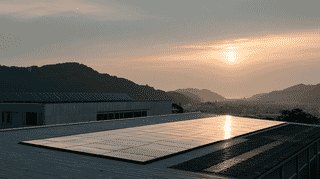
Japan's Environment Ministry will stop subsidising the purchase of conventional solar panels for new projects from fiscal 2027. The stated reason was not carbon but industry: the money was benefiting factories abroad.
Tohoku University, JAMSTEC and Fuji Electric filmed droplets on a geothermal turbine blade spinning at 430 m/s, and what held on stationary walls did not hold here. Japan itself runs just 607 MW of geothermal.
A century-old Japanese packaging company will launch a flexible CIGS solar cell in early 2027, betting that proven, long-life thin-film tech can beat still-maturing perovskite to Japan's weak roofs and walls. The contrarian logic, and the catches.
METI has unveiled Japan's first post-Fukushima numeric target for replacing nuclear reactors: up to 5 by the 2040s, 14 by the 2050s. Behind the decarbonization, energy-security and AI-demand drivers lies a harder question: regulatory capture, the Nuclear Village, and whether the regulator can be trusted.
A team led by the Nagoya Institute of Technology has found that water vapor can accelerate bond exchange in vitrimers, a third class of plastic that could finally make 'unrecyclable' thermosets repairable and reusable.
Hoku Energy K.K., the Japanese subsidiary of UK-based Hoku Infrastructure, will build Japan's first new-build 100% hydrogen mono-firing thermal power plant in Aomori Prefecture. The 106.6MW Daiichi Plant, awarded under Japan's 3rd Long-Term Decarbonized Power Source Auction, is scheduled to start operations in the early-to-mid 2030s. We compare it with hydrogen power efforts by Plug Power, MHI in Utah, Linde, Air Liquide, and South Korea's Doosan, and explain what it means for Japan's GX strategy.
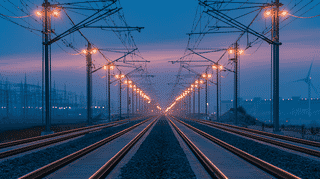
Hokuriku Electric has broken ground on a 2,000 kW hydropower plant in Komatsu, Ishikawa, the first in Japan dedicated to a bullet train. All output will flow to JR West under an offsite PPA. How does Japan's decarbonization push compare with SNCF and Deutsche Bahn?
Between March and May 2026, Japan launched a wave of perovskite solar cell demonstrations across the country—world efficiency records, rice paddies, mountain tea fields, skyscraper windows, highway parking areas, and Toyota's Woven City. We unpack for international readers why everything is happening at once.
In 2012, the Sankei Shimbun reported a biofuel revolution centered on Enomoto algae, a hyper-growth Botryococcus bred by Kobe University spin-off G> under Professor Taira Enomoto. Heavy-industry giant IHI joined biotech venture Neo-Morgan Laboratory to commercialize it, with then-CEO Tomohiro Fujita declaring he wanted to cut the price to one-tenth within ten years. Fourteen years later, the joint venture has dissolved, but the algae fueled the world's first flight on SAF meeting ASTM D7566 Annex 7, and a Japanese-led 5-hectare facility in Malaysia is now the largest of its kind on Earth. Did the promise come true, or is the dream over?
By fiscal 2034, new data centers and semiconductor fabs will add peak electricity demand equal to seven nuclear reactors in Japan, with roughly 60 percent of capacity clustered around Tokyo and the connection queue backed up. The government's answer is Watt-Bit Integration. Set against Virginia's pricing fix, Ireland's renewables mandate, and Singapore's hard area cap, Japan's regional-distribution-plus-decarbonization bet comes into focus.
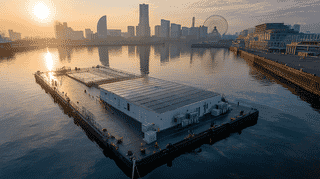
On March 25, 2026, five partners, NYK Line, NTT Facilities, Eurus Energy, MUFG Bank, and the City of Yokohama, launched a world-first floating data center powered entirely by solar panels and batteries at Yokohama Port. How does this off-grid demonstration differ from the MOL-Hitachi used-ship concept, and what does it say about Japan's answer to the AI power crisis?
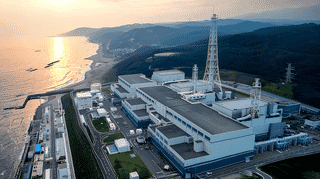
On April 16, 2026, TEPCO's Kashiwazaki-Kariwa Unit 6 resumed commercial operation for the first time in 14 years, the first post-Fukushima restart for the utility responsible for the 2011 disaster. With Middle East tensions squeezing LNG supply, electricity prices climbing, and 2050 carbon neutrality targets looming, Japan's energy policy has reached an inflection point. A deep dive into the restart's context, comparisons with Germany, France, and South Korea, the 'enclave mega-solar' scandal denting renewables, and how ordinary Japanese people are actually reacting.
A deep dive into Japan's latest energy policy as reported in the April 2026 Keidanren Times. Covering the three pillars of perovskite solar cells, next-gen geothermal, and offshore wind, plus hydrogen supply chains, CCS demonstrations, and green steel initiatives toward carbon neutrality by 2050.
Rohm has achieved its NEDO-funded technical target for 8-inch SiC MOSFETs two years ahead of schedule, demonstrating over 50% power loss reduction versus conventional silicon IGBTs. We explore what this means for EVs, renewable energy, and Japan's power semiconductor consolidation race involving Toshiba, Mitsubishi Electric, and Denso.
Sekisui Chemical has officially launched SOLAFIL, Japan's first commercially produced film-type perovskite solar cell. Lightweight and flexible enough for walls and curved surfaces, this next-gen technology positions Japan at the forefront of the global perovskite race against Chinese and European rivals.
AT Tokyo and elleThermo successfully demonstrated waste heat power generation using Semiconductor-Sensitized Thermal Cells (STC) in a live data center. This Science Tokyo-born technology generates electricity directly from low-grade heat at just 30-40°C — no temperature differential required. A look at how this could reshape data center energy efficiency amid soaring AI power demands.
As the yen approaches 160 to the dollar, the Hormuz Strait blockade has triggered an oil price surge, delivering a devastating double blow to Japan's energy-import-dependent economy. Analysis of record gasoline prices, structural vulnerabilities, and comparisons with South Korea and Germany.
Japan's GX Promotion Organization will guarantee up to $1.2 billion in debt for JFE Holdings' next-generation electric arc furnace. This $2.2 billion project aims to cut 2.6 million tonnes of CO₂ annually by replacing a blast furnace. How does Japan's industrial decarbonization strategy compare to the EU's CBAM and America's IRA?
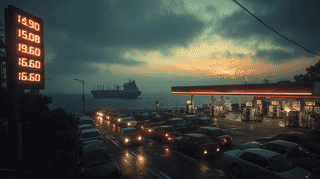
Japan's gasoline hits a record ¥190.8/L ($1.27/L) as the Hormuz Strait blockade chokes off 90%+ of crude imports. With the last Middle East tanker arriving March 22, government subsidies restarting, and Alaska crude on the table at the US-Japan summit, Japan faces its gravest energy crisis in decades.
Toyota announces mass production of water electrolysis systems by 2029, developed with Chiyoda Corporation. With 5MW domestic and 20MW international units, Toyota bets on hydrogen alongside EVs and hybrids. How Japan's multi-pathway strategy compares to the global EV-first approach.