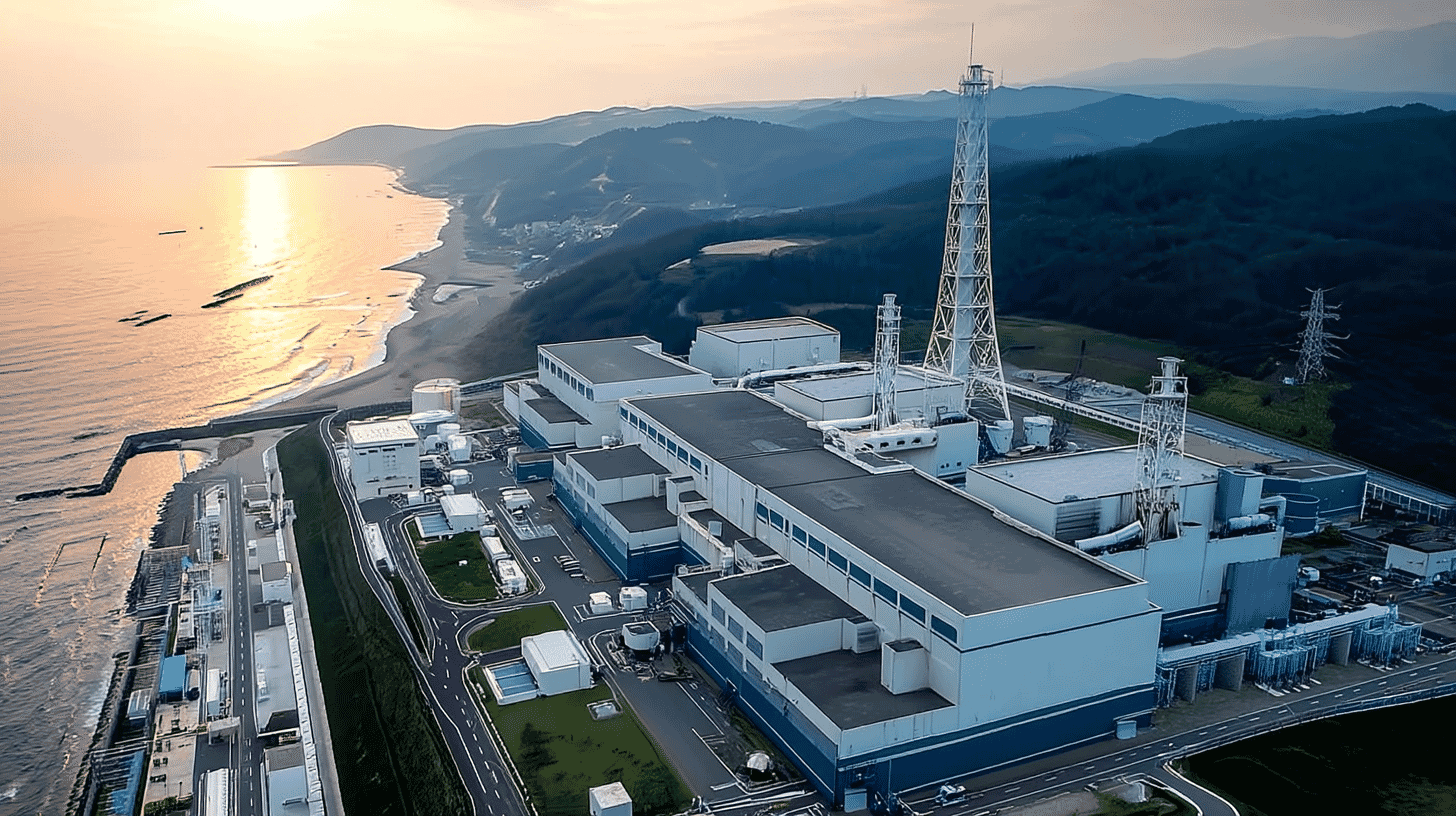
April 16, 2026, 4:00 PM, Kariwa Village, Niigata Prefecture. After 14 years of silence, a nuclear reactor begins sending commercial power back to the grid. TEPCO's Kashiwazaki-Kariwa Unit 6: 1,356 MW of capacity at the world's largest nuclear complex, operated by the same company responsible for the Fukushima Daiichi disaster. Meanwhile in the Middle East, oil tankers are being attacked in the Strait of Hormuz, Japan's gasoline briefly crossed ¥190/L ($1.20/L), and electricity bills keep climbing. For a resource-poor island nation staring down energy security, carbon neutrality, and industrial competitiveness all at once, nuclear has quietly become the answer it once swore off.
What Actually Happened: "Commercial Operation" After 14 Years
Unit 6 at Kashiwazaki-Kariwa had been offline since a routine inspection in March 2012. It cleared the Nuclear Regulation Authority's post-Fukushima safety screening and briefly restarted on January 21, 2026, only to stop again over a control rod alarm glitch. After rebooting, two separate commercial operation start dates (February 26 and March 18) slipped due to minor issues.
Then came April 16. The NRA issued both the "Pre-Use Confirmation Certificate" and the "Pre-Use Inspection Pass Certificate." At 4:00 PM, commercial operation officially began. Plant Director Takeyuki Inagaki remarked: "This is not the goal. It's the starting line. We will prioritize safety and continue stable operation."
TEPCO projects this single reactor alone will improve its financials by roughly ¥100 billion ($630 million) per year, a lifeline for a company still carrying the massive compensation and decommissioning costs of Fukushima Daiichi.
Why Now: Three Tailwinds Behind Japan's Nuclear Pivot
① Fossil Fuel Risk from the Middle East
In late February 2026, US and Israeli military action against Iran triggered a regional escalation. Commercial shipping in the Strait of Hormuz was attacked repeatedly in March, and transit volumes collapsed. Japan imports 94% of its crude oil from the Middle East, most of it through Hormuz.
LNG is less exposed, only about 6% flows through Hormuz, but the broader risk shock was immediate. In an unusual reversal, the government decided to suspend the 2026 operating cap on inefficient coal plants, allowing even aging coal-fired units to run at higher loads to conserve LNG.
Economy Minister Ryosei Akazawa calculated that Unit 6 running at rated output for a full year could save roughly 30% of Japan's Hormuz-routed LNG imports. A single reactor restart rewrites Japan's energy security equation.
② Rising Power Costs and Industrial Competitiveness
Japan's energy self-sufficiency rate is just 13%, the lowest in the G7. A fuel cost adjustment mechanism passes fuel price spikes directly through to household and business electricity bills, so Middle East instability translates almost immediately into domestic pain.
The acute pressure is industrial. TSMC's semiconductor fab in Kumamoto and the country's rapidly multiplying data centers require massive, 24/7, carbon-free power. Solar and wind alone can't deliver either the volume or the stability. Global customers like Apple demand clean power; coal and gas emit carbon; the remaining option that's large, stable, and low-carbon is, whether you like it or not, nuclear.
③ Decarbonization and Japan's 2040 Electricity Mix
The 7th Strategic Energy Plan, approved by Cabinet in 2025, sets the 2040 electricity mix at roughly 20% nuclear, 40–50% renewables, and 30–40% fossil. Critically, the previous language promising to "reduce dependence on nuclear power as much as possible" has been deleted. Nuclear now sits alongside renewables as a "decarbonization power source."
Germany, France, South Korea: The World Split
Japan's pivot isn't an outlier. It's part of a broader realignment, though each country has taken a sharply different path.
Germany: Complete Exit. On April 15, 2023, Germany shut down its last three reactors (Emsland, Isar 2, Neckarwestheim 2), completing a decades-long phase-out catalyzed by Fukushima. But Germany has since flipped from net power exporter to net importer, ironically buying much of its replacement electricity from neighboring France's nuclear fleet. A 2025 poll showed 55% of Germans now favor restarting the shuttered plants.
France: Doubling Down. France gets roughly 70% of its electricity from nuclear and plans to build six new reactors by 2035 under President Macron, framing nuclear as "the answer to climate and security." France successfully pushed the EU to classify nuclear alongside renewables in its green taxonomy, reversing Germany's dominance on the issue.
South Korea: Reversal. Under President Moon Jae-in (2017–2022), South Korea announced a Germany-inspired nuclear phase-out. But rising power prices and competitive pressure on the steel and semiconductor industries made it politically untenable. President Yoon's administration reversed course, and Korea now actively exports reactor technology.
Japan, the country that actually lived through a Fukushima, has chosen the French/Korean path. The unforgiving math of a resource-poor island nation seems to have overridden the trauma.
But Renewables Are Taking a Beating: The "Enclave Mega-Solar" Scandal
While nuclear advances, solar power in Japan is facing a reputational crisis.
In April 2026, the "Blue Power Bandai-Inawashiro" solar plant in Fukushima became the first facility ever ordered to refund approximately ¥600 million ($3.8 million) in feed-in-tariff subsidies, its certification revoked. The scheme: register just two decorative solar panels at the official site, then operate the real 75,000-panel array on a former golf course 3 km away, connecting the two with a proprietary transmission line to game the system. The sites were treated as a single plant for FIT purposes, allowing the operator to apply the much higher 2013 feed-in rate to everything. Japanese media call this "electricity origin fraud."
Add to that: ecological damage at a mega-solar near Hokkaido's Kushiro Wetlands, Mitsubishi's consortium withdrawing from three major offshore wind projects due to spiraling construction costs, and mounting citizen opposition to large-scale solar on forested hillsides. The political framing has shifted, solar is increasingly portrayed as "foreign capital damaging Japan's landscape," a narrative high-profile politicians have picked up.
In December 2025, the ruling LDP proposed ending FIT support for new ground-mounted mega-solar starting fiscal 2027. The optimistic "we'll run Japan on renewables alone" argument is quietly collapsing under its own weight.
What It Means for Ordinary People
Running at rated output, Unit 6 will generate roughly 10 billion kWh annually, enough to cover about 10% of household electricity demand in TEPCO's service area (Tokyo and eight surrounding prefectures).
Short term:
- Upward pressure on electricity bills eases somewhat
- Reduced exposure to LNG spot prices means more stable monthly bills
- Lower risk of summer/winter supply crunches
Long term:
- Momentum builds for restarting other idled reactors toward the 20% nuclear target
- Data centers and chip fabs gain access to stable, low-carbon power, a siting advantage
- Higher nuclear dependence also means higher consequences if something goes wrong
The Unfinished Questions
Policymakers and industry are bullish. The concerns of skeptics haven't disappeared, though.
Niigata Governor Hanazumi approved the restart but submitted seven demands to the national government, including accelerated evacuation road construction. He's made clear the prefecture will monitor compliance. Kashiwazaki-Kariwa was damaged in the 2007 Niigata Chuetsu-oki earthquake, Japan Sea seismic risk has been part of the debate since before Fukushima.
About 40% of the operators at Unit 6 have no actual real-world reactor operation experience, reflecting the 14-year gap. TEPCO says training is sufficient; critics note that operational knowledge is a generational asset, not a manual.
And Japan still has no permanent disposal site for high-level radioactive waste. As reactors run, spent fuel accumulates. The "apartment without a toilet" metaphor, coined by Japanese critics decades ago, remains unresolved even as new power starts flowing onto the grid.
Fourteen Years After Fukushima
The Kashiwazaki-Kariwa restart isn't a claim that "nuclear is now safe." Risks remain. It's a statement that, weighed against the risks of fossil fuel dependence, runaway power costs, and missing climate targets, this is the answer Japan is willing to live with, at least for now.
Whether to exit like Germany, expand like France, or navigate between lived trauma and resource constraints like Japan, each country will answer differently.
What's the nuclear debate like in your country right now? Between energy security, climate change, and safety, where do you think the right balance lies? We'd love to hear your perspective in the comments.
References
- https://www.tepco.co.jp/niigata_hq/kk-np/kk-info/index-j.html
- https://news.yahoo.co.jp/articles/ba37eee17bec1781966471cac5e701bdaa23274b
- https://www.nikkei.com/article/DGXZQOCC1105Z0R10C26A4000000/
- https://www.bloomberg.com/jp/news/articles/2026-04-16/TDKKU7T96OSJ00
- https://www.niigata-nippo.co.jp/articles/-/814969
- https://www.jetro.go.jp/biz/areareports/2026/190b55f892c6980c.html
- https://www.enecho.meti.go.jp/category/others/energysecurity/index.html
- https://www.seikeitohoku.com/inawashiro-enclave-mega-solar-revoked/
- https://newswitch.jp/p/47604
- https://en.wikipedia.org/wiki/Nuclear_power_phase-out
- https://world-nuclear.org/information-library/country-profiles/countries-g-n/germany



Global Discussion
12 comments