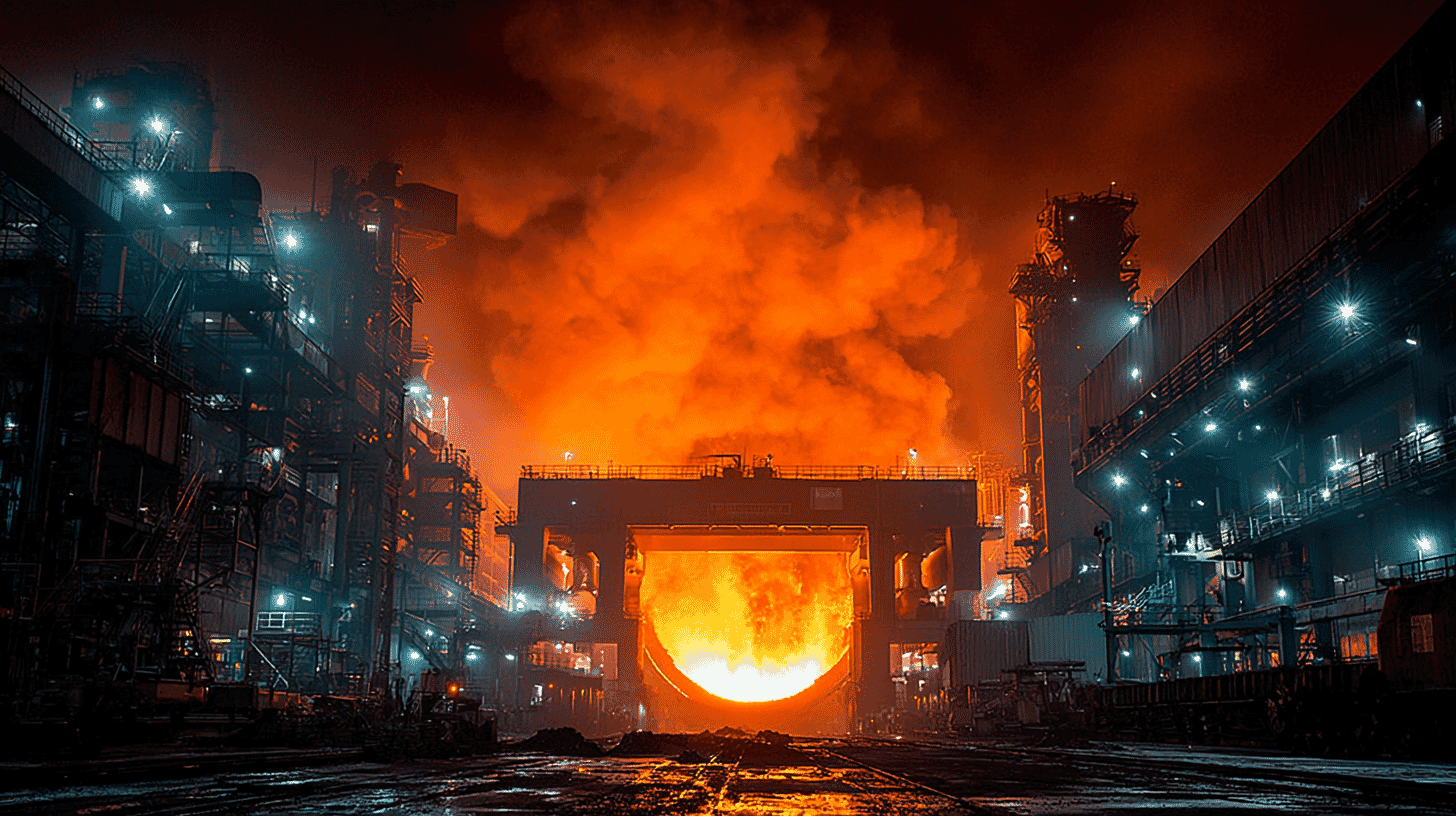
Making steel produces staggering amounts of CO2, and in Japan, the steel industry alone accounts for roughly 40% of all industrial emissions. Now the Japanese government is backing an ambitious plan to create a "green steel" market of over 3 million tons per year by the early 2030s. With the EU's Carbon Border Adjustment Mechanism (CBAM) now in full force and global competition heating up, Japan is betting on a three-pronged technological approach and a suite of policy tools to transform one of the world's most carbon-intensive industries.
Why Decarbonizing Steel Is So Hard
Steelmaking is one of the hardest industries to decarbonize. In the conventional blast furnace process, coal (coke) is used to strip oxygen from iron ore, a chemical reaction called "reduction." This process inherently generates massive CO2 emissions. But coal isn't just a fuel here: it simultaneously serves as the reducing agent, heat source, and a structural support that keeps raw materials stable inside the furnace. You can't simply swap it out for another energy source.
There's an alternative: electric arc furnaces (EAFs) that melt recycled steel scrap using electricity, producing far less CO2. But the world's iron demand far outstrips available scrap supply, the International Energy Agency projects this gap will persist through 2050. Moreover, conventional EAFs struggle to remove impurities like copper ("tramp elements") that accumulate in recycled scrap, making it difficult to produce the thin, high-strength steel grades that automakers demand for car body panels.
Three Paths to Green Steel
Japan's steel industry is pursuing three complementary decarbonization technologies.
Hydrogen-based reduction replaces coal with hydrogen as the reducing agent. Since the byproduct is water (H₂O) rather than CO2, this approach could theoretically eliminate process emissions entirely. However, hydrogen reduction is an endothermic reaction that cools the furnace, creating major engineering challenges around maintaining temperature, scaling up operations, and ensuring stable production.
EAF conversion involves replacing existing blast furnaces with large-scale electric arc furnaces. Nippon Steel plans to install three new EAFs at its Yawata, Hirohata, and Shunan works by fiscal year 2029, converting approximately 2.9 million tons of annual production capacity. The total investment reaches approximately $5.8 billion, and is expected to cut around 3.7 million tons of CO2 emissions per year.
CCUS (Carbon Capture, Utilization, and Storage) captures CO2 from existing blast furnace processes for underground storage or reuse as chemical feedstock. This serves as a transitional technology, allowing continued blast furnace operation while reducing emissions during the shift to cleaner processes.
The Japanese government defines "Green Steel for GX Promotion" specifically as steel produced through these technologies where additional capital investment significantly raises manufacturing costs above conventional products, even though the finished steel is functionally identical.
The Government's Four-Part Support Strategy
A government-led study group called the "Green Steel Study Group for GX Promotion" met five times between October 2024 and January 2025, bringing together policymakers, industry experts, and both steel producers and buyers. The group produced a concrete action plan with four pillars.
Standardizing carbon footprint (CFP) measurement. The steel industry established a common CFP calculation guideline in October 2025, creating a unified way to quantify emissions per product. Japan is pushing to have these standards reflected in international frameworks like ISO and the World Steel Association's guidelines. This matters because if international buyers can't verify a product's green credentials using globally recognized metrics, the environmental premium becomes meaningless.
Government procurement preferences. Japan's Green Purchasing Act was amended in January 2025 to prioritize low-carbon steel in public infrastructure projects, bridges, buildings, and other government-funded construction will increasingly specify green steel.
Demand-side incentives. The government added a bonus of up to ¥50,000 (about $330) to clean energy vehicle subsidies for cars that use green steel components. This creates a tangible financial incentive for automakers, the primary consumers of high-grade steel, to specify green steel in their supply chains.
Producer-side investment support. Through GX Transition Bonds and tax incentives, the government is subsidizing the enormous upfront costs of switching production methods. Nippon Steel and JFE Steel have already secured over $2 billion in combined government financial support for their EAF conversion projects.
The CBAM Factor: Why International Standards Are Urgent
The EU's Carbon Border Adjustment Mechanism became fully operational in January 2026, requiring importers of steel and other carbon-intensive goods to purchase certificates reflecting the embedded CO2 emissions. Certificate prices are linked to the EU Emissions Trading System, currently running at approximately $85–$125 per ton of CO2.
For Japanese steelmakers, CBAM creates a dual challenge. There's the direct cost increase on European exports. But more strategically, CBAM is becoming a de facto global standard for carbon accounting. If Japan's CFP methodology and carbon pricing under its GX-ETS aren't recognized as equivalent by the EU, Japanese steel exporters could be hit with default emission values, the highest-emission benchmarks, regardless of their actual performance.
Japan's GX-ETS enters its second, mandatory phase in fiscal year 2026, requiring participation from all companies emitting over 100,000 tons of CO2 annually. Getting this system recognized as equivalent by the EU would allow Japanese exporters to offset CBAM costs. The push for international standardization isn't just environmental policy, it's a trade strategy with billions of dollars at stake.
Can Japan Hit the 3-Million-Ton Target?
The government's goal of over 3 million tons of green steel per year by the early 2030s represents roughly 3.5% of Japan's total crude steel output (approximately 85 million tons annually). Nippon Steel alone projects about 1.6 million tons per year of GX Steel from its EAF conversions, and JFE Steel's projects would add further capacity. On paper, the numbers are achievable.
But significant hurdles remain. Green steel costs more to produce, and finding enough buyers willing to pay a premium for environmental value, rather than just functional performance, is the central challenge. The EAFs themselves will require massive amounts of electricity, and Japan's energy mix still relies heavily on fossil fuels. Securing stable, decarbonized power is critical.
Globally, Sweden's HYBRIT project leads in commercializing hydrogen-based steelmaking, while European steelmakers are pouring billions into similar technologies. China, producing over half the world's steel, is increasing its EAF ratio. The global race for green steel markets is already underway.
Japan's approach is distinctive: rather than betting on a single technology, it combines hydrogen reduction, EAF conversion, and CCUS in a pragmatic, multi-track strategy backed by coordinated government support. Whether this industrial transformation succeeds will have implications far beyond Japan's borders.
How is steel decarbonization progressing in your country? Are you feeling the impact of CBAM or similar carbon border policies? Share your thoughts in the comments.





Global Discussion
13 comments