🔷 In 2023, a retired print technician in the English seaside town of Bridlington cracked a problem that had sat open for about fifty years. His answer was a lopsided thirteen-sided shape that everyone immediately started calling "the hat."
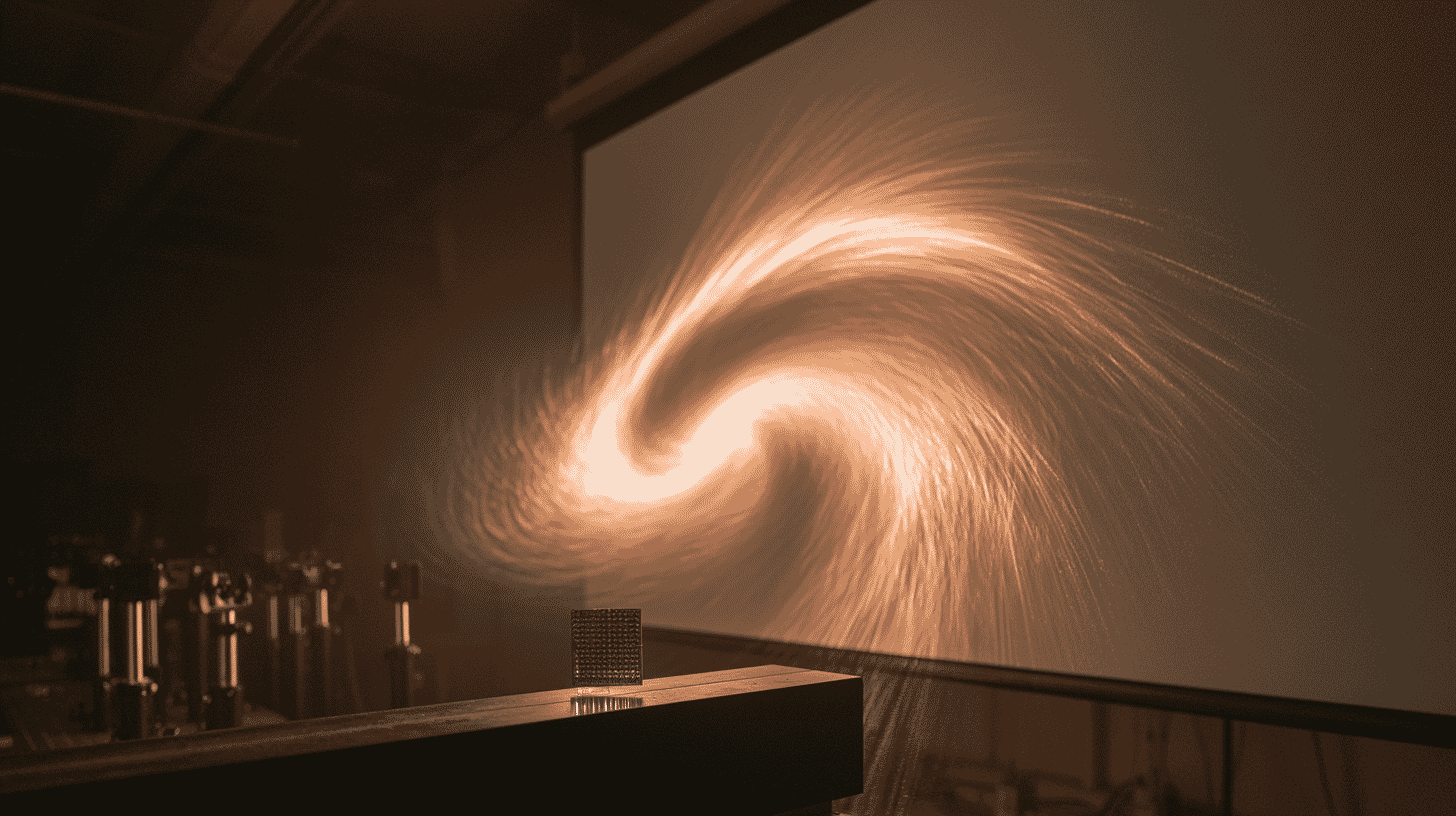
A little over three years later, a team in Japan carved 372,100 copies of its pattern into a wafer and pointed a laser at it. A pinwheel appeared on the screen.
The thirteen-sided shape everyone calls "the hat"
Tile a floor with squares and the pattern repeats. Slide the whole floor over by one square and nobody could tell. That repetition is what makes a tiling periodic, and for most of the history of the subject, it was the only thing a single shape could do.
Then in 1974 Roger Penrose found a pair of shapes that cover the plane forever without the pattern ever coming back around. Two shapes. The obvious next question was whether one would be enough. Mathematicians named it the einstein problem. The name has nothing to do with Albert Einstein; it comes from the German ein Stein, meaning one stone.
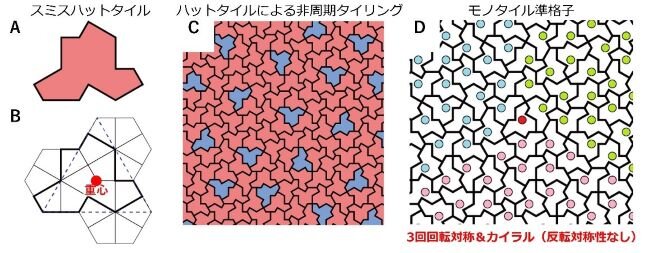
It took until 2023. David Smith, a hobbyist who tinkers with shapes, cut out a polygon assembled from eight kite-shaped pieces, thirteen sides in total, and started laying copies of it across a table. The pattern refused to repeat. Smith teamed up with Craig S. Kaplan, and the two brought in Chaim Goodman-Strauss and Joseph Samuel Myers; in a little over a week, Myers had a proof. The paper went up on arXiv on March 20, 2023, and the New York Times had it before the month was out.
A hat tiling uses the hat alongside its flipped-over mirror image. Same shape, reversed, which is why it still counts as a single tile. The same four later found a version that needs no flipping at all and called it the spectre.
Source: Institute of Industrial Science, the University of Tokyo
Turning a mathematical figure into something you can shine light on
A tiling is not a material. To find out what the hat does physically, somebody has to build one.
That is what Yuto Moritake, now an associate professor at the University of Tokyo's Institute of Industrial Science, set out to do with Masaya Notomi, a professor at Institute of Science Tokyo who is also a fellow at NTT's basic research arm, and NTT engineers Masato Takiguchi and Takuma Aihara. Their results ran in Nature Communications on July 29, 2026.
Rather than reproduce the hat outlines, the team marked each tile's centroid with a single point and discarded the shapes. What remains is a cloud of points, and it has an unusual pair of properties: perfect threefold rotational symmetry, and no mirror symmetry whatsoever. Rotate it a third of a turn and it lands back on itself. Hold it up to a mirror and it does not.
That second property is where the physics lives. Penrose tilings have mirror lines. This one has none, and the reason sits inside the recipe for building hat tilings: hats group into clusters, clusters group into larger clusters, and at every level the cluster sits slightly rotated relative to the honeycomb grid beneath it. The rotation accumulates. The structure comes out handed. The mirrored hats from a moment ago are still in there. They just never buy the pattern a mirror line.
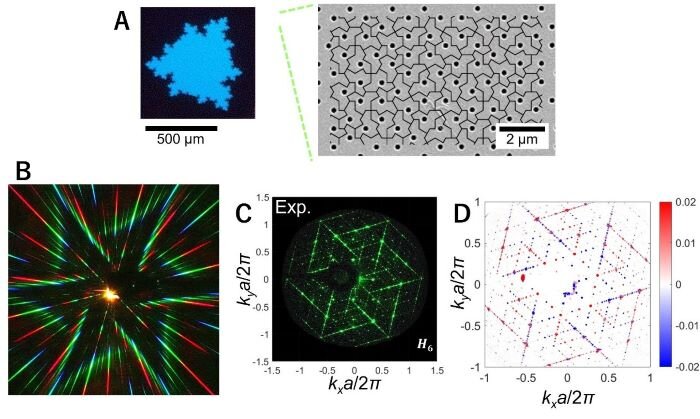
Fabrication went to NTT. On a film of silicon nitride 350 nanometers thick, electron beam lithography and etching cut circular holes with a radius of 100 nanometers at every point of the pattern, 372,100 of them across a patch roughly 500 micrometers on a side. The team built the mirror-image version too, so they would have something to compare against.
Source: Institute of Industrial Science, the University of Tokyo
What the white laser drew
Send light at a regular grid and it scatters into a tidy array of dots. Send it at this pattern and you get something else.
Source: Institute of Industrial Science, the University of Tokyo
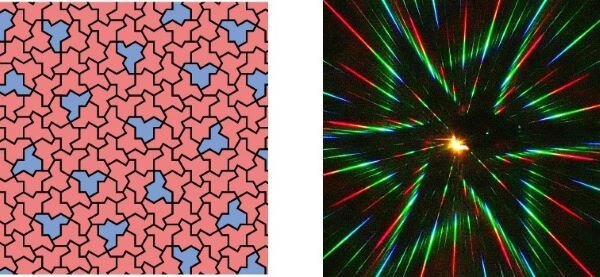
Under a white supercontinuum laser, the diffraction pattern is a pinwheel: arms of light sweeping around a center, with no mirror line anywhere in it. The handedness of the structure had transferred directly into the light. Run the same measurement on the mirrored sample and the pinwheel turns the other way.
Swap in a green laser at 532 nanometers and the picture resolves into a dense field of sharp peaks. Sharp peaks mean long-range order, the fingerprint of a quasicrystal: a solid that is perfectly ordered and yet never repeats. Dan Shechtman saw the first one in 1982, was told for years that it could not exist, published in 1984, and collected the 2011 Nobel Prize in Chemistry for it.
The team also moved the laser spot around the sample. The peaks stayed exactly where they were. In a merely disordered structure they would wander, so holding still is the evidence that the order runs across the whole thing.
A golden ratio hiding in the tilt
The arms of the pinwheel are tilted, and the tilt is calculable from the geometry alone. Track how much each cluster rotates as the hierarchy is built up, and the numbers follow the Fibonacci sequence. Push that to the limit and the ratio converges on the golden ratio, the constant that keeps turning up in geometry. Feed it through and the tilt comes out at about 15.52 degrees. Measure where the diffraction peaks actually sit, and they line up along that direction.
The golden ratio appearing in a quasiperiodic structure is not itself a surprise; it runs all through Penrose tilings. Here it arrives by a different route: a quirk of how the tiles stack in real space shows up as an angle you can measure in scattered light.
The structure can tell left-handed light from right-handed
Light can corkscrew. In circularly polarized light the electric field rotates as the wave travels, either clockwise or counterclockwise, and that handedness is called helicity.
The team fired left-handed circularly polarized light at the sample, then right-handed, and compared the brightness of each diffraction peak. On a honeycomb grid or a Penrose tiling, nothing would happen. Those structures have mirror symmetry, so the two handednesses are equivalent and the light cannot tell them apart. On this one, the peaks came out measurably different. Put the mirrored sample in and the difference flips.
This is the part the researchers single out as new. Diffraction from hat tilings had already been worked out on paper. Joshua Socolar showed in 2023 that the structure is quasiperiodic with the golden ratio locked into it, and in 2024 Kaplan, one of the hat's discoverers, and colleagues reported a chiral six-fold symmetry inherited from the hexagonal grid underneath, working from a different choice of points. Chirality itself was not the surprise. What none of the theory had identified, the Nature paper says, is the dependence on circular polarization, and that came out of the measurement. Nor is this the only group putting hats into hardware: a preprint posted in May 2026 describes hat lattices sculpted from light-matter quasiparticles inside a semiconductor microcavity. What is new here is scoped to optical diffraction from a nanofabricated structure.
So what does this let us do
Nothing yet, and the team is careful not to imply otherwise.
What they are claiming is a new category to work with. Metasurfaces, the flat arrays of sub-wavelength structures used to steer and shape light, normally get chiral behavior from periodic design or from placing a twisted shape at every site. Here the handedness comes from the arrangement itself, not from the pieces. As of the July 2026 announcement, whether that becomes a useful lever in a working device is open. The paper presents it as a place to look for new optical behavior, not a route to a product.
The chain runs from a hobbyist laying cardstock shapes out on a table in Bridlington, through a physicist in Tokyo who read a popular paperback on Penrose geometry and wondered what that shape would do to light, to NTT's fabrication line and a paper in Nature Communications backed by five government research grants. No application in sight, and a little over three years from one end to the other.
That last part is the argument every country has about basic research, usually at budget time. Where does it stand where you are? Does work with no product at the end of it get funded, and do people hear about it when it turns into something like this?
References
- https://www.iis.u-tokyo.ac.jp/ja/news/5114
- https://www.nature.com/articles/s41467-026-75023-7
- https://www.eurekalert.org/news-releases/1137592
- https://www.quantamagazine.org/hobbyist-finds-maths-elusive-einstein-tile-20230404/
- https://momath.org/the-hat/
- https://arxiv.org/abs/2305.01174
- https://asu.elsevierpure.com/en/publications/periodic-diffraction-from-an-aperiodic-monohedral-tiling
- https://arxiv.org/abs/2605.13206
- https://www.nobelprize.org/prizes/chemistry/2011/summary/
- https://cs.uwaterloo.ca/~csk/hat/







Global Discussion
4 comments