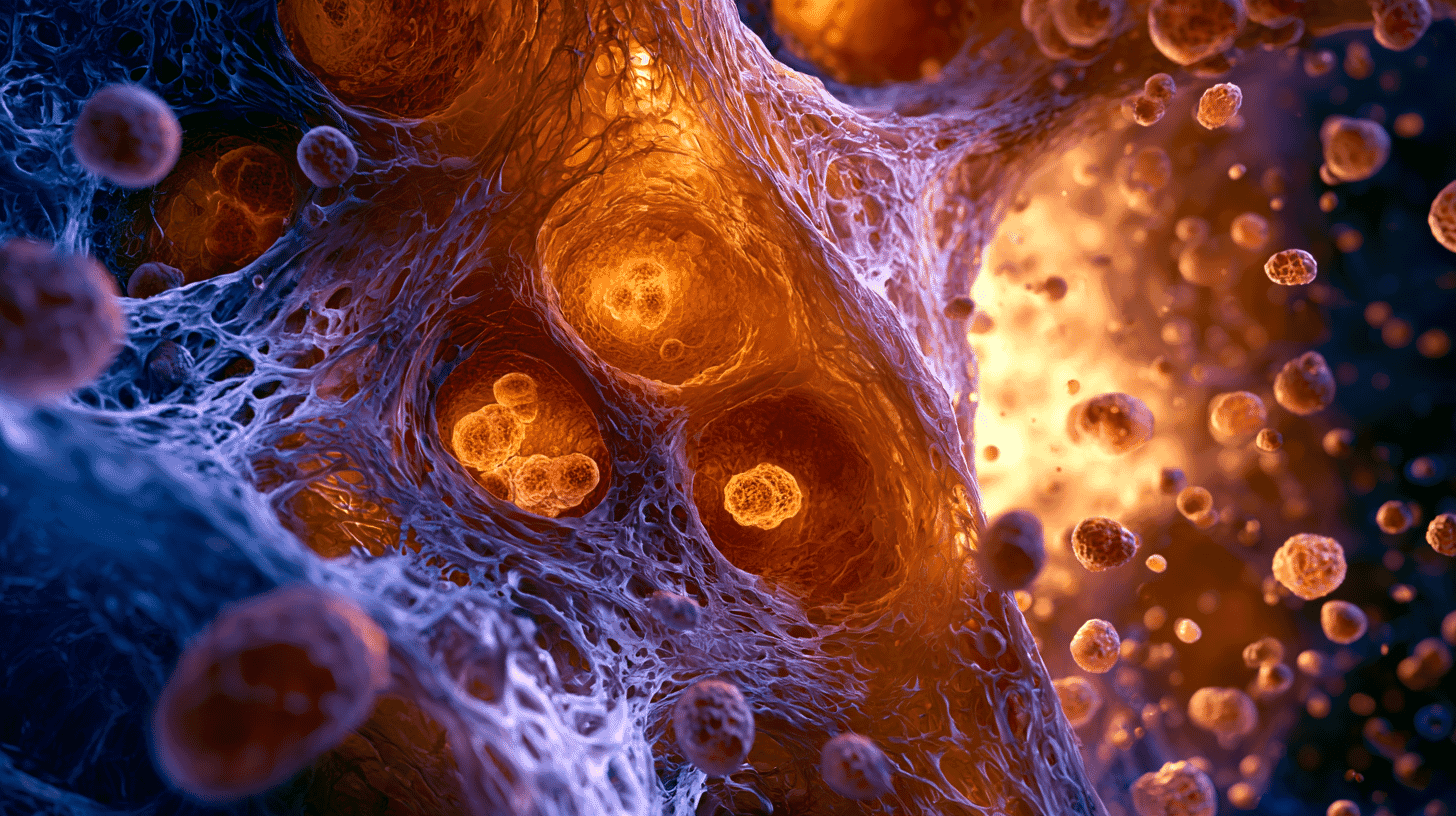
Getting a COVID shot every autumn has become routine enough that most people have stopped asking why. For years the answer was that nobody could point to the exact cell that was failing. A Japanese team has now named the step where it goes wrong, and the timing is awkward: the world's next-generation vaccine money is pouring into a different problem.
The number behind your yearly booster
Antibodies do not float around on their own forever. They are secreted, continuously, by plasma cells. Most plasma cells die within days. A small minority crawls into the bone marrow, settles into a survival niche and keeps producing antibody for years. Those are long-lived plasma cells, and the durability of any vaccine is a question of how many of them it installs.
In 2024, the Lowance Center for Human Immunology at Emory University put a number on it. The team sampled bone marrow from 19 healthy adults, 22 samples in all, taken between two and a half and 33 months after mRNA vaccination, and sorted the antibody-secreting cells by which compartment they were sitting in.
Among the cells in the long-lived compartment, spike-specific cells accounted for 0.14%. In the same people, in the same bone marrow, influenza-specific cells accounted for 7.3% and tetanus-specific cells 2.1%. Spike-specific cells were detectable in the long-lived compartment in only 6 of 17 subjects tested, while tetanus and influenza responses showed up in every single one. Serum antibody against spike faded three to six months after vaccination.
So the mRNA vaccines were not failing to generate plasma cells. They were generating plenty. The cells simply were not being installed in the compartment where antibody production becomes permanent. The booster schedule is not a policy preference. It is the visible consequence of a cell-fate decision happening somewhere upstream, and until this week that decision was a black box.
Who gets a seat in the bone marrow
The paper that opens the box appeared in Science Immunology on September 4, 2026, from a group led by Tomohiro Kurosaki, specially appointed professor at Okayama University Graduate School of Medicine, Dentistry and Pharmaceutical Sciences and visiting professor at Osaka University's Immunology Frontier Research Center. Yuki Tai is first author; Takuya Koike, a project assistant professor at the University of Tokyo Pandemic Preparedness, Infection and Advanced Research Center (UTOPIA), is among the co-authors, as are Niklas Engels and Jürgen Wienands on the German side.
The question they went after is older than COVID. Early in any immune response, B cells make IgM antibody. Later they class-switch to IgG, and IgG is what sticks around and blocks reinfection. Everyone knew IgG lasts longer. Nobody could explain why, because the proportion of cells that switch class does not account for the size of the gap.
Working in mice immunized with a protein, the team tracked IgM-type and IgG1-type cells separately through three stages: B cells, plasma cells in lymphoid tissue, and plasma cells in the bone marrow. The IgG1 share climbed at every step. Three separate mechanisms were stacking on top of each other.
First, the IgG1-type B cell receptor presents antigen to T cells more efficiently than the IgM version, which means more proliferation once the cell has become a plasma cell. Second, signals arriving through the IgM-type receptor drive plasma cells toward death more strongly than IgG1 signals do. Third, IgG1 plasma cells physically migrate into the bone marrow more readily, and the group identified candidate genes behind that difference.
Each of the three is a small bias on its own. Stacked, they change the meaning of class switching, understood until now as a change in the antibody a cell makes. This paper says it is also a change in what happens to the cell itself.
"This study showed that the class of the antibody controls the proliferation, survival and bone marrow migration of antibody-producing cells, and thereby determines how many long-lived plasma cells form in the bone marrow," Kurosaki told broadcaster RSK. "We hope it leads to vaccines whose effect lasts longer."
The world bet on breadth
Almost every dollar in next-generation vaccine development is aimed at an axis other than duration. The dominant goal since 2021 has been breadth: one shot that survives mutation, covers variants that do not exist yet, ideally covers a whole viral family. CEPI is backing Centi-flu from the US biotech Centivax with up to $5 million, a pan-influenza design that focuses the immune response on conserved viral sites instead of the variable surface proteins; CEPI says preclinical data spanned strains from 1918 through current H5N1. Pan-coronavirus work follows the same logic. At the end of July 2026 the clinical-stage candidates were a protein subunit from Britain's Gylden Pharma, whose phase 1 trial is now fully recruited; a sarbecovirus vaccine from France's INSERM Vaccine Research Institute and Ennodc, running one phase 1 trial and one phase 1/2 trial; and a DNA vaccine from Britain's DIOSynVax, tested in a phase 1 trial.
The US walked away from mRNA. On August 6, 2025, the Department of Health and Human Services cancelled 22 mRNA vaccine development investments under BARDA, worth roughly $500 million. Secretary Robert F. Kennedy Jr. framed the pivot this way: "We're shifting that funding toward safer, broader vaccine platforms that remain effective even as viruses mutate." Broader. Not longer. What survived fits that description: the Gylden Pharma phase 1 ran on US Project NextGen money.
Breadth and duration are not the same engineering problem, and solving one does not solve the other. A vaccine that covers every coronavirus variant and still empties out of the bone marrow within months is a vaccine you take every year forever. Candidates aimed at duration do exist. The July 29, 2026 edition of the monthly next-generation vaccine record kept by Hilda Bastian lists a "durable or variant-proof" category holding a polymer-nanoparticle hydrogel vaccine from Stanford University and a self-amplifying mRNA "wobble vaccine" from Emory University, both still preclinical, in mice and non-human primates. What has reached the clinic is the breadth side. One-year results on VLPCOV, the self-amplifying mRNA candidate from Japan's VLP Therapeutics, showed immune responses waning across all three vaccines compared, including a Pfizer shot that had been updated for Omicron while VLPCOV had not.
What Japan is actually holding
Japan's answer to the pandemic was not a rival to Moderna. It was money aimed further back in the pipeline. SCARDA, the vaccine R&D center set up inside AMED in March 2022, was handed three programs from the 2021 supplementary budget totalling 251.9 billion yen, about $1.61 billion at 156.27 yen to the dollar, the rate on September 4, 2026 used for every conversion here. Of that, 51.5 billion yen, roughly $330 million, went to building world-class research hubs: the University of Tokyo as flagship, with Osaka, Chiba, Nagasaki and Hokkaido as synergy hubs. UTOPIA, where Koike sits, is that flagship.
Four years on, what that spending is producing is not a product. It is a chain of papers narrowing in on the same question. In 2022 the group reported surface markers that distinguish long-lived plasma cells from the ones that die. In February 2025 they showed the transcription factor KLF2 and integrin beta-7 are required for plasma cells to reach the bone marrow at all. This week's paper sits upstream of both, explaining which cells get selected to make that trip in the first place. This study was funded by Otsuka Pharmaceutical, the Nippon Foundation, JSPS KAKENHI, AMED and the Takeda Science Foundation.
The limits are real. This is mouse work, with a model protein antigen, looking at one IgG subclass. Nobody has shown that pushing a human vaccine toward IgG-type receptor signalling produces more long-lived plasma cells in a human bone marrow. The distance between a mechanism in mice and a shot in an arm is measured in years, and most mechanisms do not make the trip.
But the space is unusually empty. The US National Institute of Allergy and Infectious Diseases has listed the biology of short-lived and long-lived plasma cells as a highlighted research topic since September 2025, yet the candidates aimed at duration are still preclinical, and the money that has reached the clinic has agreed to chase breadth. What the Japanese group spent those four years mapping is that empty space. Japan's health ministry currently runs a routine COVID vaccination each autumn and winter through local governments, the annual cadence that this line of research exists to break.
Japan takes its shot every autumn and is now funding the basic biology that might eventually make that unnecessary. How often are you being asked to roll up your sleeve, and has anyone in your country made the case for why it has to be that often?
References
- https://news.yahoo.co.jp/articles/3432eaf201b49ab8aab1c5f5c6ce6ebeb80afca2
- https://www.u-tokyo.ac.jp/focus/ja/press/z0406_00018.html
- https://www.nature.com/articles/s41591-024-03278-y
- https://www.u-tokyo.ac.jp/content/400257965.pdf
- https://absolutelymaybe.plos.org/2026/03/01/progress-for-universal-vaccine-more-nextgen-covid-vax-news-update-no-38/
- https://absolutelymaybe.plos.org/2026/07/29/bumper-month-of-clinical-trial-news-to-ring-out-this-vax-series/
- https://www.biospace.com/policy/rfk-jr-axes-22-mrna-vaccine-projects-under-barda
- https://cepi.net/pioneering-vaccine-tech-could-pave-way-all-one-shots-against-rapidly-mutating-viruses
- https://www.amed.go.jp/content/000100523.pdf
- https://www.amed.go.jp/program/list/21/02/002.html
- https://www.mhlw.go.jp/stf/seisakunitsuite/bunya/vaccine_00184.html
- https://grants.nih.gov/funding/find-a-fit-for-your-research/highlighted-topics/22







Global Discussion
3 comments