💧 A pipe starts weeping somewhere above a factory ceiling. A few drops land on a black ribbon wrapped around the pipe. That water is enough to make a trickle of electricity, which gets banked, boosted, and spent all at once on a Bluetooth alert to whoever runs the building.
No battery. No power cable. Nobody had to crawl into the ceiling void to wire anything up.
The circuit that makes this work is called CLEAN-Boost, and it comes from ABLIC, a Tokyo analog chipmaker inside the MinebeaMitsumi group. The engineer who has spent years on it explains the whole idea by pointing at a Japanese garden.
A garden ornament, rebuilt as a circuit
Visit almost any temple garden in Kyoto and you will hear a shishi-odoshi: a length of bamboo, pivoted at its middle, that fills slowly from a bamboo spout. Nothing happens for a long time. Then the bamboo tips, dumps its water, swings back, and cracks against a stone with a sharp knock. Gardens use it to startle deer. Tourists film it.
Yusuke Takeuchi, the senior expert who leads CLEAN-Boost at ABLIC, uses it to describe the circuit, according to Newswitch, the news site run by the Nikkan Kogyo Shimbun. Ambient energy dribbles out in amounts far too small to run a radio continuously: a temperature difference across a wall, a bit of vibration from passing traffic, moisture on a metal electrode.
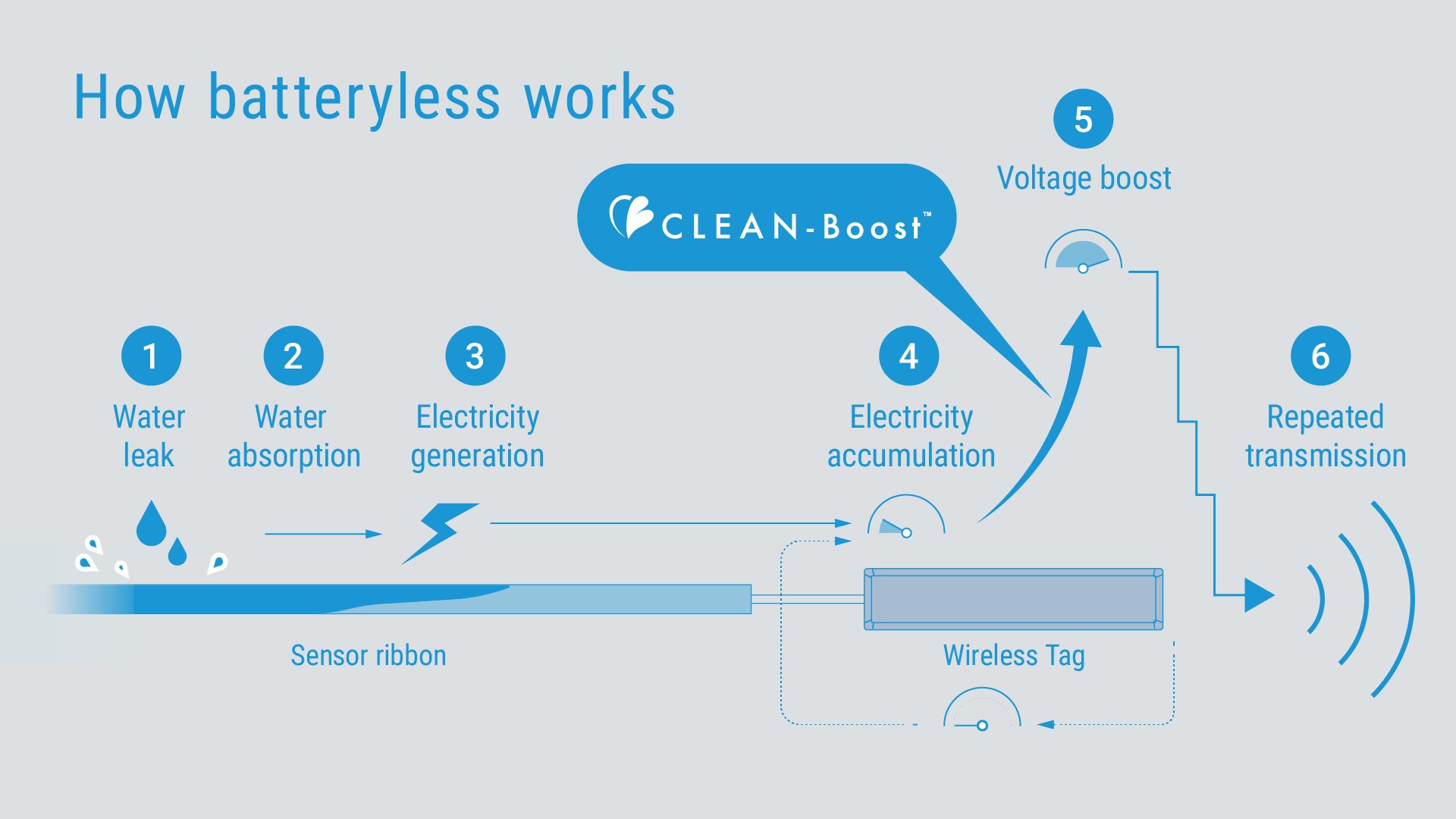
So CLEAN-Boost does not try. It accumulates the trickle, waits, and then releases everything in one burst at a usable voltage. ABLIC's technical documentation says the circuit can amplify the collected power by up to 30,000 times on discharge, and that a harvester generating 150 nanowatts or more is enough to keep an IoT device firing. For scale, the company points to a solar cell the size of a mechanical pencil lead's cross-section. Indoors, under ordinary room lighting, that is roughly what it produces.
The storage-and-boost circuit at the heart of the technology came out of joint research with Ritsumeikan University in Kyoto. In the version ABLIC shipped for the American and European markets, the boost stage starts working at 0.35 volts, letting the system make efficient use of input power in the single-microwatt range. A paper on the underlying 150-nanowatt intermittent startup circuit, built on FD-SOI (a low-leakage chip process that puts an insulating layer under the transistors), took the Best Paper Award at the IEEE S3S Conference, held in the United States in October 2019.
Source: ABLIC Inc.
What 150 microliters of water can actually do
The Battery-less Water Leak Sensor, developed jointly with the construction firm Taisei Corporation and on sale in Japan since July 10, 2019, comes in two parts: a fabric ribbon with two metal electrodes woven through it, and a small wireless tag.
When water soaks the ribbon, the two dissimilar metals set up a weak galvanic current, the same basic chemistry as a lemon battery. The tag banks that current, boosts it, and sends a Bluetooth Low Energy 5.0 beacon. Then it starts over. As long as the ribbon stays wet, the cycle repeats.
ABLIC specifies detection from 150 microliters of water, which its own product page describes as no more than a few drops, with signal transmission in under five minutes for ordinary tap water. Ribbons come in half-meter, two-meter and five-meter lengths and can be chained up to fifteen meters. Detection does not depend on where along the ribbon the water lands. The company calls it the world's first sensor able to detect leaks at the individual-drop level, and footnotes that as based on its own internal research.
On October 28, 2025, ABLIC took the product to the United States and the European Union, having cleared FCC and CE certification. The export version got two upgrades over the Japanese model: roughly double the communication range, now about 100 to 200 meters, and an operating ceiling raised from 60°C to 85°C. That second number is aimed squarely at data centers, where server rooms run hot and a cooling-loop leak is a very expensive way to find out you had one.
Company president Seiji Tanaka, in comments accompanying the launch, said more than 80 companies in Japan had adopted the sensor. Among them: NTT East, which put them into roughly 650 unattended communication facilities so maintenance crews stop making inspection rounds in bad weather, and a metal processing plant that lived through the 2011 Tohoku earthquake. He also mentioned two uses well outside the plumbing world, monitoring a mare's perspiration during foaling and tracking sap levels in plants.
The trillion-sensor promise and its battery problem
The technology began with a forecast.
In 2013, the American engineer Janusz Bryzek, then at Fairchild Semiconductor, began pushing a target he called the Trillion Sensors Universe: a world consuming a trillion sensors a year, embedded in farmland, bridges, water mains, hospitals, everything. The first TSensors Summit convened that year, and Japanese industry took the framing seriously.
Takeuchi's objection, as Newswitch reports it, was practical. Conventional sensors need batteries, and batteries are not easy to throw away. Multiply that by a trillion and the environmental accounting gets ugly fast.
He was not alone in noticing. EnABLES, an EU-funded research project coordinated by Ireland's Tyndall National Institute, published a position paper in 2021 estimating that if nothing changed, 78 million IoT batteries would be dumped worldwide every single day by 2025 rather than recycled. That was a projection rather than a measurement, and it was built on assumptions about IoT growth that have not all held up. But it framed the problem the same way ABLIC's engineers did: the sensor lasts ten years, the battery lasts three, and somebody has to go change it.
Meanwhile, the trillion-a-year figure itself has not arrived on the schedule Bryzek sketched. Energy harvesting has been about to break through for well over a decade.
Why a watch company ended up here
ABLIC's route to this problem runs through wristwatches.
The company began in 1968 as the group developing CMOS chips for quartz watches inside what is now Seiko Instruments. It was carved out as a separate semiconductor business that started trading in January 2016, renamed itself ABLIC in January 2018, and became a MinebeaMitsumi subsidiary in April 2020. Every step of that history was about the same discipline: making circuits that do useful work on absurdly little current, because a watch has to run for years on a cell the size of a shirt button.
Seiko took the logic further than most. In 1998 it released Thermic, a wristwatch generating its own power from the temperature difference between the wearer's skin and the surrounding air, running about ten months on a full charge. It was a commercial curiosity and did not stay in production long.
Takeuchi told Newswitch his ideal is ambient energy used anytime, anywhere, without anyone noticing.
Where Europe and the US are building differently
EnOcean, spun out of Siemens in 2001 and based at Oberhaching near Munich, is the most established name in the field. It attacked buildings first: self-powered light switches and room sensors that harvest energy from the press of a finger or from indoor light. Its radio protocol was ratified in 2012 as ISO/IEC 14543-3-10, an international wireless standard designed from the ground up around energy harvesting.
Belgium's e-peas, based in Louvain-la-Neuve, sells the power-management chip rather than the finished device. Its AEM parts are designed to squeeze usable output from photovoltaic cells, thermoelectric generators and RF, with recent devices cold-starting from about 275 millivolts and 1.5 microwatts. Everactive in the United States goes further in the other direction, selling a self-powered system-on-chip that puts an ARM core, a low-power radio and the harvesting power management on one die. It had built a battery-free steam-trap monitoring business first, then sold that division to Canada's Shoplogix in a deal announced in February 2025, and went back to selling silicon.
Against that, ABLIC's position is narrower. Rather than a general-purpose harvesting platform, it built a burst-mode circuit tuned for event reporting and shipped a complete product around one problem it could solve outright. That is as much a limitation as a strategy: a sensor that stores energy for minutes and then blurts out a single beacon is a good fit for "something is leaking" and a bad fit for continuous measurement.
ABLIC is candid about the rough edges. Its soil sensor kit, powered by electricity-generating bacteria that live in fertile earth, comes with a warning on ABLIC's own page: soil microbes depend heavily on their environment, cultivating soil that generates reliably takes time, and output is often unstable. Product pages as of August 2026 also list a LoRa version of the leak sensor as still in development, and the standard model needs a separate Bluetooth receiver, so the wiring you avoid at the pipe reappears, in smaller form, at the gateway.
Still, a few drops of water now run a radio. In Japan the pitch leans hard on aging pipes, unstaffed facilities and a shrinking maintenance workforce. If you have ever had a ceiling stain appear over a weekend, or wondered what happens to the battery in that sensor on the wall, how is that conversation going where you live?
References
- https://newswitch.jp/p/50132
- https://www.ablic.com/jp/semicon/clean-boost-technology/
- https://www.ablic.com/en/semicon/news/2025/10/28/bl_waterleaksensor_useu_market/
- https://hub.ablic.com/ja/cb/wls
- https://hub.ablic.com/cb/kit/soil
- https://www.ablic.com/jp/semicon/corp/history/
- https://museum.seiko.co.jp/collections/watch_latestage/collect041/
- https://www.enables-project.eu/outputs/position-paper/
- https://site.ieee.org/scv-mems/files/2013/09/Emergence-of-Trillion-Sensors-Movement.pdf
- https://en.wikipedia.org/wiki/EnOcean
- https://e-peas.com/product/aem13921/
- https://everactive.com/
- https://shoplogix.com/shoplogix-acquires-industrial-monitoring-services-division-of-everactive-in-strategic-asset-sale/









Global Discussion
3 comments