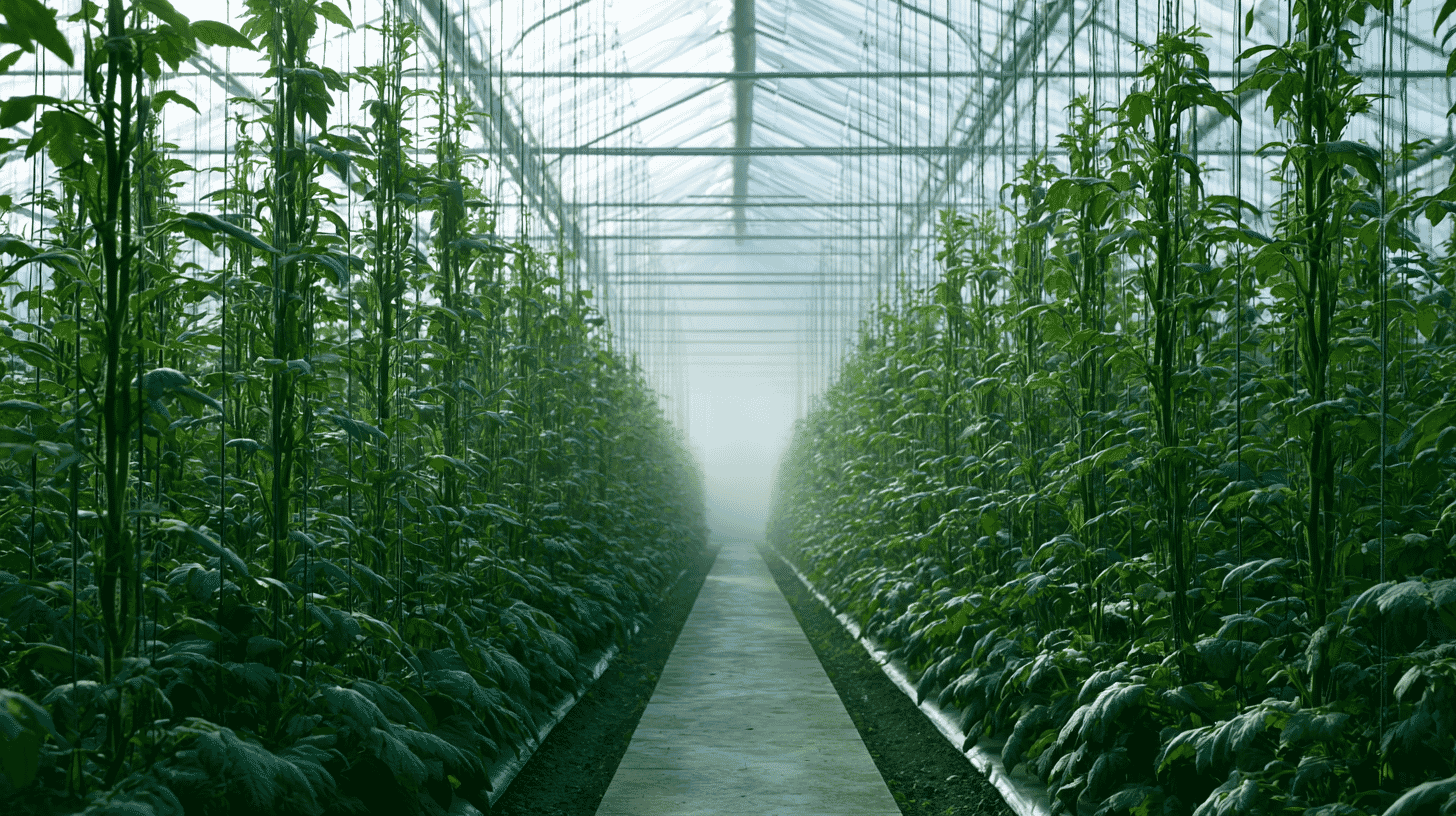
🍅 On September 25, 2026, the company that sells Japan's gene-edited "Sicilian Rouge High GABA" tomato opened one of its growing fields to visitors for the first time. The tomato is often called the world's first gene-edited food, but that "first" only holds under certain conditions, and those conditions explain why Japan was able to move early.
"World's first" comes with conditions
The field was opened by Sanatech Seed, the Tokyo-based company that sells the tomato. According to Japan's farm daily Nihon Nogyo Shimbun, it is a commercial growing field in Chiba Prefecture, and the paper's headline pointed to hopes that more farmers will start selling the fruit.
The first food made with gene editing (cutting a targeted spot in an organism's own genes to change how they work) to be sold commercially was not this tomato. On February 26, 2019, US company Calyxt made its first commercial sale of oil pressed from gene-edited soybeans, to the restaurant and food-service trade. In a release filed with the US Securities and Exchange Commission, Calyxt presented this as the first time a gene-edited food had ever been sold commercially.
What Japan's tomato can claim is narrower. In December 2021, Nature Biotechnology reported that, for the first time, a food made with CRISPR-Cas9, the gene-editing tool recognized by the 2020 Nobel Prize in Chemistry, had gone on general sale. Sales had begun that September. The developer's own description is the world's first crop made with CRISPR/Cas9.
Nothing was added. A brake was removed.
Genetic modification (GM), in the sense most people know, inserts genes from another organism. The editing in this tomato adds nothing from outside.
Tomatoes already make GABA, an amino acid, using an enzyme with a built-in brake. A University of Tsukuba research team led by Hiroshi Ezura cut into the part of the gene that encodes that brake so it stops working. Japan's national agricultural research agency, NARO, puts the edited tomato's GABA content at four to five times that of the variety it came from. Development and the government filing were handled by Sanatech Life Science, a University of Tsukuba spinout formerly called Sanatech Seed. Why university spinouts like this are multiplying in Japan is the subject of an earlier piece.
In Japan, GABA is often marketed as helping with blood pressure and stress. In November 2022, the tomato's filing as a "Food with Function Claims" was accepted, allowing four health claims on the label, including lowering blood pressure in people whose readings run high. Japan's Consumer Affairs Agency explains that this system involves no government review of whether a food works; companies file their own evidence and take responsibility for it. According to Scientific American, Sanatech does not say the tomato itself treats any condition.
Why Japan could move early
On October 1, 2019, Japan's health ministry launched a notification system for gene-edited foods. If no foreign DNA remains, the food skips the safety review that GM foods must pass. Developers consult with officials in advance, submit information, and can then sell. According to Nikkei, the notification itself is voluntary, with no penalty for skipping it.
On December 11, 2020, the tomato became the first food filed under this system. The Consumer Affairs Agency's list, updated August 12, 2026, now shows 13 filings, six of them tomatoes. Five products have reached the market: two tomato varieties, plus red sea bream, tiger puffer and olive flounder. The company behind those fish appears in our piece on Japanese food-tech startups.
Gene editing without foreign DNA would be treated like conventional breeding. Japan drew that line early, and the more natural reading is that the line, rather than anything else, is what let products reach the market early.
No label required
In Japan, gene-edited food does not have to be labeled as such. In 2019 the Consumer Affairs Agency gave its reason: when no foreign DNA remains, there is no practical test that can tell an edited mutation from one produced by conventional breeding, so nobody could check whether a label was accurate.
Sanatech labels its products voluntarily, noting that the variety came from gene editing and that the government filing is complete. The No! GMO Campaign, a Japanese citizens' group, argues that gene editing, too, can lead to genetic changes nobody intended, and that its safety has yet to be fully established.
The Council for Biotechnology Information Japan, a group whose stated purpose is to raise consumer acceptance of GM crops and related technology, surveyed 2,000 people in their 20s to 50s in October 2025. Of those, 58.2% said they knew nothing at all about gene-edited food. In the same group's 2021 survey, the figure was 51.2%. Four years after the tomato went on sale, awareness has not spread.
Europe has reached a similar answer
For years, the EU regulated gene-edited crops as strictly as GM crops. On June 17, 2026, the European Parliament gave final approval to Regulation (EU) 2026/1388 on new genomic techniques (NGTs). Plants judged equivalent to conventionally bred ones, called Category 1, will not need a food label; only seeds and other planting material must be marked. As of September 2026, the rules on selling these products are set to apply from July 17, 2028. That is close to how Japan already works. The European consumer group SAFE criticized the outcome, saying Category 1 plants will become invisible and undetectable and consumers will lose their freedom of choice.
In England, the Precision Breeding Regulations took effect on November 13, 2025. In the United States, a federal court vacated USDA's 2020 rule on biotech crops on December 2, 2024. According to the Congressional Research Service, oversight as of 2026 runs under the earlier regulations while revisions are considered.
Other countries have begun ruling on the tomato itself. According to Sanatech, the Philippines' agriculture department (announced by the company in May 2024) and the Singapore Food Agency (October 2025) each confirmed it falls outside their GM rules, and Health Canada concluded in May 2026 that it is not a "novel food."
Showing the field
Sanatech first sent seedlings to home gardens rather than fruit to stores, and in 2021 it gave free seedlings to more than 5,000 home gardeners who applied. Opening a commercial field is the next step, with the hope that more farmers will sell the tomato. With no labeling rule in Japan, how much to show is left to the people who grow and sell it.
Is gene-edited produce or fish already on sale where you live? And if it were, would anything tell you?
References
- https://www.agrinews.co.jp/news/index/408840
- https://www.sec.gov/Archives/edgar/data/1705843/000115752319000454/a51946820ex99_1.htm
- https://www.nature.com/articles/d41587-021-00026-2
- https://sanatech-seed.com/ja/blog/211026/
- https://www.naro.go.jp/laboratory/brain/contents/fukyu/episode/episode_list/135850.html
- https://www.scientificamerican.com/article/crispr-edited-tomatoes-are-supposed-to-help-you-chill-out/
- https://bio-sta.jp/news/administration/4156/
- https://www.caa.go.jp/policies/policy/food_labeling/foods_with_function_claims/index.html
- https://www.nikkei.com/article/DGXMZO49976870Z10C19A9000000/
- https://www.caa.go.jp/policies/policy/standards_evaluation/bio/genome_edited_food/list
- https://www.caa.go.jp/policies/policy/food_labeling/quality/genome/pdf/genome_190919_0003.pdf
- https://sanatech-seed.com/ja/20210915/
- https://gmo-iranai.org/?p=4749
- https://cbijapan.com/wp-content/uploads/2025/12/2025_CBIJ_Consumer_Survey_on_GM.pdf
- https://agenceurope.eu/en/bulletin/article/13890/17/european-parliament-approves-text-of-compromise-with-eu-council-on-new-genomic-techniques
- https://agrinfo.eu/book-of-reports/new-eu-rules-on-plant-genomic-techniques/
- https://www.safefoodadvocacy.eu/wp-content/uploads/2026/06/NGTs-ENVI-vote-plenary.pdf
- https://www.mofo.com/resources/insights/251125-uk-finalizes-precision-breeding-rules
- https://blog.aspb.org/policy-update-federal-judge-vacates-usda-rule-regulating-biotech-crops/
- https://www.everycrsreport.com/reports/IF11573.html
- https://sanatech-seed.com/en/240524-2/
- https://sanatech-seed.com/en/20251105-2/
- https://sanatech-seed.com/en/260514-2/
- https://agfundernews.com/sanatech-seed-brings-worlds-first-consumer-gene-edited-tomato-to-market








Global Discussion
0 comments