An 82-year-old man in northern Japan went under anesthesia while doctors aimed a laser at the cancer on his lip. The treatment was invented in a U.S. government lab in Bethesda, Maryland. Yet it is approved only in Japan, and in the United States the company behind it is still running the trial it needs to apply.
Hirosaki University Hospital in Aomori Prefecture has now used it on 17 patients over two years. Most saw their tumors shrink or disappear, though not all. Japan approved the treatment before large trials were finished, and those 17 cases show both sides of that choice.
From a spot on the lip to treatment with light
According to the regional newspaper Toon Nippo, the man, who lives in the Tsugaru region, noticed something like a wart on his lip in June 2025. A local clinic sent him to a general hospital, which passed him on to Hirosaki University Hospital. There he was diagnosed with lip cancer, and doctors judged that surgery was unlikely to remove all of it.
Instead, the hospital offered photoimmunotherapy, known in Japan as Alluminox treatment. In October 2025 he was put under anesthesia, a laser was aimed at the tumor, and the session was over in about an hour and a half. He told the paper it did not wear his body down. "It took a weight off my mind," he said.
Hirosaki first used the treatment in October 2024, on a patient with oral cancer. According to the paper, it was the first hospital in Aomori to do so and is still the only one in the prefecture that offers it.
A dye with bullet-train roots that bursts cancer cells
The drug has two parts. One is cetuximab, an antibody that latches onto EGFR, a protein found in large amounts on the surface of many head and neck cancer cells. The other is a dye called IR700, which is harmless in the dark.
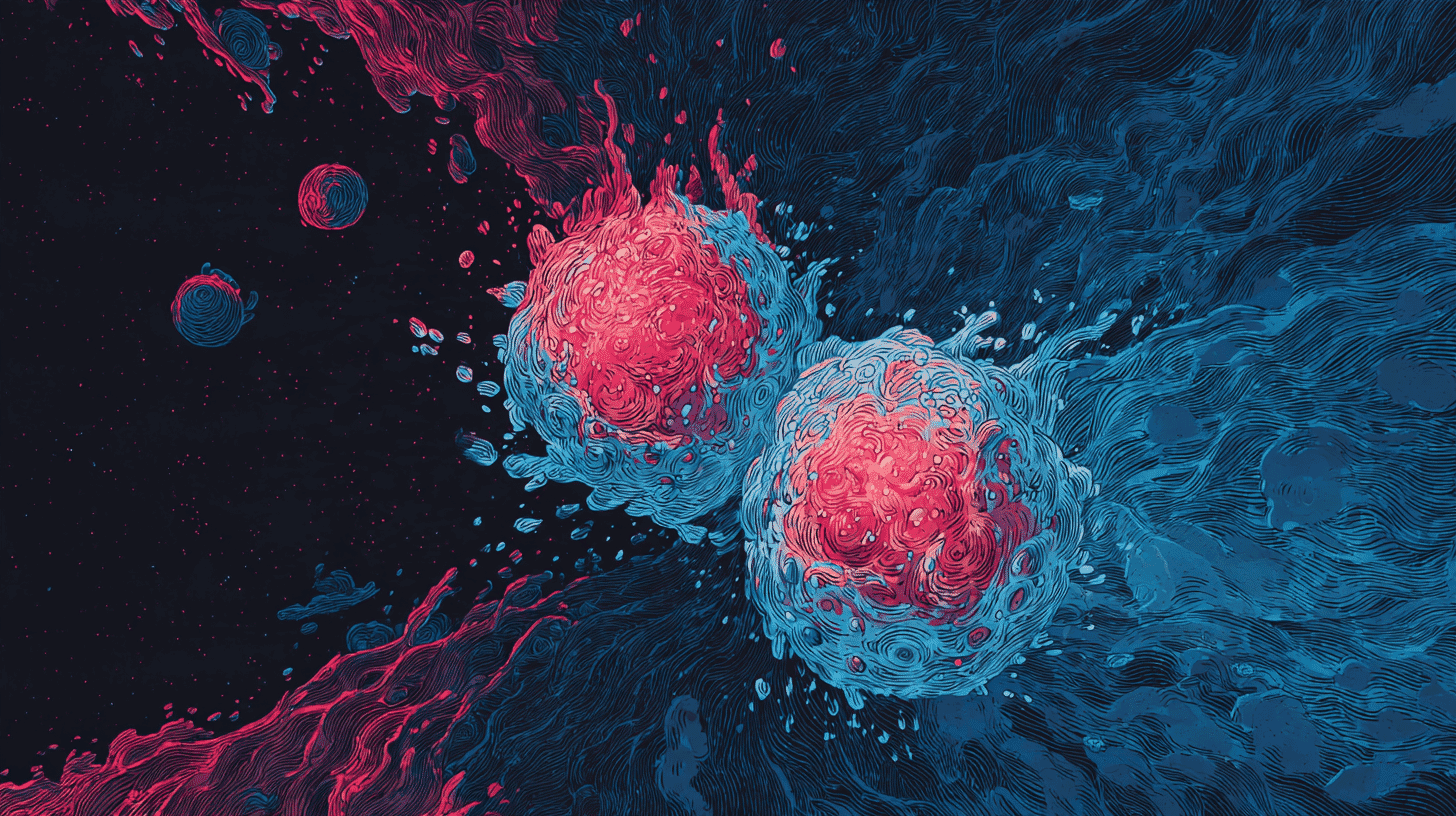
Patients receive the drug through an IV drip. Between 20 and 28 hours after the infusion, doctors deliver red light at 690 nanometers, right at the edge of the near-infrared range, through optical fibers. The light changes the dye's structure, and the membrane of the cancer cell it is stuck to fails. The cell swells and bursts. Healthy cells without the antibody attached are largely spared.
In a 2021 interview with the Kobe Shimbun, the treatment's inventor explained that IR700 is derived from phthalocyanine, the main ingredient of the paint used for the blue stripe on Tokaido Shinkansen bullet trains.
Because the cells burst open, they spill their contents. The inventor's lab at NIH says this may prime the immune system to attack cancer cells that survived, even some far from the treated spot. In patients, how much that effect matters is still being studied.
Invented in Maryland, approved first in Japan
The inventor is Hisataka Kobayashi, a senior investigator in the Molecular Imaging Branch of the U.S. National Cancer Institute (NCI). He told the Kobe Shimbun that in spring 2009, a researcher in his lab reported that a dye she was testing to make cancer cells glow kept killing them. Kobayashi was intrigued by how quickly the cells died. His team published the method in Nature Medicine in 2011.
The technique was patented and licensed to Aspyrian Therapeutics, a San Diego startup. In 2013, Rakuten founder Hiroshi Mikitani, searching for treatments after a family member was diagnosed with cancer, was introduced to Kobayashi and decided to back the clinical work. Aspyrian began the first human trial, in patients with inoperable head and neck cancer, in mid-2015. The startup was renamed Rakuten Medical in 2019, and Mikitani is now its CEO.
Japan was the first to act. In April 2019, the health ministry put the drug under its Sakigake ("pioneer") program, which speeds review of innovative medicines that companies plan to submit in Japan first. In May 2020, it was also placed under Japan's conditional early approval system. Introduced in 2017, that system covers serious diseases with few treatment options, where trials are hard to run or would take a very long time. It allows approval without results from a confirmatory trial, on condition that the company keeps studying the drug after it goes on sale.
The drug, Akalux, and its companion device, the BioBlade Laser System, were approved in September 2020 for unresectable locally advanced or recurrent head and neck cancer. Public health insurance began covering it in November 2020. As of May 2026, according to Rakuten Medical, it had not been approved by any regulator outside Japan.
How much evidence was there?
The review report from Japan's drug regulator, PMDA, shows what the approval rested on. The core evidence came from an overseas early-stage trial: in its main part, 13 of 30 patients (43.3%) saw their tumors shrink substantially or disappear. A Japanese study added data from 3 patients. Neither study had a comparison group.
So the approval came with conditions. The company had to track every patient treated until a set number had been collected, and to share results from a randomized Phase 3 trial that was already under way.
Those Phase 3 results were presented at the ASCO cancer conference in May 2026, according to Rakuten Medical. The trial enrolled 135 patients, well short of the 275 targeted in the 2020 review. All had failed at least two earlier treatments. On one main goal, the time before the cancer grew again, the two groups were almost identical: a median of 3.2 months with photoimmunotherapy and 3.1 months with standard care. On the other main goal, survival, the photoimmunotherapy group did better on paper, at a median of 15.7 months versus 9.6 months, but the company describes this as a numerical trend and did not report it as a statistically significant result. Severe side effects (grade 3 or higher) were more common in the photoimmunotherapy group, at 58.3% versus 36.4%. The company itself notes that the trial's small size, and the larger share of patients who left the comparison group, limit what it can show.
What 17 patients in Aomori can tell us
At Hirosaki, according to Toon Nippo, tumors disappeared in 6 of 7 patients in the oral and maxillofacial surgery department. The seventh was not cured even after several sessions and moved to systemic chemotherapy. In the otolaryngology–head and neck surgery department, tumors shrank in all 10 patients. Some vanished entirely, but in other cases they shrank only slightly or came back within a short time.
The professor heading the oral surgery department called it a strong treatment option. His counterpart in the ENT department said his team is studying what drives the differences in outcome and how to make the treatment work better.
Seventeen patients at one hospital, with no comparison group and short follow-up, can show whether tumors respond. They cannot show whether patients live longer than they would have with other treatment. Still, the report does not hide the cases that went badly. Conditional approval is built on records like these, gathered after a drug reaches patients.
As of September 2026, about 200 sites across Japan offered the treatment, about 500 doctors were trained to perform it, and it had been given about 1,600 times in total.
The long road back to America
In January 2026, Rakuten Medical raised $100 million to pursue US approval. It is running a global Phase 3 trial (NCT06699212), started in December 2024, that pairs photoimmunotherapy with the immunotherapy drug Keytruda (pembrolizumab) as a first treatment for recurrent head and neck cancer, with patients in the United States, Taiwan, Japan and Ukraine as of May 2026. As of January 2026, the company aimed to file for FDA approval in 2028.
Japan chose speed and accepted thinner evidence, betting that later data would back the choice. The randomized trial it asked for has not settled that bet yet.
If surgery could not remove your tumor, would you want this option now, or would you rather wait for the full answer? Where does your country draw that line?
References
- https://news.yahoo.co.jp/articles/74a8a86263b5a7e97065682816e99a953f784092
- https://irp.nih.gov/pi/hisataka-kobayashi
- https://doi.org/10.1038/nm.2554
- https://www.kobe-np.co.jp/news/sougou1/202111/0014858596.shtml
- https://www.kobe-np.co.jp/news/sougou1/202111/0014856542.shtml
- https://rakuten-med.com/us/news/press-releases/2019/02/28/6893/
- https://www.pmda.go.jp/review-services/drug-reviews/0045.html
- https://www.mhlw.go.jp/content/11123000/0000081011.pdf
- https://www.pmda.go.jp/files/000239770.pdf
- https://rakuten-med.com/us/news/press-releases/2020/09/25/7442/
- https://rakuten-med.com/us/news/press-releases/2026/05/30/7959/
- https://www.biospace.com/press-releases/rakuten-medical-raises-100-million-in-oversubscribed-series-f-to-accelerate-development-toward-u-s-regulatory-approval
- https://clinicaltrials.gov/study/NCT06699212







Global Discussion
4 comments