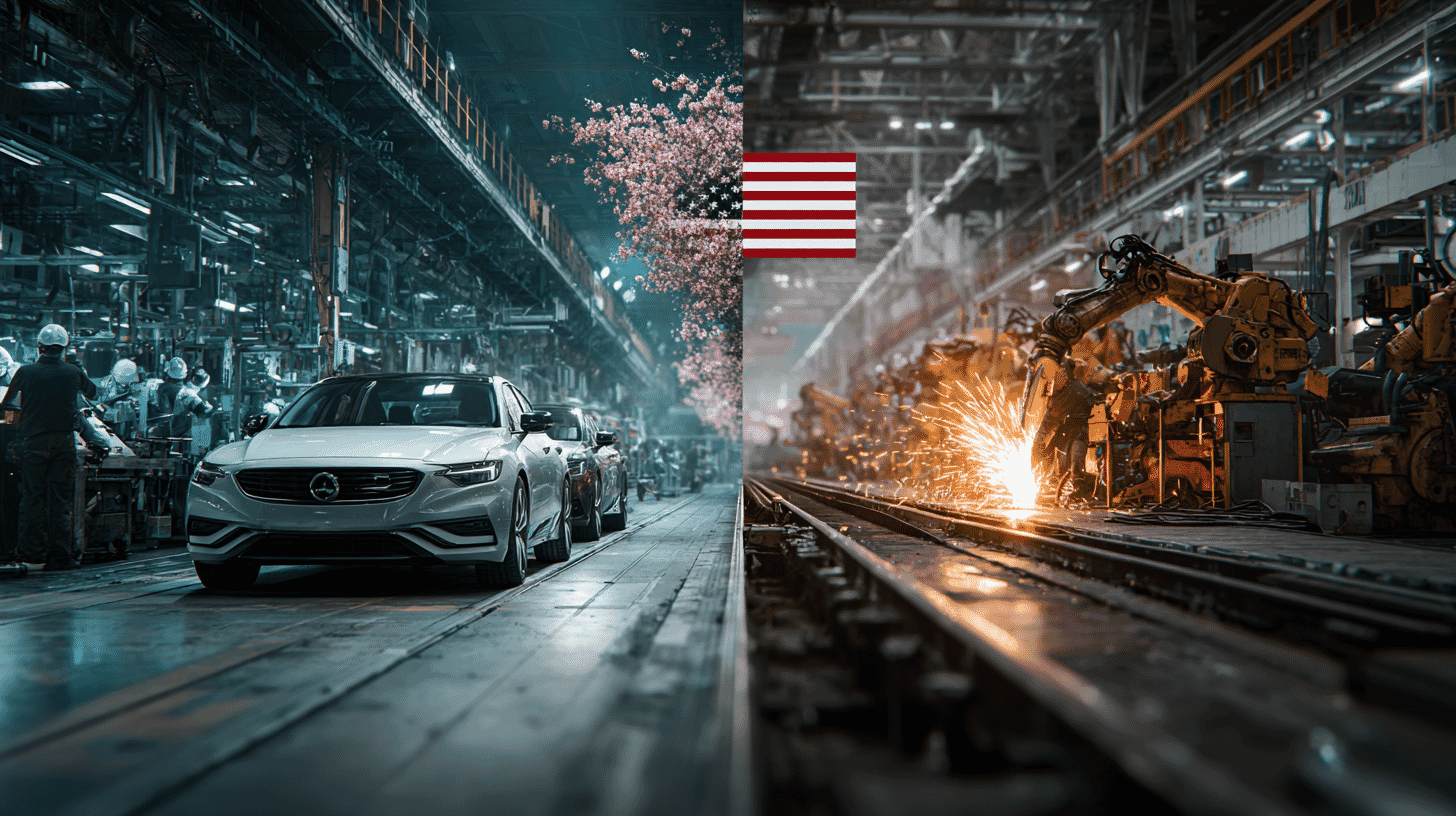
The Japanese car in your driveway may not be Japanese-built anymore. Prompted by the Trump administration's tariffs, Toyota, Honda, Nissan, and Subaru have all moved production to the United States. Behind the shift is roughly $35 billion a year in tariff costs across the industry, and a turning point that echoes the trade friction of the 1980s.
The Tariff Storm: What Happened
On April 3, 2025, President Trump imposed a 25% additional tariff on all automobiles imported into the United States. For Japanese passenger cars, this meant the rate jumped from 2.5% to 27.5% overnight. By May, the same tariffs were extended to auto parts.
After intense negotiations, Japan and the US reached an agreement on July 22, 2025. The surcharge was halved from 25% to 12.5%, bringing the total with the 2.5% base rate to 15%, effective September 16. But even at 15%, that's six times the original rate. In just the first half of fiscal 2025, Japan's top seven automakers absorbed a combined 1.4 trillion yen (roughly $9 billion) in tariff costs. Nissan, Mazda, and Mitsubishi all fell into the red.
For the full year of 2025, global automakers' tariff burden on US-bound vehicles totaled an estimated $35 billion (about 5.6 trillion yen).
How Each Automaker Is Adapting
Toyota: "Don't Panic," and Hold the Line at Home
Toyota President Koji Sato declared the company would "not act rashly" or make "knee-jerk decisions." Toyota exports about 500,000 vehicles annually to the US, but rather than scramble to relocate factories, the plan is to adjust export destinations in the short term while developing "locally suited products through local development and local production" over time.
Crucially, Toyota has committed to maintaining domestic production of 3 million vehicles per year. The company invested roughly $83 million in additional US capacity, but refuses to abandon Japan-based manufacturing. With US inventory at just 10 days' supply, and as low as 5 days for popular hybrids, Toyota's sheer demand gives it negotiating power that few competitors can match.
Honda: Civic and CR-V Shifted from Japan and Canada
Honda has moved most aggressively. The company relocated production of the Civic 5-door hybrid from its Saitama factory in Yorii-machi to its Indiana plant, effective June 2025. The decision came after only 3,000 units had been built domestically over two months, a rapid reversal of production plans.
The SUV CR-V is also being transferred from Canada to the US. Honda's stated goal is ambitious: within 2 to 3 years, 90% of its US sales will come from vehicles built on American soil. The estimated annual tariff cost for fiscal 2025 is 4,500 billion yen (approximately $30 billion), with operating profit expected to drop by 7,134 billion yen from the prior year.
Looking further ahead, the next-generation Civic hybrid will be produced in Indiana starting in 2028, not in Mexico as previously planned, with annual output of around 210,000 units.
Nissan: Rogue Moves from Kyushu to Tennessee, with an Eye on the Middle East
Nissan shifted a portion of its US-bound Rogue SUV production, roughly 10,000 units scheduled for May through July, from its Kyushu plant in Kanda-machi, Fukuoka to its Tennessee factory. The company estimates maximum tariff costs of 4,500 billion yen ($30 billion).
What's particularly noteworthy is Nissan's parallel strategy: while reducing US-bound production, the company is ramping up output of Middle Eastern-market vehicles at its Nissan Shatai Kyushu subsidiary. This "don't put all eggs in one basket" approach offers a pathway to protect domestic plants and jobs even as the American market becomes more expensive to serve from Japan.
Subaru: $270 Million Bet on US Forester Production
For Subaru, the US market accounts for roughly 70% of sales, making it perhaps the most US-dependent of all Japanese automakers. But of its approximately 680,000 US sales, only about 350,000 are built locally. The rest are imported from Japan, leaving Subaru maximally exposed to tariffs.
Without countermeasures, the annual tariff hit was estimated at $2.5 billion (about 3,600 billion yen). In response, Subaru began producing its flagship Forester SUV at its Indiana plant in fall 2025, investing roughly $270 million. The company also started building hybrid vehicles in the US for the first time, with shipments beginning in February 2026.
Mazda: Low US Production Ratio Means Maximum Pain
Mazda faces the toughest math. US sales of roughly 430,000 vehicles are supported by only about 100,000 units of local production. In April 2025 alone, tariff costs hit 9 to 10 billion yen ($60–70 million). The company swung to a loss, and began cutting sales incentives to cope. Without a significant US manufacturing base, Mazda's structural vulnerability remains a major challenge.
Echoes of the 1980s: History Repeating?
Japan's automakers first built large-scale US factories in response to the trade friction of the 1980s. Back then, Japan voluntarily limited exports through what were called Voluntary Export Restraints, or VERs. As an alternative, Honda opened the first Japanese-owned auto plant in America at Marysville, Ohio in 1982. Toyota partnered with GM to launch the NUMMI joint venture in California in 1984.
Four decades later, tariffs are once again driving production across the Pacific. But the situation is far more complex today. Modern vehicles contain roughly 30,000 individual parts, and supply chains built under the USMCA (the US-Mexico-Canada Agreement, successor to NAFTA) involve highly integrated cross-border production networks.
One senior automaker executive noted that even with 25% tariffs, importing from Japan is cheaper than producing 100% domestically in the US. The labor cost advantages of Mexico and Canada, which made USMCA-based production efficient, can't simply be reversed without driving up vehicle prices and fueling inflation, creating a double bind.
5.5 Million Japanese Jobs at Stake
According to the Japan Automobile Manufacturers Association, the domestic auto industry, including parts and materials suppliers, employs roughly 5.5 million people, about 10% of Japan's entire workforce. The sector's combined capital investment and R&D spending totals approximately $37 billion (5.5 trillion yen), representing about 30% of all manufacturing investment in Japan.
If automakers treat US tariffs as a permanent "new normal" and expand American production, Japanese domestic factories face downsizing pressure. In Kanda-machi, Fukuoka, a so-called "company town" built around Nissan, parts suppliers are already reportedly considering workforce reductions.
Yet the picture isn't simply one of hollowing out. Toyota's commitment to 3 million domestic units, and Nissan's pivot to Middle Eastern markets to keep Kyushu plants busy, suggest more nuanced strategies. Japanese government officials increasingly view US high tariffs as likely to persist regardless of which party holds the White House, making a coordinated national response essential.
Mexico and Canada: The Shifting "Third Option"
Under USMCA, Mexico and Canada served as crucial production bases for Japanese automakers. But tariff policy is altering that equation too.
Honda transferred CR-V production from Canada to the US. The next-generation Civic, previously slated for Mexico, will now be built in Indiana. At Mazda's Mexican plant, US-bound production has been curtailed, with workers seeing their shifts reduced.
USMCA itself is up for review starting in 2026, with discussions expected to focus on raising domestic content requirements and tightening qualification standards. Japanese automakers face the challenge of redesigning their entire North American supply chains.
One industry veteran likened the tariffs to a natural disaster. Toyota's refusal to panic, Honda's rapid transfers, Subaru's heavy spending, Nissan's diversification: the responses differ, but all rest on the same assumption, that there is no going back.
In your country, are automakers shifting production too? How are tariffs and trade policies affecting car prices and jobs where you live? We'd love to hear your perspective.
References
- https://toyotatimes.jp/toyota_news/financial_results_2025/007.html
- https://www.jetro.go.jp/biznews/2025/05/18eb10d8b5913fb5.html
- https://www.nippon.com/ja/in-depth/a10405/
- https://frontier-eyes.online/automobile_tariff/
- https://www.strategyand.pwc.com/jp/ja/publications/report/trump-20-impacts.html
- https://www.webcg.net/articles/-/53067






Global Discussion
13 comments