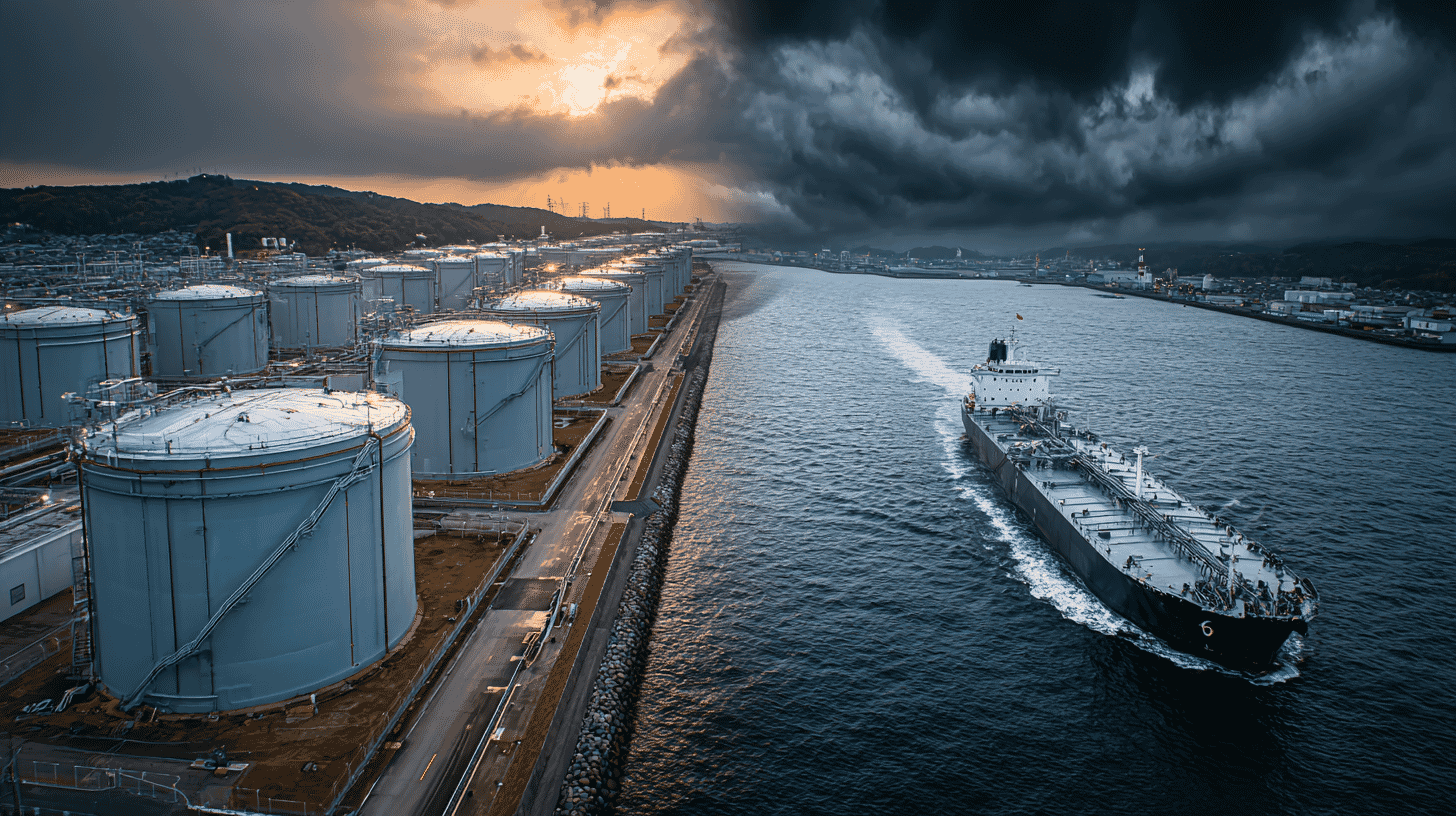
⛽ Japan has been stockpiling oil since 1978. For nearly half a century, it never seriously touched the pile. On March 26, 2026, it finally did. The Strait of Hormuz had been shut in all but name, and a country that gets more than 90% of its crude from the Middle East had to start spending its savings. Four months on, the strait has partly reopened and, this July, is closing again. So how many of those 254 days are left?
March 11: the IEA Approved a Record 400 Million Barrels
It started on February 28, 2026, when the United States and Israel struck Iran's nuclear and military sites, and reports came that Supreme Leader Khamenei had been killed. On March 2, Iran warned it would attack ships transiting the Strait of Hormuz. There was no formal closure declaration. Shipping companies simply stopped going, and the strait effectively stopped.
The strait is about 34 km wide at its narrowest. In normal times roughly 20 million barrels a day of crude and products pass through it, around a fifth of all seaborne oil trade. Traffic collapsed from March 1. By the end of March there were days with three vessels.
On March 11, the 32 member countries of the International Energy Agency agreed unanimously to release 400 million barrels from emergency stocks. It is the largest release in the IEA's fifty-year history, and the sixth coordinated release ever, after 1991, 2005, 2011 and two in 2022. The plan spreads it over roughly 120 days, adding about 3.3 million barrels per day to the market.
The split tells you the shape of the crisis. The United States put up 172 million barrels, 43% of the total. Japan put up 80 million, or 20%. Between them, over 60%. The same day, G7 leaders held an online summit chaired by France, with Japanese Prime Minister Sanae Takaichi attending.
The 254 Days Actually Opened
Japan's stockpile comes in three layers. National reserves, held directly by the state, cover 146 days. They sit at ten bases managed by JOGMEC, from Tomakomai in Hokkaido to Shibushi in Kagoshima, deliberately split across aboveground tanks, underground rock caverns and floating tanks. Private reserves, mandated by law on refiners and importers, cover 101 days. A joint stockpile arrangement, where Japanese tanks are leased to national oil companies of producing countries with priority supply to Japan in an emergency, adds 7 days. At the end of December 2025 the total was about 74.45 million kiloliters: 254 days.
On March 8, opposition lawmaker Akira Nagatsuma visited the national reserve base in Shibushi and revealed that the Agency for Natural Resources and Energy had already instructed JOGMEC to prepare for release. The instruction had gone out on March 6.
After that it moved fast. At a March 11 press conference, Takaichi said Japan would temporarily cut the private stockholding obligation from 70 days to 55 and release 15 days of private reserves plus one month of national reserves starting as early as March 16. Fuel subsidies began on the 19th. On the 24th the cabinet approved 800.7 billion yen from FY2025 contingency funds, of which 794.8 billion went into the gasoline subsidy pot.
The national release actually began on March 26. The first tranche was about 8.5 million kiloliters, roughly 540 billion yen worth, about one month of domestic demand. It came out of eleven bases, taken up by ENEOS Holdings, Idemitsu Kosan, Cosmo Energy Holdings and Taiyo Oil. Roughly five days' worth of the joint stockpile also went to market in March. A second tranche followed at about 5.8 million kiloliters. Then in May, the energy agency said there would be no third.
Economy minister Ryosei Akazawa had framed the release as not about suppressing prices but about securing stable supply when supply falls short.
Why Japan Is Uniquely Exposed
According to METI statistics, the Middle East accounted for 93.5% of Japan's crude imports in 2025: the UAE at 42.3%, Saudi Arabia at 39.8%, Kuwait at 6.0%. The Petroleum Association of Japan puts the share of crude imports transiting Hormuz at about 73.7% as of 2023. Energy self-sufficiency runs around 13%, and 99.7% of oil is imported.
The comparison with the US sharpens it. The American SPR held roughly 415 million barrels in mid-March. Take out 172 million and about 243 million remains. But the US became a net energy exporter on the back of shale, so a drained reserve still leaves domestic production as an exit. Japan has no exit. The stockpile is the last card.
Looking for a Road That Skips Hormuz
Running alongside the release was a scramble for routes around the strait. There are essentially two. A 1,200 km pipeline carries Saudi crude from the eastern fields to Yanbu on the Red Sea. The Habshan-Fujairah line, ADCOP, takes Abu Dhabi crude to Fujairah on the Gulf of Oman side.
On March 28, the first tanker to reach Japan without passing through Hormuz arrived, apparently from Yanbu. April 5 brought one from Fujairah, and April 25 one from outside the Middle East entirely. As of May, the Takaichi government said alternative routes had secured a path to roughly 60% of pre-conflict crude volumes.
The IEA estimates the spare capacity of the Saudi and UAE bypass pipelines at 3.5 to 5.5 million barrels a day combined. Against the 20 million that used to move through the strait, that is not close. And a pipeline or port is itself a target.
Gasoline Never Hit 328 Yen. But
Early in the crisis a forecast circulated that a prolonged conflict would push gasoline to 328 yen per liter. It didn't happen. On June 1 the national average for regular was 169.5 yen. The subsidy applied for June 4 through 10 was 33.3 yen per liter, which is how Takaichi's stated line of holding prices to 170 yen has survived so far. The subsidy is doing the work, not cheap crude.
The pain surfaced elsewhere. Naphtha, the feedstock for plastics and synthetic fibers, is not subsidized. Supply tightened, domestic chemical makers cut ethylene output, and shortages and price spikes hit downstream goods like garbage bags and cling film. Electricity lags. Nozomu Mori, chairman of the Federation of Electric Power Companies, said in an April interview that the fuel spike would likely show up properly in July and August bills.
The strait itself has been a rollercoaster. The April 8 US-Iran ceasefire dropped WTI from $117.63 to $91.05, then Israel struck Lebanon and Iran declared the strait closed again. On April 12, Trump announced a "reverse blockade." The Islamabad memorandum, signed remotely by Trump and Pezeshkian on June 17, provides for 60 days of toll-free transit, mine clearance within 30 days and the lifting of the US naval blockade. It is not a peace agreement. By July 2 WTI was back to $67, its level before the war started in late February.
That was not the end. On July 6, ten Japan-linked merchant ships, mostly managed by Mitsui O.S.K. Lines, finally left the strait after months stuck inside the Gulf. Six were VLCCs carrying about 12 million barrels of Middle East crude loaded back in late February and early March. The next day, a Qatari LNG carrier and a Saudi-flagged tanker were hit. On the 12th Iran declared the strait closed again and the US struck back. On the 13th, Trump claimed a 20% transit fee on all cargo through the strait and announced the reimposition of the blockade on Iranian ports. WTI climbed back to $78, touching $79 in Tokyo trading on the 14th.
Reserves shrink when you use them. Japan has already released a month and then twenty days, and passed on a third round in May. Alternative routes have plateaued around 60%. The strait keeps opening and closing. The half-century of savings is still holding. But nobody can yet say this is over.
How does your country plan for the day energy stops arriving? Stockpiles, diversified suppliers, or is domestic production enough that the question never comes up?
References
- https://www.jiji.com/jc/article?k=2026031101201&g=int
- https://www.jetro.go.jp/biznews/2026/03/4f6286734e8c5901.html
- https://www.enerdata.jp/publications/energy-news/iea-oil-release-japan-80m.html
- https://www.nri.com/jp/media/column/kiuchi/20260325.html
- https://www.nri.com/jp/media/column/kiuchi/20260501_2.html
- https://www.nri.com/jp/media/column/kiuchi/20260714_2.html
- https://www.jiji.com/jc/v8?id=202604hormuz-team
- https://www.smd-am.co.jp/market/ichikawa/2026/04/irepo260409/
- https://www.bk.mufg.jp/report/whatsnew/report_20260403.pdf





Global Discussion
14 comments