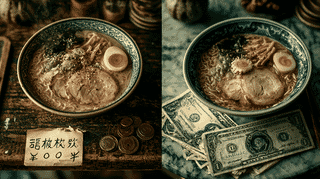
Behind Umitamago aquarium in Oita, a hose dispenses 120 liters of filtered seawater for 100 yen. Izakayas and home aquarists buy it, and one restaurant's remark kept the machine alive.
The IMF projects Japan will fall to sixth by nominal GDP in 2027, behind India and Britain, yet the gap to Britain is roughly 0.5%. The weak yen explains the ranking; it does not explain Japan's slow real growth.
Japan's competition watchdog searched Asahi, Kirin, Suntory and Sapporo on October 7, 2026, over suspected coordination of wholesale beer prices. Nothing is proven. How would Europe or the US punish it?
Minoru Kiuchi, Japan's economy minister and long seen as a reflationist, says Abenomics-style reflation is over. The BOJ was already at 1.25%. Yet Japan still hasn't declared deflation over.
Japan had 2,730 sento left at the end of fiscal 2024. Under a 1946 ordinance, prefectures still cap their prices, and Tokyo calculates its cap like a utility rate. It rose to 600 yen in August 2026.
Seven in ten Japanese bookstore companies were profitable in fiscal 2025, but only 13.4% grew both sales and profit, on a 0.6% margin. What lifted the numbers, and why bookshops are multiplying in the US and Britain.
Japan lost about 1.9 million dogs in twelve years, yet its pet market grew to 12.7 billion dollars in fiscal 2025. Shipment tables show dog food going from 397 to 811 yen per kilogram.
Sushi shop bankruptcies in Japan rose 45.5% in the first half of 2026, yet only 18.8% were losing money, the lowest in Teikoku Databank's 20 years. They are not failing. They close because nobody takes over.
Japan's calorie-based food self-sufficiency fell to a record-low 37% in fiscal 2025 while the production-value measure rose to 66%. A 48% rise in rice prices moved both. By production value, Japan ranks above the US.
Japan bought yen without warning on July 30, moving the currency five yen in an hour. The BOJ then held at 1% and warned inflation could overshoot, as Washington and Seoul moved too.
Japan saw a record 36 ramen shop bankruptcies in the first half of 2026. While the world pays $18 a bowl, shops in ramen's homeland collapse against a cultural price ceiling of 1,000 yen (about $6). Here is the structural squeeze behind the paradox.
Japan's antitrust regulator raided six major ice cream makers over an alleged price-fixing cartel. Among them: Akagi Nyugyo, the maker of Garigari-kun, a company beloved for theatrically apologizing over a 10-yen price increase. Here is what the probe alleges and why it stings.
On June 16 the Bank of Japan raised its policy rate to 1.0%, the highest in 31 years, with Governor Ueda hospitalized and absent. We unpack the 7-1 vote, the lone hiker among major central banks, the still-weak yen, and Japan's swelling debt-service bill.
Japan's PM Takaichi wants to scrap food consumption tax for two years, but POS vendors say the register overhaul takes a year. Why does changing a number take so long? We compare Japan's tangled POS systems with the US, where a tax change takes an afternoon. The twist: America's speed is a side effect of its chaotic tax code.
PM Takaichi met BOJ Governor Ueda on May 22 and asked the central bank to carry out 'appropriate policy.' We explain Japan's central bank independence next to the US Fed and the ECB, and how a weak yen near 159 and the carry trade tie this to global markets.
On the afternoon of May 14, Japan's 10-year government bond yield hit 2.625%, the highest since 1997. OIS markets now price a 74% probability of a rate hike at the June 15-16 BOJ meeting. BOJ board member Kazuyuki Masu, previously considered cautious, said in a Kagoshima speech that 'early rate hikes are desirable.' With US PPI surprise, USD/JPY near 158, and 'long rates at 3% in sight,' we map where Japan's FX, bond, and rate-hike expectations stand right now.
Nintendo sold 19.86 million Switch 2 units in about ten months, the fastest start of any hardware it has made. On the same day, it announced a 10,000 yen price hike for Japan effective May 25, plus $50 increases in the US and Canada from September 1. Japan's 20% jump beats the 11% in the US and lands nearly four months sooner. Why Japan went first and hardest: AI-driven memory prices, a weak yen, and an arbitrage gap that made the domestic model a reseller target.
Reuters reported that Japan conducted multiple yen-buying interventions during the May Golden Week, exploiting thin holiday liquidity. Market estimates put the total at roughly 10 trillion yen including the April 30 operation; the Ministry of Finance later confirmed 11.7349 trillion yen, a record for a yen-buying episode. Vice Finance Minister Mimura said IMF rules do not constrain intervention frequency. Within a month the effect had faded and the yen was back at 161 to the dollar.
The BOJ released its March 18-19 meeting minutes on May 7. The deliberation sections are anonymous, but votes and dissenting opinions are published with names attached. The 8-1 split? Hajime Takata alone dissented. We trace the 9 members behind the March meeting, the shift to a 6-3 split in April, and the rebalancing coming when Nakagawa's term ends in late June.
Private estimates put Japan's April 30 yen-buying intervention at 5 to 5.4 trillion yen, derived from the gap between the BOJ's current-account forecast and money brokers' projections. What that bazooka means in practice: a 190bp US-Japan rate gap, a yen carry trade starting to unwind into emerging markets, and the political constraint of the US Treasury's monitoring list.