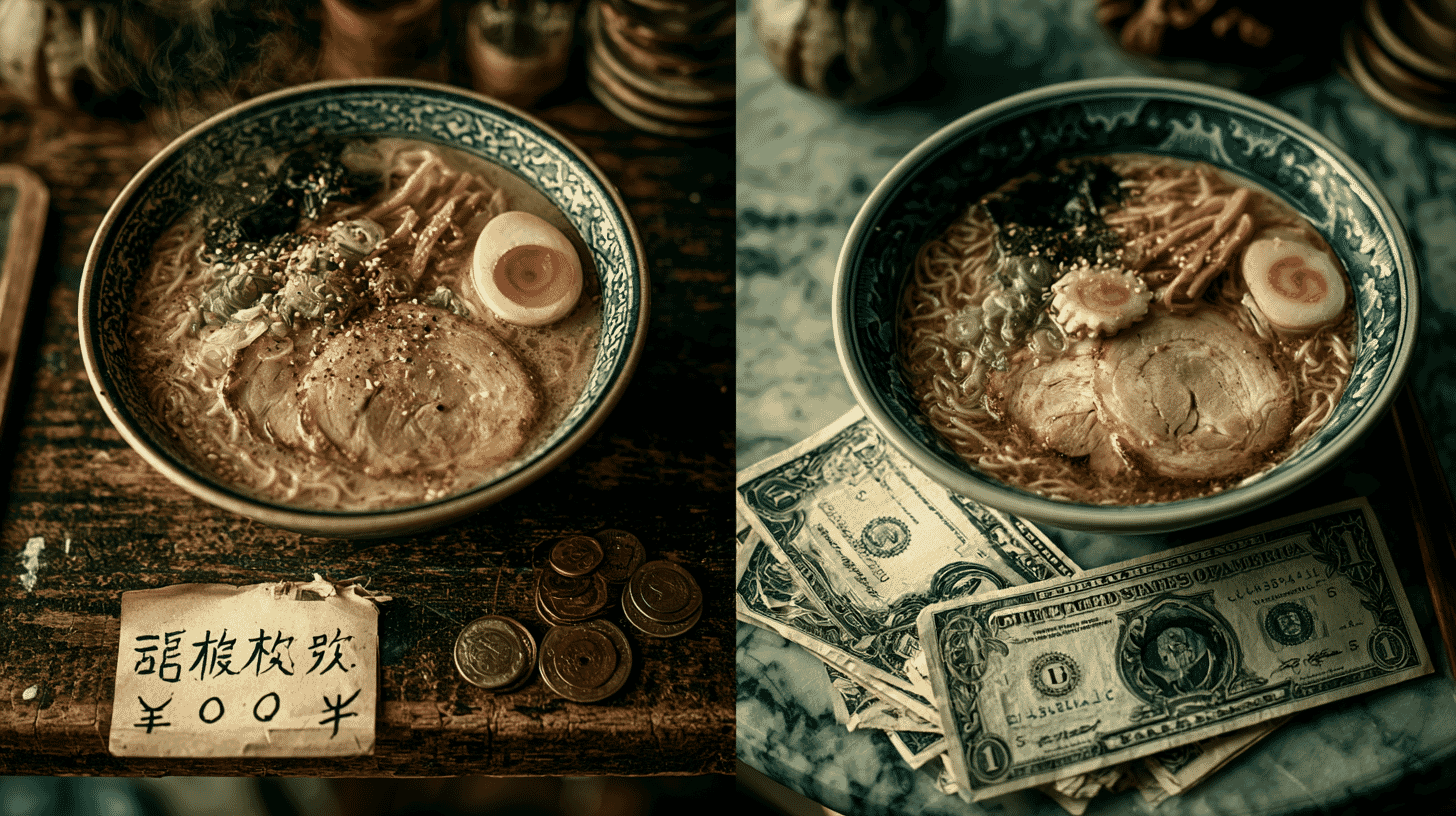
🍜 The world has never loved ramen more. New York lines up for $18 bowls, the global ramen market is worth tens of billions of dollars, and Japanese chains keep getting requests to open abroad. Meanwhile, in ramen's homeland, shops are going under at a record pace: 36 bankruptcies in the first half of 2026 alone, the most ever recorded. The reason isn't that Japanese people stopped eating ramen. It's that they refuse to pay more than about $6 for it.
A record first half, driven by the smallest shops
According to credit research firm Tokyo Shoko Research (TSR), 36 ramen shop operators went bankrupt between January and June 2026, up 44.4% from the same period last year, and the highest first-half figure since the firm began tracking the category in 2009. The previous record, 33 cases, was set in 2024.
Look closer at the numbers and a pattern emerges: this is a wipeout of the little guys. Bankruptcies with liabilities under 100 million yen (about $620,000) accounted for 31 of the 36 cases, over 86% of the total. The average debt per bankruptcy actually shrank, from roughly 66 million yen (about $410,000) a year earlier to 41 million yen (about $250,000). In other words, more shops are failing, but each failure is smaller. The tiny, family-run counter joints, the kind of place with eight stools and a hand-written menu, are the ones disappearing.
The mode of failure tells the same story. Of the 36 cases, 35 were straight liquidation bankruptcies; only one shop attempted court-supervised restructuring. When a small ramen shop runs out of road in Japan today, there is usually nothing left to rebuild.
The single largest cause in TSR's breakdown is weak sales, at 28 cases (up 27.2%), or 77.7% of the total. Two other categories set records: bankruptcies attributed to rising prices hit 10 cases (up 66.6%), and those attributed to labor shortages reached 5 (up 25.0%), both first-half highs. Behind them sits a yen that has weakened to around 162 to the dollar and energy costs pushed up by instability in the Middle East, both of which feed directly into the price of imported wheat, pork, and the gas burners that keep broth simmering for hours on end.

Source: Wikimedia Commons (public domain)
The 1,000-yen wall: why a $6 bowl can't get more expensive
To understand why ramen shops fail while ramen itself thrives, you need to understand one phrase that every shop owner in Japan knows: sen-en no kabe, the 1,000-yen wall.
Ramen occupies a specific place in the Japanese psyche. It is the people's food: fast, hot, filling, and cheap. For decades, an unwritten rule held that a bowl should cost less than 1,000 yen, about $6.20 at today's exchange rate. Cross that line, and customers don't complain. They simply stop coming.
The problem is that the cost side of the business has ignored the rule entirely. Teikoku Databank, another major credit research firm, calculates a "ramen cost index" tracking the total ingredient cost of a typical tonkotsu bowl in Tokyo. With 2020 as the baseline of 100, the index reached 141 in 2025, a roughly 40% jump in five years, spanning everything from wheat and pork bones to green onions and energy.
A business whose costs rose 40% while its ceiling price stayed frozen has exactly two options: absorb the losses or break the taboo. Many shops that raised prices past 1,000 yen found that customers judged them ruthlessly. TSR notes that once a bowl crosses the line, diners expect the flavor, toppings, and service to justify every yen, and shops that can't deliver that "premium feeling" watch their regulars drift to the cheap gyudon chain next door.
Pause on how unusual this is. In most countries, restaurants pass inflation on to customers as a matter of course. In Japan, where consumer prices barely moved for three decades, a price hike still reads as a betrayal, especially for a working-class staple like ramen.
Who survives: chains, ramen towns, and the death of the artisan model
Not everyone is losing. In fact, the ramen market itself is growing: Teikoku Databank estimates it reached about 790 billion yen (roughly $4.9 billion) in fiscal 2024, 1.6 times its size a decade earlier. People aren't eating less ramen. The money is just flowing to different kinds of shops.
Update: in a survey released on July 1, 2026, the same firm put fiscal 2025 at a record 885.5 billion yen (about $5.5 billion), up 11% year on year, and said the market could reach a trillion yen as early as fiscal 2027. Combined net profit, meanwhile, fell to 17.1 billion yen from 35.6 billion a year earlier, roughly a halving. Record revenue, half the profit: the paradox is widening.
Teikoku Databank describes the shift as a move from "individual" to "collective" combat. The classic model, a master craftsman perfecting a broth through years of trial and error, running a shop on skill and stamina, is giving way to capital-backed chains armed with central kitchens, cashless ticket machines, and simplified operations. Soupless noodle formats (mazesoba and abura soba), which skip the most expensive and labor-intensive component of ramen entirely, are expanding for exactly this reason. Some operators have gone the opposite direction, selling 3,000-yen-plus bowls as a "premium experience" for tourists and enthusiasts. What's vanishing is the middle: the honest neighborhood shop charging 900 yen.
There's also a geographical wrinkle. TSR's regional data shows bankruptcies concentrated in Kanto (13 cases), Kinki (10), and Tohoku (6, a sixfold jump). But regions with famous local ramen cultures (Toyama, Tokushima, Fukuoka) recorded notably few failures, and TSR reads this as a sign of resilience. Where ramen is local identity rather than commodity lunch, customers seem more willing to pay what it actually costs.
The consolidation is accelerating. Larger restaurant groups and investment funds have begun acquiring struggling independent shops, keeping the recipes and the branding while injecting back-office efficiency. Teikoku Databank predicts a "ramen conglomerate" era, in which shops focus on flavor while a corporate core handles procurement, systems, and scale.
Abroad, the same bowl sells for triple
Now for the part that makes this story genuinely strange. Everything that is killing ramen shops in Japan is absent overseas, because overseas, the 1,000-yen wall doesn't exist.
In New York, a basic bowl at Ichiran's outpost starts around $18 before tax and tip; bowls in the low twenties are unremarkable across Manhattan. That is roughly triple the psychological maximum in Tokyo, for a product that costs broadly similar amounts to make. Global demand keeps climbing: market researchers project the worldwide ramen category (including instant noodles) to grow from about $58 billion in 2025 toward $85 billion by 2030, and Ichiran itself has reported a steady stream of requests for new international locations.
The result is a brutal asymmetry. A shop that stays in Japan fights for survival at $6 a bowl. A brand that crosses the ocean sells the same craft at premium-dining prices to customers who consider it a bargain. The weak yen sharpens the contrast further, every dollar earned in New York is worth more yen than ever, while every imported ingredient bought in Japan costs more yen than ever. The exchange rate that squeezes the domestic shop is the same one that fattens the exporter.
None of this means Japanese ramen is dying. As a cuisine and a global brand, it has never been stronger. What is dying is a specific business model: the independent artisan selling world-class food at street-food prices to a public that refuses to pay restaurant prices for it. The bowls will survive. Many of the people who perfected them may not.
Japan's unwritten rule says a bowl of noodles should never cost more than 1,000 yen, no matter what happens to wheat, pork, or gas prices. Is there a dish in your country with an invisible price ceiling, one that people simply refuse to pay more for, even as everything else gets expensive?








Global Discussion
4 comments