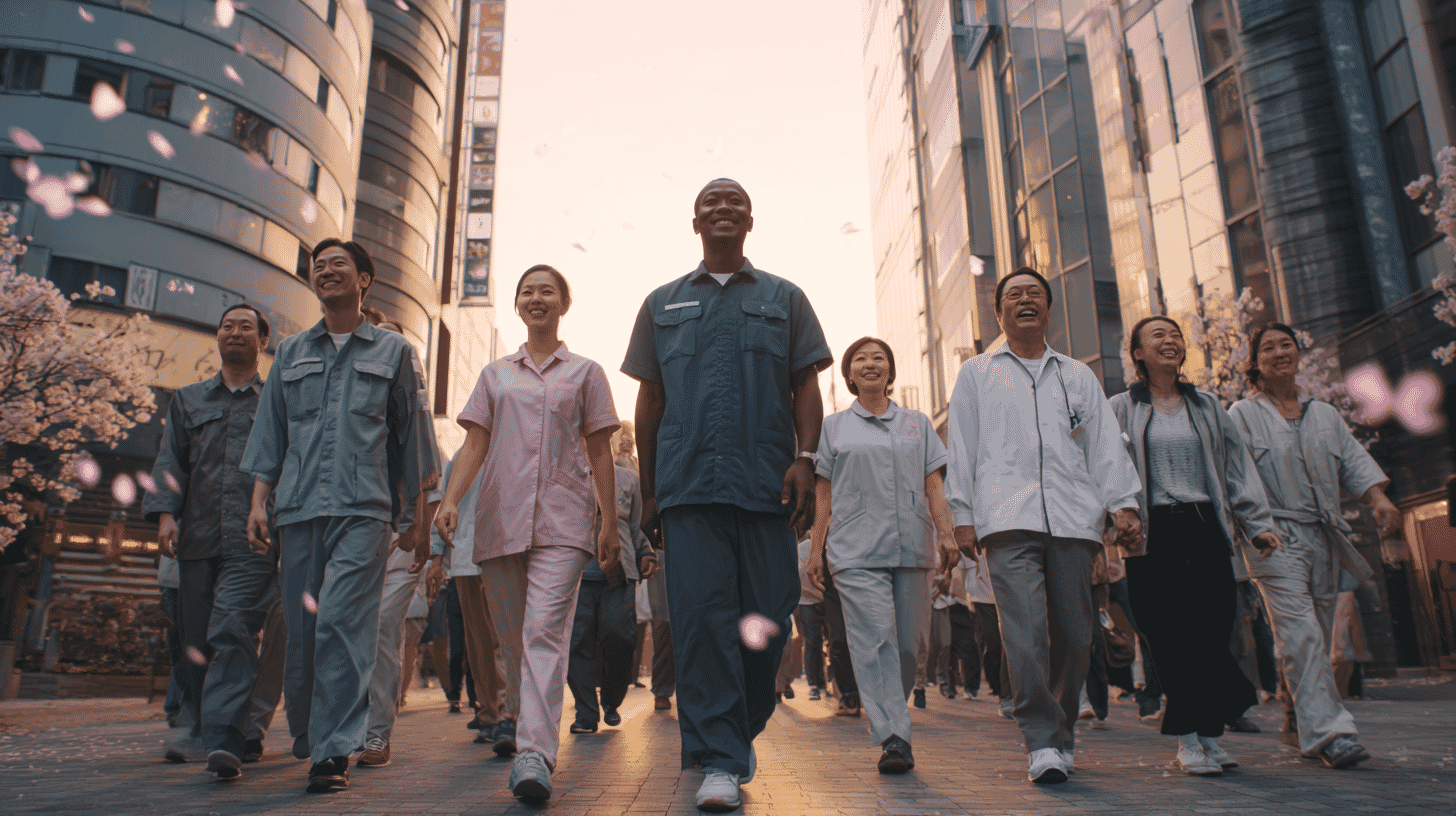
On January 23, 2026, the Japanese government approved by cabinet decision an operational policy capping foreign worker intake at 1,231,900 through the end of fiscal 2028. The breakdown: 805,700 across 19 fields under the existing Specified Skilled Worker (i) status, and 426,200 across 17 fields under Ikusei Shūrō, the new system starting April 2027. It is the first time a ceiling including the new program has been published.
What matters is that this is not an expansion. The Specified Skilled Worker (i) cap had been 820,000 across 16 fields. Three fields were added, bringing it to 19, and yet the number was revised down to 805,700, the first downward revision ever, after factoring in productivity gains from IT. The 426,200 for Ikusei Shūrō also comes in below the roughly 450,000 technical intern trainees in Japan as of the end of June 2025. Commentators read the tightening as the imprint of Prime Minister Sanae Takaichi's administration and its emphasis on stricter residency management.
The gap between ceiling and reality is wide. As of the end of June 2025, about 330,000 people held Specified Skilled Worker (i) status, and only about 3,000 held (ii). A government official put it plainly: 1.23 million is a ceiling, and nobody expects foreign worker numbers to surge.
Meanwhile, the labor market keeps shifting. As of October 2025, foreign workers in Japan numbered roughly 2.57 million, a record. That is about one in every 29 workers. In 2009 it was one in 112. Fifteen years rewrote the picture.
The 19 fields include nursing care, construction, industrial products manufacturing, food and beverage manufacturing, food service, accommodation, and agriculture. Three were newly added: linen supply (laundering and managing linens for hotels and hospitals), logistics warehousing, and resource circulation, meaning recycling. The largest single field, industrial products manufacturing, gets 200,000 under Specified Skilled Worker plus 120,000 under Ikusei Shūrō, for 320,000 total.
The cap is not decorative. On March 27, 2026, the Immigration Services Agency announced that new intake for Specified Skilled Worker (i) in food service would be suspended in principle from April 13, because the number of residents in that field was set to hit its 50,000 ceiling. The door really does close.
Why Japan Scrapped Its Trainee Program
To see what the new system is for, look at what the old one did.
Created in 1993, the Technical Intern Training Program was officially about international contribution: learn Japanese techniques, take them home. In practice it functioned as a pipeline of cheap labor for companies short on staff.
The core problem was that changing employers was, as a rule, forbidden. Interns placed in terrible workplaces had nowhere to go. Unpaid wages, brutal hours, confiscated passports. Reports came from all over the country, and thousands of interns disappeared every year. Workplace injuries and fatalities among foreign workers have kept climbing.
The international response was harsh. The US State Department has criticized the program repeatedly in its annual Trafficking in Persons Report, noting the system is abused to exploit foreign workers, and has placed Japan in Tier 2, the second of four rankings. UN committees have raised similar concerns.
Fees paid to sending organizations before departure can reach around one million yen (roughly $6,500) for Vietnamese workers. You arrive in Japan already in debt, which means you stay no matter how bad it gets. That structure is what earned the "modern trafficking" label.
What's Actually Changing Under Ikusei Shūrō
Launching in April 2027, Ikusei Shūrō is created by what the government calls the developmental dissolution of the intern program. Technical intern training is abolished at the same time, and transfer into Ikusei Shūrō is not permitted as a rule. Transitional measures keep some interns in Japan, but their numbers taper off.
A change of purpose: The pretense of international contribution and technology transfer is dropped. The stated goals are workforce development and workforce securement. For the first time, the system design admits that Japan needs foreign workers as labor.
Freedom to change jobs: Prohibited under the old system, transfers become possible under conditions. After one to two years at the same company (the restriction period is set per industry) and passing a basic skills test and a Japanese language test, workers may move within the same field at their own initiative.
Language requirements: Entry requires JLPT N5 or equivalent, the level of basic greetings and simple conversation. Moving to Specified Skilled Worker (i) requires N4, and (ii) requires N3.
A long-term career path: Ikusei Shūrō (three years) to Specified Skilled Worker (i) (up to five years) to Specified Skilled Worker (ii), which carries no residency limit and permits family accompaniment. Meet the conditions and permanent residency opens up.
Higher costs for employers: Travel costs and part of the sending organization fees, previously borne by the worker, shift to the company. The added cost is estimated at roughly 500,000 to 1 million yen (about $3,200 to $6,500) per worker per year.
The Rural Drain Dilemma
Freedom of movement is a real gain for worker rights, and it creates a new problem: foreign workers concentrating in cities with higher wages and better infrastructure, leaving rural labor shortages worse.
The government designated major metropolitan areas including Tokyo, Osaka, Nagoya, and Yokohama as non-designated zones, capping the share of transferring workers they can absorb at one-sixth of all Ikusei Shūrō workers. Strong rural employers get incentives in the form of larger intake quotas.
Whether that holds is unknown. Moving toward better pay and better living conditions is what people do, and system design alone is a thin instrument for keeping anyone in the countryside.
The Language Challenge
Language requirements enter the system for the first time. They are also its hardest problem.
N5 at entry is very basic Japanese, nowhere near enough to do a job. Understanding safety instructions, talking to colleagues, running a daily life: all of it takes language. Companies are obligated to support Japanese education, which lands heavily on smaller firms in both money and staff time.
Plain Japanese initiatives and online learning tools are part of the answer, but this needs public and private effort together.
How Japan Compares to Other Countries
South Korea: Employment Permit System (EPS)
South Korea abolished its own trainee scheme in 2004 and introduced the Employment Permit System. Its defining feature is cutting out private brokers: the government directly runs recruitment, selection, and placement. Migration costs for workers fell sharply, and the system won a United Nations Public Service Award in 2011.
Japan's Ikusei Shūrō keeps an intermediary layer in the form of supervising support organizations, which puts it behind EPS on transparency. That said, EPS limits job transfers too and is not a complete answer on worker protection.
Singapore: The Levy System
Singapore charges employers a monthly levy for each foreign worker, varying by sector and skill level, using economic incentives to keep firms from leaning too hard on foreign labor. It also sets a Dependency Ratio Ceiling on the share of foreign workers per industry.
Managing through market mechanisms is efficient, but Singapore shows little interest in career progression or social integration, treating foreign workers as temporary by design. That Ikusei Shūrō opens a road to permanent residency is the opposite approach.
Germany: The Integration Model
Since its 2005 immigration law, Germany has mandated integration courses combining language and civic education, packaging German lessons with instruction in history, culture, and legal institutions, and supporting integration as a matter of policy.
Japan's new system takes language seriously, but nothing like Germany's systematic civic curriculum exists. Designing for arrival as a member of society, not just as labor, is the work ahead.
The Lives Behind the Numbers
1.23 million is a design ceiling, not a target. But foreign workers in Japan are projected to reach 3.77 million by 2035, which makes coexistence unavoidable as a subject.
At the same time, Japan is tightening the entrance. On March 10, 2026, the cabinet approved amendments to the immigration law raising the ceiling on residence status change and renewal fees from 10,000 yen to 100,000 yen, the permanent residency permit fee ceiling from 10,000 yen to 300,000 yen, and creating JESTA, a pre-travel online screening system. Intake and control are advancing simultaneously.
Whether the new system actually protects workers' rights, sustains regional economies, and restores international trust depends on how it is run. Changing the law is not enough. The test is workplace treatment, community acceptance, and whether the idea that foreign workers are valued colleagues takes root.
Japan is at a turning point on foreign labor. What policies does your country have for accepting foreign workers? If something is working, or clearly is not, we'd love to hear about it.
References
- https://www.nikkei.com/article/DGXZQOUA2307B0T20C26A1000000/
- https://news.yahoo.co.jp/articles/e7f9cd249601e9b1fb86342f577a9d6fcf07eda9
- https://www.moj.go.jp/isa/applications/faq/ikusei_qa_00002.html
- https://www.mhlw.go.jp/content/11601000/001301676.pdf
- https://jp.usembassy.gov/ja/trafficking-in-persons-report-2022-japan-ja/
- https://www.hrdkorea.or.kr/ENG/4/2








Global Discussion
13 comments