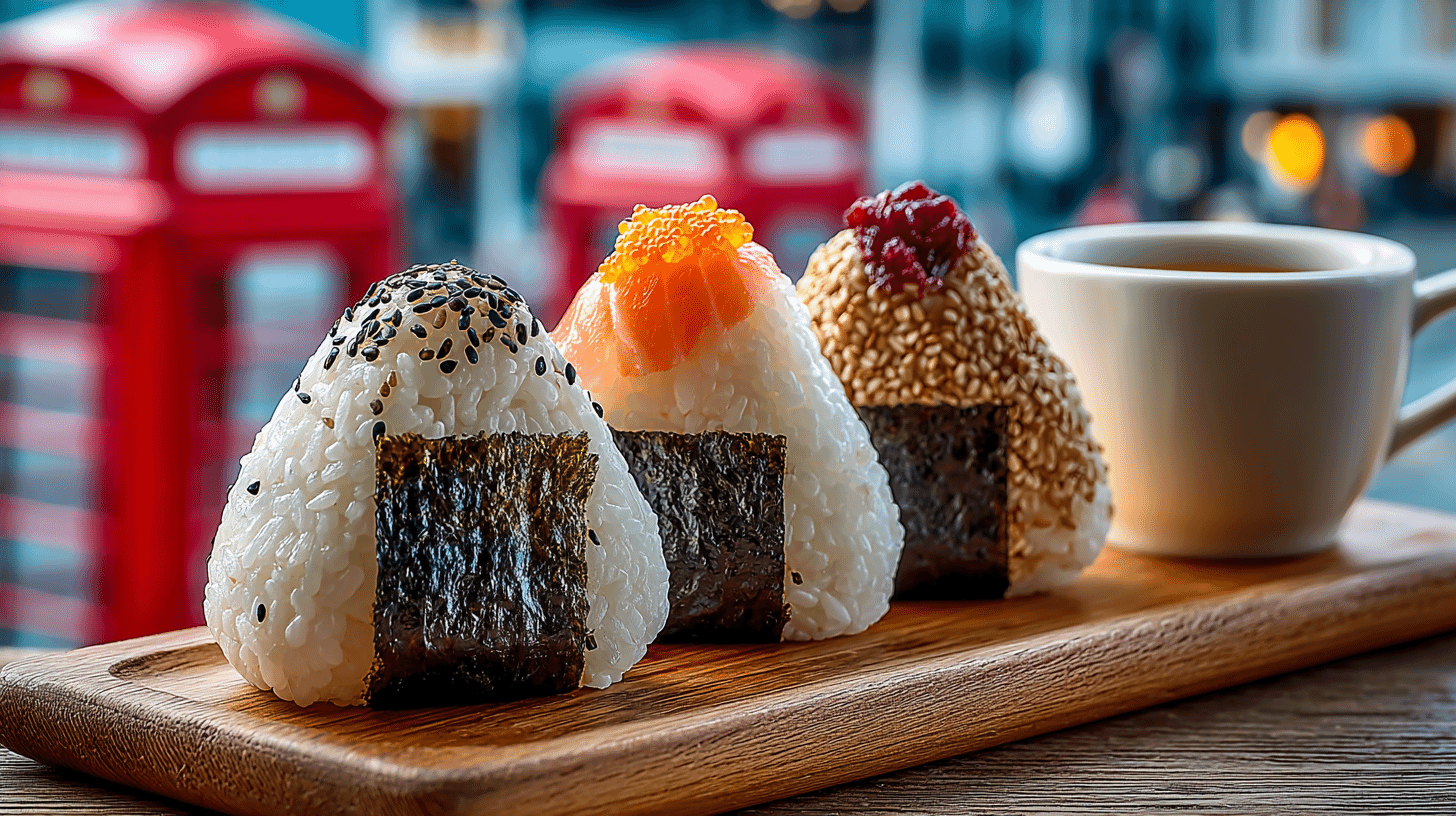
A Japanese railway company is selling onigiri in London. Not frozen, not pre-packaged: freshly hand-shaped rice balls made with Hokkaido's premium Yumepirika rice, cooked in filtered water to replicate Japan's soft water conditions. Behind this move lies a national strategy to make the humble rice ball the next global Japanese food sensation after sushi and ramen.
Why Is a Railway Company Selling Rice Balls in London?
On December 3, 2025, "TOKYO ONIGIRI Produced by Omusubi-dokoro Honnoriya" opened in London's Leicester Square. The operator is JR East Cross Station Foods Company, a subsidiary of East Japan Railway Company, the country's largest railway group.
JR East Cross Station is a retail and food services giant that runs approximately 2,019 stores across Japan, including the NewDays convenience store chain, the Honnoriya onigiri brand, Irorián Kiraku soba noodle shops, and Beck's Coffee shops. Combined store revenue tops ¥385.1 billion (roughly $2.4 billion). This was their first overseas foray into the onigiri business.
The London entry didn't happen overnight. JR East established a London office in 2014, won the franchise to operate the West Midlands passenger rail service in 2017 (running it until 2021), and in 2024 set up a UK subsidiary called JRE Business Development UK (JRUK). That same year, JRUK acquired Decoram Vending, which operates about 1,000 vending machines at UK railway stations. From railways to vending machines to rice balls, the group has methodically built its UK presence.
The collaboration model is distinctive. JR East Cross Station supplies recipes and operational know-how, JRUK handles market research and project management, and JAPAN CENTRE, London's largest Japanese food and culture retailer, manages store operations and ingredient sourcing. This three-way partnership recreates the Japanese experience of freshly shaped onigiri in the heart of London.
The attention to detail is remarkable. TOKYO ONIGIRI uses Yumepirika rice from Hokkaido, one of Japan's most prized varieties. Because London's water is hard, the team filters it to approximate Japanese soft water before cooking, a step that ensures the rice achieves its signature fluffy, melt-in-your-mouth texture. The store also features vending machines stocked with Oi Ocha green tea from Itoen, Japan's leading tea brand, creating a complete onigiri-and-tea pairing experience.
JR East says it aims to expand to multiple locations across the UK and Europe.
The GOHAN Project: A National Strategy to Export Rice Through Onigiri
JR East's overseas push coincides with a broader government effort. Japan's Ministry of Agriculture, Forestry and Fisheries (MAFF) launched the GOHAN Project in December 2025, a series of strategy meetings bringing together exporters, industry groups, JETRO, and other stakeholders to accelerate Japanese rice and rice product exports.
The project has moved at unusual speed. The first meeting addressed content categories, onigiri, dining, ready-made meals, and packaged rice, identifying challenges and strategic directions. The second meeting focused on the US market. The third (March 2026) examined European market characteristics. And the fourth, held just days ago on April 9, 2026, tackled Asian market strategy.
Four meetings in four months is exceptionally fast for a government-led initiative. The urgency stems from a structural crisis: Japanese per-capita rice consumption has been declining since its 1962 peak and now sits at roughly half that level. With the domestic market shrinking, creating overseas demand is both a food security imperative and an economic necessity.
Onigiri occupies a special position in the GOHAN Project's thinking. Unlike sushi, which requires trained chefs, or ramen, which demands significant capital investment in kitchen equipment, onigiri can be made by anyone with rice, salt, nori seaweed, and a filling. It's cheap to produce, easy to carry, naturally gluten-free, and adaptable to vegan diets. It's the lowest-barrier entry point for getting Japanese rice onto foreign plates.
Onigiri Summit 2026: 14 Municipalities Unite Behind the Rice Ball
On the grassroots side, the Onigiri Society (a non-profit based in Kamakura) organized the third annual Onigiri Summit on January 27, 2026. Fourteen local governments participated, up from eleven the previous year, with Ōma Town (Aomori), Fuji City (Shizuoka), and Tokai City (Aichi) joining as newcomers.
Each municipality showcased onigiri featuring local specialties, turning the event into a showcase of regional food culture. But the discussions went deeper than just food. Sessions addressed rice price inflation, environmental sustainability, and disaster preparedness, all viewed through the lens of onigiri and rice culture. Tokyo University professor Nobuhiro Suzuki delivered a keynote on food security lessons from the "Reiwa rice panic" of recent years.
The Onigiri Society's 2026 trend forecast identifies three themes: "global food" (onigiri becoming a standard takeout item overseas), "polarization complete" (the market splitting into premium and budget segments), and "complete onigiri" (meal-sized rice balls packed with enough protein and vegetables to replace a full meal).
TARO TOKYO ONIGIRI: Making "Onigiri" a Global Word
One brand embodies the global ambition most explicitly. TARO TOKYO ONIGIRI was created by RICEREPUBLIC, a joint venture between Shinmei Holdings (one of Japan's largest rice wholesalers) and Manpuku Holdings, established in 2022.
The brand name itself is a statement: "TARO", one of the most traditional Japanese given names, paired with "TOKYO" and "ONIGIRI" signals the intent to make the Japanese rice ball as universally recognized as sushi or ramen. The concept is to transform "onigiri" from a Japanese word into a global one.
TARO TOKYO operates locations in central Tokyo, including a shop at Gransta Tokyo (inside Tokyo Station). It uses over 20 rice varieties, more than 30 types of salt, and multiple nori options, with three base rice preparations, white, black, and brown. Even the interior design was supervised by a Musashino Art University professor. The company targets 130 domestic stores within five years and aims to expand to major cities overseas.
The Hidden Technology Inside Convenience Store Onigiri
Any discussion of onigiri's global potential must include Japan's convenience store packaging technology.
Seven-Eleven developed the "Parikko Film", a dual-layer wrapping system that keeps the nori seaweed separated from the rice until the moment of consumption. When a customer pulls the numbered tabs, the film slides away and the nori wraps around the rice, delivering a perfectly crispy bite. This technology was patented in the 1990s and remains one of the most ingenious pieces of food packaging engineering anywhere.
The experience of unwrapping a Japanese convenience store onigiri for the first time has become viral content, with videos garnering hundreds of millions of views. Foreign visitors frequently describe the three-step opening process as a "puzzle," but once mastered, most are fascinated by the engineering elegance behind it.
Japan's three major convenience store chains, Seven-Eleven, Lawson, and FamilyMart, each stock 30+ onigiri varieties year-round, constantly rotating seasonal and regional limited editions. In the 2025 convenience store onigiri popularity survey, tuna mayo ranked first across all four major chains. At around 100-200 yen ($0.60-$1.25) per piece, Japanese onigiri represents extraordinary value compared to the $5-$8 sandwiches common in Western cities.
Can Onigiri Become the "Third Wave" of Japanese Food?
The evidence is accumulating. Paris now has over 50 onigiri specialty shops, some generating lunchtime queues. Hong Kong's Waa Yue Kee chain operates roughly 120-130 locations. Japan's Omusubi Gonbei runs stores in Paris and New York, importing all rice, salt, and nori from Japan.
Anime drives awareness too. Every time onigiri appears in series like Demon Slayer, overseas fans ask "what's that black triangle?" TikTok and YouTube onigiri-making tutorials have accumulated billions of views, and making onigiri at home has become a genuine hobby worldwide.
Sushi went global in the 1980s. Ramen followed in the 2000s. Onigiri is making its bid in the 2020s. The convergence of corporate investment (JR East), national strategy (GOHAN Project), local government mobilization (Onigiri Summit), and organic social media virality creates a momentum that previous Japanese food trends never had at this stage.
Challenges remain. Japanese rice is significantly more expensive than local varieties in most export markets, making cost competitiveness a concern. Some overseas consumers find nori's texture off-putting, complaints about it sticking to the palate or feeling like paper are common. But solutions are emerging: seasoned nori, nori-free mixed-rice styles, and localized fillings that bridge cultural taste gaps.
Have you seen onigiri for sale in your country? What fillings do you think would be a hit in your local market? We'd love to hear your thoughts.
References
- https://prtimes.jp/main/html/rd/p/000000992.000082978.html
- https://www.jetro.go.jp/biznews/2025/12/8a43ed1998086f6e.html
- https://www.maff.go.jp/j/press/nousan/kikaku/260408.html
- https://www.onigiri.or.jp/archives/6410
- https://www.ssnp.co.jp/rice/292530/
- https://www.gov-online.go.jp/hlj/ja/february_2026/february_2026-09.html









Global Discussion
15 comments