🍽️ Can fine dining save the planet? UNESCO has teamed up with world-class chefs to launch a groundbreaking initiative using gastronomy to protect biodiversity. Japan's three-Michelin-star Chef Shinobu Namae joins the project, working in the UNESCO World Heritage waters of Amami Oshima.

UNESCO and Relais & Châteaux: A New Vision for Food

In February 2026, UNESCO and Relais & Châteaux — an association of 580 independent luxury hotels and restaurants across 65 countries — officially announced four pilot projects that connect world-renowned chefs with UNESCO-designated sites to protect biodiversity and preserve cultural heritage through food.

The partnership, signed in Paris in November 2024, is built on three pillars: respecting all life on Earth, passing local knowledge to future generations, and standing together to drive change. The initiative envisions a future where dining experiences contribute to environmental protection and local economies — a concept known as "gastronomy tourism."

Leading this movement is Mauro Colagreco, Vice President of Chefs for Relais & Châteaux and UNESCO Goodwill Ambassador for Biodiversity. The Argentine-born chef, who runs the three-Michelin-star restaurant Mirazur in Menton, France, has championed the idea that cuisine has the power to transform the world and actively protect ecosystems.

Four Projects, Four Continents

The pilot projects span Japan, South Africa, France, and the United States, each tackling sustainability through a unique cultural lens.

Japan: Restoring the "Underwater Forests" of Amami Oshima

Japan's project is led by Chef Shinobu Namae of L'Effervescence, a French restaurant in Tokyo's Nishi-Azabu district. L'Effervescence holds three Michelin stars along with a coveted Green Star, awarded to restaurants demonstrating outstanding commitment to sustainability. Chef Namae has been a pioneer in linking food and environmental advocacy — in 2022, he spoke about seaweed at the United Nations World Oceans Day event in New York, representing Relais & Châteaux as the sole Japanese panelist.

The project takes place in and around Amami Oshima, Tokunoshima, the northern part of Okinawa Island, and Iriomote Island — registered as a UNESCO World Natural Heritage Site in 2021. Chef Namae focuses on free-diving spearfishing, a traditional method where fishermen dive into the sea without scuba gear, observing marine ecosystems firsthand while harvesting fish. Compared to net-dragging or trawling, this approach places minimal stress on the ocean floor and surrounding habitats.

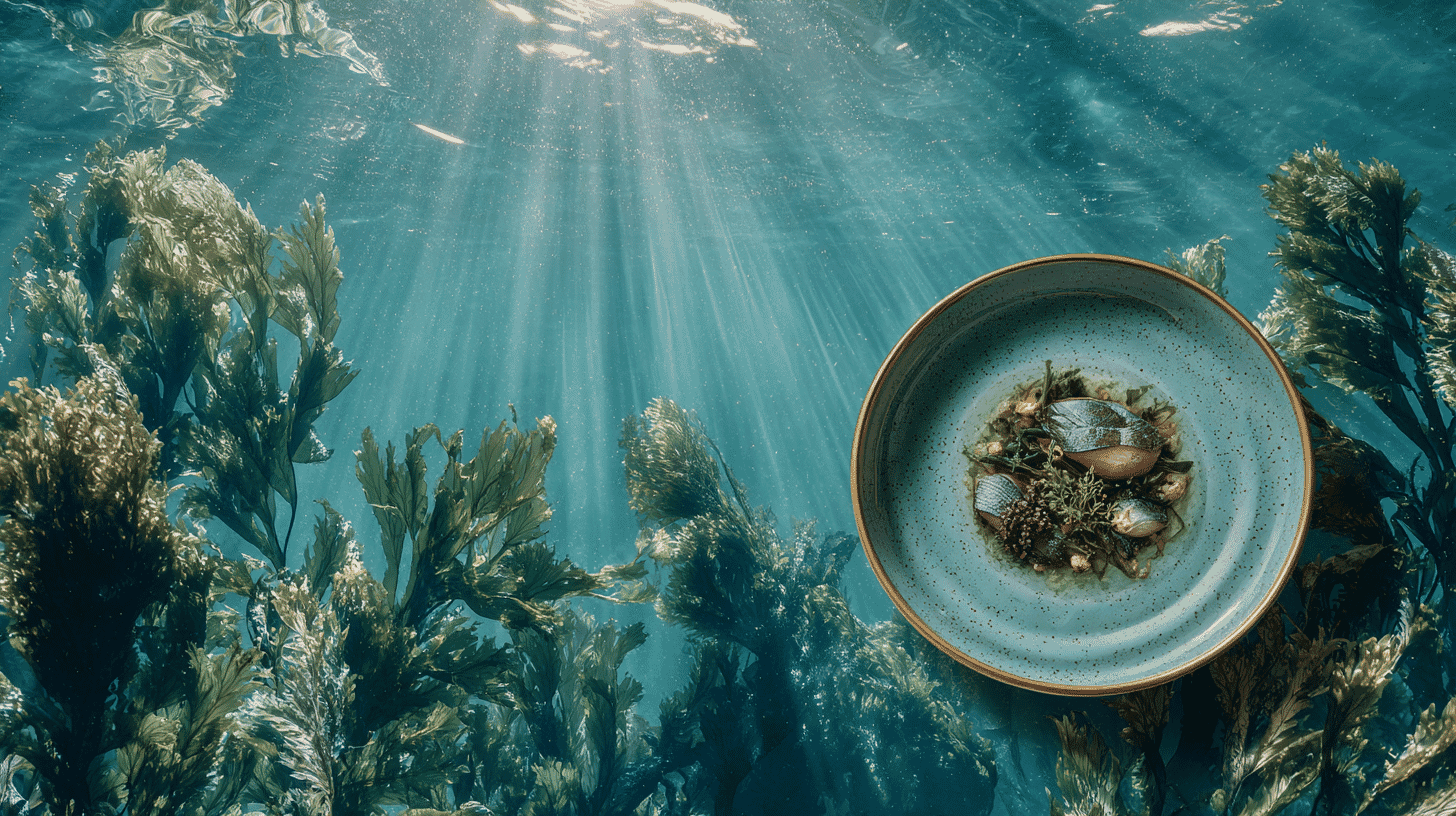
The project also addresses "isoyake" — a phenomenon where underwater seaweed beds disappear due to rising ocean temperatures and environmental degradation. These seaweed forests, sometimes called "underwater forests," serve as spawning grounds and nurseries for marine life, functioning much like forests do on land. Restoring them is essential to reviving the entire marine ecosystem.

By collaborating with local fishermen, community groups, and the World Heritage management bodies on Amami Oshima, the project aims to preserve traditional fishing knowledge while demonstrating a sustainable model for ocean stewardship that can be shared worldwide.

South Africa: Saving Endangered Plants Through Cuisine

Chef Peter Tempelhoff of Fyn Restaurant in Cape Town operates within the Kogelberg Biosphere Reserve and Cape Floral Region — one of the most plant-diverse areas on Earth. Illegal harvesting of rare indigenous plants is a serious threat here. Tempelhoff's approach is to cultivate endangered native species on a dedicated farm and incorporate them into his restaurant's dishes, creating a "eat to protect" model. Working alongside paleontologist Dr. Jan de Vynck, the team reconnects ancient food knowledge with contemporary culinary techniques.

France: Organic Agriculture Meets Intangible Heritage

Chef Anne-Sophie Pic of Maison Pic embodies the "Gastronomic Meal of the French" — a UNESCO Intangible Cultural Heritage. She sources nearly all ingredients from organic farms in the local Drôme and Ardèche departments and is working to revive ancient plant varieties. Her project explores the connection between agricultural biodiversity and wild biodiversity, bridging the gap between producers and diners.

United States: Plant-Based Innovation and Food Education

Chef Daniel Humm of Eleven Madison Park in New York sources ingredients from the Champlain-Adirondack Biosphere Reserve and has established the "Food Futures Lab." Working with Indigenous communities and local producers, the lab promotes plant-based culinary arts and biodiversity education — a forward-looking initiative aimed at inspiring the next generation of chefs and conscious consumers.

Why Japan Matters in This Global Initiative

Japan's selection for this project is no coincidence. In 2013, "Washoku: Traditional Dietary Cultures of the Japanese" was inscribed on UNESCO's Intangible Cultural Heritage list. What was recognized wasn't simply cooking techniques, but an entire philosophy: respecting nature, honoring seasonal ingredients, and using every part of a food source with minimal waste.

The Japanese concept of "mottainai" — a deep sense of regret over waste — has been cited globally in the movement against food waste. L'Effervescence practices zero-waste composting and accepts whatever vegetables farmers send, regardless of shape or variety. This embodies mottainai in action.

Japan also has the concepts of "satoyama" (managed woodland landscapes) and "satoumi" (managed coastal areas) — secondary natural environments shaped by centuries of human-nature coexistence. Amami Oshima's traditional fishing practices are rooted in this same philosophy: not exploiting nature, but tending to it while receiving its bounty. This is precisely the kind of relationship the UNESCO project aims to promote worldwide.

The Promise of Gastronomy Tourism

This initiative extends far beyond fine dining restaurants. Food-motivated travel — gastronomy tourism — is one of the fastest-growing segments of the global tourism industry.

If the Amami Oshima project succeeds, it could inspire experience-based tourism where visitors dive alongside fishermen, watch chefs prepare their catch on the spot, and learn about marine conservation firsthand. When local fishermen and farmers directly engage with tourists, the economic benefits spread across entire communities rather than concentrating in a few high-end establishments.

Notably, nearly half of all Relais & Châteaux member properties are located within two hours of a UNESCO Biosphere Reserve. The four pilot projects serve as a proving ground for eventually scaling these practices across all 580 member properties worldwide.

What About Your Country?

Food is a concentrated expression of a region's climate, history, and culture. UNESCO's initiative to advance environmental conservation through gastronomy challenges us to rethink what "eating" truly means. The wisdom of coexisting with nature — deeply embedded in Japan's traditional food culture — is now being spotlighted on the world stage.

How does traditional food culture connect with environmental protection in your country? Does the idea of "eating to protect" exist in your region? We'd love to hear about your country's food culture and how it relates to sustainability.


References

Reactions in Japan

So happy that Amami's free-diving fishing was chosen for the UNESCO project. My grandpa used to do this method too. There was a time people dismissed it as 'outdated,' but now it feels like the world is recognizing its value.

I agree 0
I disagree 0

L'Effervescence doesn't just hold three Michelin stars and a Green Star — they're doing this kind of work too. The course is over 30,000 yen (about $200), but knowing this background changes how you see its value.

I agree 0
I disagree 0

Speaking as a fisherman's wife — we're grateful for the attention, but the reality on the ground is harsh. We're on the brink of losing traditional fishing methods due to lack of successors. Without actual funding and people, this won't mean much.

I agree 0
I disagree 0

Balancing isoyake countermeasures with fisheries is an incredibly difficult topic even for researchers. If a chef's influence can bring this issue to the general public, it's groundbreaking as science communication. Maybe delicious food moves people more than research papers.

I agree 0
I disagree 0

In the end, isn't this just branding for luxury restaurants? It's not like money actually flows to Amami's fishermen. Tokyo celebrities just feel good about themselves using the word 'sustainability.'

I agree 0
I disagree 0

It's been over 10 years since washoku was inscribed as UNESCO Intangible Heritage. Finally, we're seeing projects with concrete action. Getting registered and then doing nothing would be pointless.

I agree 0
I disagree 0

The potential for gastronomy tourism development is huge. Diving with fishermen and having a top chef cook the catch — this kind of experiential content is a perfect fit for wealthy inbound tourists.

I agree 0
I disagree 0

Chef Namae gave a UN speech, published an impact report, and now this UNESCO project. It really hits me that we're in an era where chefs do this level of social work. I want to become this kind of chef too.

I agree 0
I disagree 0

The Ikeda-maru, the only boat still doing traditional drive-in fishing in Setouchi Town, is down to just one vessel. Crew aging is serious. Global projects matter, but the immediate issue is whether this fishery can even survive. I hope that gap gets bridged.

I agree 0
I disagree 0

Even neighborhood French restaurants like mine are increasingly sustainability-conscious. But the reality is we can't compete on the same stage as three-star places. I wish projects like this would open their doors to smaller restaurants too.

I agree 0
I disagree 0

Truly grateful that seaweed bed restoration is getting attention. But seaweed recovery takes years. I pray this project won't be pressured for short-term results. Steady, patient work is what matters most.

I agree 0
I disagree 0

UNESCO × fine dining sounds stiff, but basically it's 'eat delicious food and protect the planet,' right? If just choosing local seasonal ingredients counts as contributing, that's actually motivating without overthinking it.

I agree 0
I disagree 0

Free-diving fishing in Japan dates back to the Jomon period — thousands of years ago. The ama divers' tradition is similar. Reevaluating this millennia-old relationship between humans and the sea through the 21st-century lens of 'sustainability' is quite moving.

I agree 0
I disagree 0

Japan, South Africa, France, and the US — so Japan is the only one from Asia. Chinese, Korean, and Thai food cultures are fascinating too. Looking forward to the next expansion phase.

I agree 0
I disagree 0

The stat that nearly half of Relais & Châteaux properties are within 2 hours of a UNESCO Biosphere Reserve is quietly impressive. It means luxury hotel and restaurant networks could become infrastructure for environmental conservation. That's a real shift in thinking.

I agree 0
I disagree 0

Voices from Around the World

Marco Bianchi

UNESCO is trying to institutionalize globally what Italy's Slow Food movement has been doing for 30 years. I'm happy, but it's taken too long. Mediterranean cuisine is also UNESCO heritage, yet industrial agriculture dominates in reality. Change needs to happen at everyday tables, not just fine dining.

Sarah Mitchell

As an American, I'm proud of Eleven Madison Park's involvement. There was controversy when Daniel Humm went plant-based, but seeing it lead to a UNESCO project is something. Still, it's hard to see how a ultra-luxury NYC restaurant's efforts translate to an Iowa farmer.

Léa Dubois

Anne-Sophie Pic representing France makes total sense — the Pic family has three generations of Michelin three-star history. But honestly, small organic farmers in southern France are being crushed by supermarket price competition. Can this project really reach that far?

Thabo Ndlovu

Living in Cape Town. Was already amazed when Fyn earned the first African three-star sustainability rating, and now UNESCO. But using fynbos in cooking is something the Khoi people have done for millennia. I hope their knowledge gets properly credited.

Kim Soo-yeon

Korean kimchi and jang (fermented paste) culture is also thoroughly sustainable. Why is Japan the only Asian representative? I'm a bit frustrated, honestly. Hope Korea joins in the next phase. That said, I genuinely respect Chef Namae's approach to seaweed.

James O'Brien

Australia's Aboriginal people have over 60,000 years of bush food knowledge — arguably the world's oldest sustainable food culture. I strongly believe Australia should be considered for the next expansion phase.

Priya Sharma

India's Ayurveda-based food culture has operated on the 'food is medicine' principle for thousands of years. Watching Western fine dining now start talking about 'sustainability' feels slightly ironic.

Hans Müller

Germany has one of the highest organic farming rates in the EU, but the connection with fine dining is still weak. UNESCO creating this framework makes it easier to influence policy. The scale of 580 Relais & Châteaux properties is not to be underestimated.

Ana Rodrigues

Brazilian Amazon ingredients — açaí, cacao, tapioca — are hugely popular worldwide, but ecosystem destruction is accelerating locally. If consuming countries are advancing projects like this, they should also commit to protecting supply origins.

David Chen

I run a Japanese restaurant in Vancouver, Canada. Respect for Japanese food culture grows every year. If this project highlights 'Japan's sustainable fisheries,' I can share that story at my restaurant. Many customers want to know the philosophy behind the food.

Fatima Al-Hassan

Moroccan food culture — tajine and couscous — was also inscribed as UNESCO heritage in 2023. But if asked what changed after registration, I honestly struggle to answer. The key is whether it can be turned into concrete projects like Japan's.

Erik Johansson

In Scandinavia, foraging became mainstream in the culinary world thanks to noma. Japan's free-diving fishing is essentially the same — the process of immersing yourself in nature to obtain ingredients has inherent value. It's the era of chefs becoming fishermen.

Nguyen Thanh Minh

Vietnam has unique fermented condiments in every region, each adapted to local climate and terroir. I'd love to see more ASEAN countries participate in global projects like this. Spotlight not just fine dining, but street food culture too.

Rachel Thompson

I'm a UK food journalist and I'd love to cover all four projects. Japan's 'underwater forest' restoration is especially visually compelling — perfect documentary material. I bet BBC or Netflix would jump on this.

Pablo Herrera

Peru's culinary scene is incredibly hot right now, with a movement to rediscover Amazonian and highland ingredients. Mauro Colagreco is Argentine, so South American gastronomy should naturally come into the next phase.