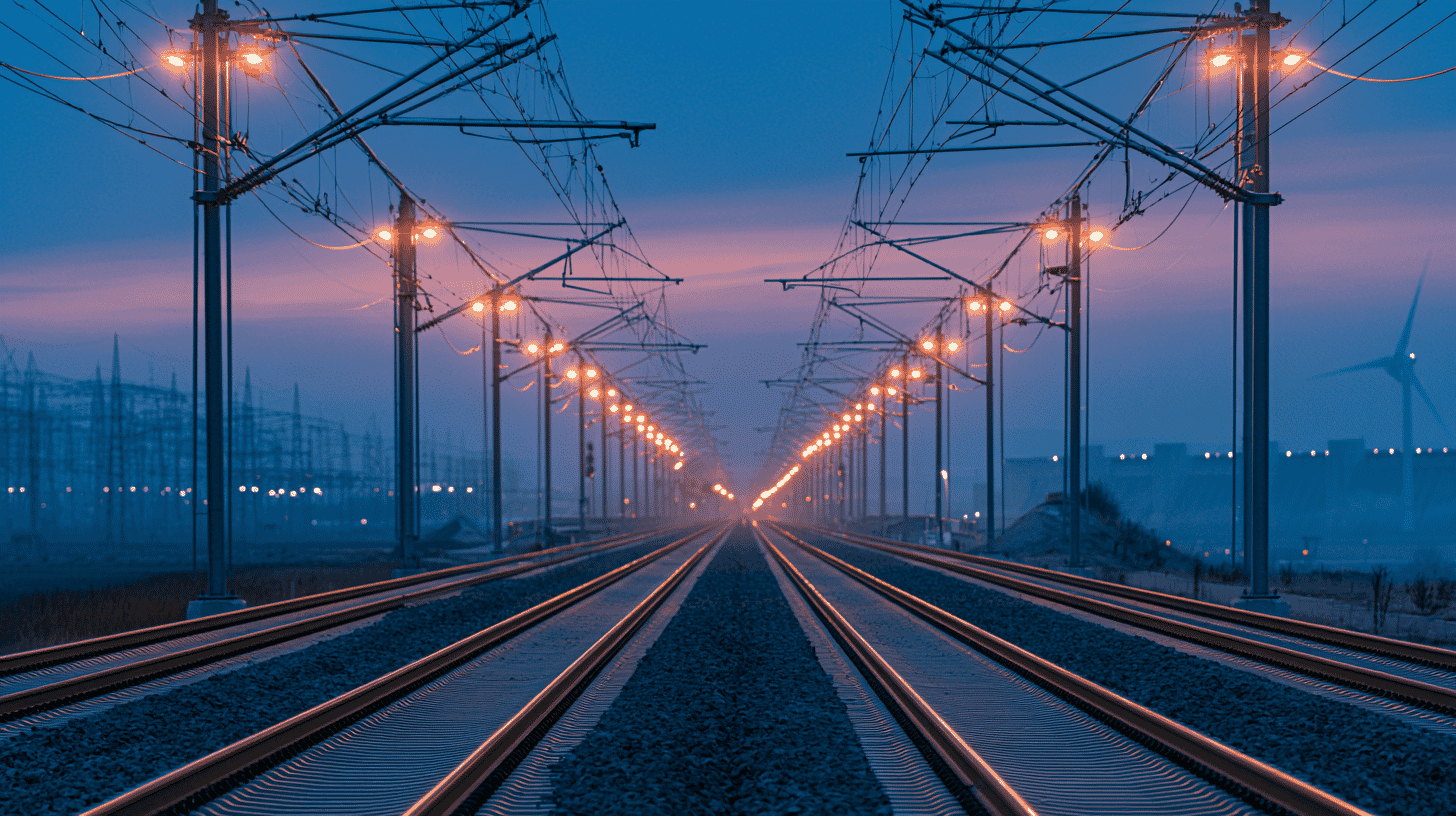
🚄 A bullet train running at 260 km/h, powered entirely by a river. Construction has just begun on a curious little hydropower plant in the hills of Ishikawa. At 2,000 kW, it can barely cover one Shinkansen trainset at peak draw. But it is the first hydroelectric plant in Japan built exclusively for a bullet train, and it tells you a lot about how Japan is approaching the same homework every railway in the world is now struggling with: decarbonizing the grid that runs the trains.
A small plant on the Daihigawa with a very specific mission
On May 18, 2026, Hokuriku Electric Power broke ground in Komatsu, Ishikawa Prefecture, on a hydropower plant designed to feed a single customer, the Hokuriku Shinkansen. Built on the Daihigawa, a tributary of the Tedori River, the new "Hanatate Power Station" was first announced via Kyodo News and picked up across Japanese outlets the same day.
According to JR West, this is the first hydropower plant in Japan built specifically to power a Shinkansen line. Rated at 2,000 kW, the plant is expected to generate roughly 11.3 million kWh per year, with commercial operation scheduled for May 2030. It sits in the Maruyama, Hanatate and Shinbo districts of Komatsu and will be Hokuriku Electric's 133rd hydropower station. Every kilowatt-hour will go to JR West and feed the stretch of the Hokuriku Shinkansen between Itoigawa and Tsuruga, the section that sits inside Hokuriku Electric's distribution territory.
"Dedicated power plant" sounds grand. The reality is fairly modest. That 11.3 million kWh a year covers only about 5% of the traction load on JR West's portion of the Hokuriku Shinkansen, or roughly the annual electricity use of about 1,900 Japanese households.
But it is part of a bigger package. In December 2024, JR West and Hokuriku Electric signed a basic agreement on an offsite Power Purchase Agreement (PPA) that also expanded their existing solar PPA. When the hydro and solar volumes are combined, the renewable share of traction electricity on JR West's Hokuriku Shinkansen rises from about 21% today to around 26%, cutting roughly 27,800 tonnes of CO2 a year, equivalent to about 10,700 households.
"Dedicated power plant" and "offsite PPA," briefly explained
A quick detour into terminology, because the structure matters more than the headline.
An offsite PPA is a long-term electricity contract signed directly between a buyer and a generator. The plant sits off the buyer's premises (hence "offsite"), and electricity moves through the public grid alongside the "environmental value", the certified claim that the power was generated without CO2 emissions. Both the electrons and the green certificate go to the buyer.
A regular electricity contract is something a company renegotiates every few years with a retailer. A PPA is closer to a 20- or 30-year purchase commitment to one specific plant. That kind of long-term certainty is what makes it bankable for the generator to build something new.
Hanatate exists because JR West committed to buy 100% of its output, period. For Hokuriku Electric, it is their first offsite PPA built around a brand-new hydropower plant. For JR West, it is a stronger signal than buying renewable electricity off a menu, it is "go build us a power station."
Why railways are suddenly chasing renewables
JR West is actually one of the more advanced players in Japanese rail when it comes to renewable sourcing.
In July 2023, JR West and Chugoku Electric started supplying solar PPA electricity to the Sanyo Shinkansen (Shin-Osaka–Hakata). That was already a Japan-first for putting Shinkansen traction power on renewable energy. The volume there is around 140 million kWh a year, cutting roughly 61,000 tonnes of CO2, about 30 times the size of Hanatate alone.
JR West Group's Scope 1 and 2 emissions sat at around 1.49 million tonnes of CO2 in fiscal 2022, and the company has committed to halving that against a 2013 baseline by 2030. For a railway, the lion's share of energy use is the traction power that actually moves trains, so the math doesn't work without decarbonizing that grid.
A small organizational note: the Hokuriku Shinkansen is split between two operators, with JR East handling Tokyo to Joetsumyoko and JR West taking over from Joetsumyoko to Tsuruga. It remains the only Shinkansen line in Japan operated jointly by two JR companies. Hanatate's electricity will feed substations on JR West's side.
Europe is much further down the same road
"Japan's first dedicated Shinkansen hydropower plant" makes for a good headline, but step back to the global picture and the scale gap is striking.
Germany: long-distance trains already run on 100% renewables
Deutsche Bahn (DB) is Europe's biggest railway and Germany's single largest consumer of green electricity. Since 2018, all ICE, IC, and EC long-distance trains running on electrified routes inside Germany have been powered by 100% renewable electricity. Imagine all of Japan's Shinkansen lines (Tokaido, Sanyo, Tohoku, Hokuriku, Joetsu) already running on green power today. That is roughly where Germany has been for the past eight years.
Across DB's full traction mix, renewables had reached 69.8% in 2024, with targets of 80% by 2030 and 100% by 2038. Net-zero across the value chain is set for 2040. Hydropower plays an outsized role: DB has been running its own hydropower plant at Bad Reichenhall, the Saalach plant, since 1914. The idea of a railway company building and operating its own power station is more than a century old in Germany.
France: PPAs scaling up fast
France's SNCF has set a 2050 net-zero target. Through its subsidiary SNCF Energie, it has been stacking long-term renewable PPAs, aiming for 40–50% renewable traction power by 2030, with 20% from PPAs alone.
In October 2025, SNCF Energie signed two long-term PPAs with Octopus Energy and BayWa r.e. covering 2.5 TWh of solar electricity over 25 years, enough to power roughly 15,500 Paris–Rennes TGV trips a year.
For comparison, Hanatate's 25-year output adds up to about 0.28 TWh. SNCF moves the same numbers per single contract, an order of magnitude away.
China: state-led integration of railway and renewables
China is taking a third approach. In 2025, CHN Energy launched what it billed as the country's first rail project integrating renewable generation directly into a railway power system, with solar plus storage. Annual generation is around 7.4 million kWh and CO2 savings around 5,800 tonnes, comparable in size to Hanatate.
What sets China apart is policy speed. The project was framed under a March 2025 government document on integrated transport-and-energy development, designed for rollout across the national rail network rather than as a one-off pilot.
Lining up the four approaches
| Japan (JR West + Hokuriku Electric) | Germany (DB) | France (SNCF) | China (CHN Energy) | |
|---|---|---|---|---|
| Main sourcing model | Offsite PPAs (solar + hydro) | Self-owned plants + many PPAs | Large corporate PPAs | State-led integrated pilot |
| Current renewable share | ~26% on Hokuriku Shinkansen | 69.8% overall, 100% long-distance | ~25% now, 40–50% by 2030 | Demonstration phase |
| Dedicated-plant concept | Explicitly "Shinkansen-only" | DB hydropower since 1914 | Site-specific solar and wind | Trackside solar integration |
Japan's approach is distinctly pinpoint engineering, pairing one specific route with one specific generator. Rather than committing to a fleet-wide 2.5 TWh contract like SNCF, JR West is building bilateral deals corridor by corridor, with Hanatate as a particularly literal example. A new hydropower plant, sized for a specific stretch of track, fed by a specific tributary, sitting inside a specific utility's territory.
For better or worse, Japan is decarbonizing rail one bespoke deal at a time. It is a more incremental, project-by-project style, a contrast with European players that line up PPAs on top of a coherent long-term strategy. Hanatate is the first of its kind, not the climax.
What is missing: speed, scale, and time
On the numbers, Hanatate by itself avoids about 5,000 tonnes of CO2 a year. That is roughly 0.003% of Japan's transport-sector emissions (about 190 million tonnes in fiscal 2023). The "Japan-first" label is real, but it is more useful to read this as a symbolic pilot than as a dent in the national footprint.
Commercial supply is still four years away. While the world's railways are racing toward their 2030, 2040, and 2050 deadlines, Japan is running behind the Europeans on both pace and scale. Hanatate is a first step, and the real test is whether JR West (and other Japanese railways) can follow up with broader sourcing, wind, geothermal, additional hydro, and bigger PPAs.
What is worth flagging for an international reader: Japanese railways are slowly shifting from being passive electricity buyers to being clients who commission new generation. A Shinkansen partly powered by a creek in Komatsu sounds quaint, but it is the first concrete sign of that shift.
What runs the trains in your country today, and where is it heading next?
References
- JR West / Hokuriku Electric press release on the offsite PPA agreement (December 18, 2024)
- Kyodo News via Yahoo! Japan: Japan's first Shinkansen-only hydropower plant breaks ground (May 18, 2026)
- How Deutsche Bahn is driving the decarbonization of energy with hydropower
- How Deutsche Bahn is focusing on renewable power for traction power
- Wind and solar powering trains | SNCF Group
- SNCF Energie, Octopus Energy, and BayWa r.e. join forces to accelerate the decarbonisation of French rail
- China launches its first railway project integrating renewable energy (Dialogue Earth)
- JR West renewable energy plan, Sanyo Shinkansen solar PPA (Renewable Energy Institute case study)




Global Discussion
3 comments