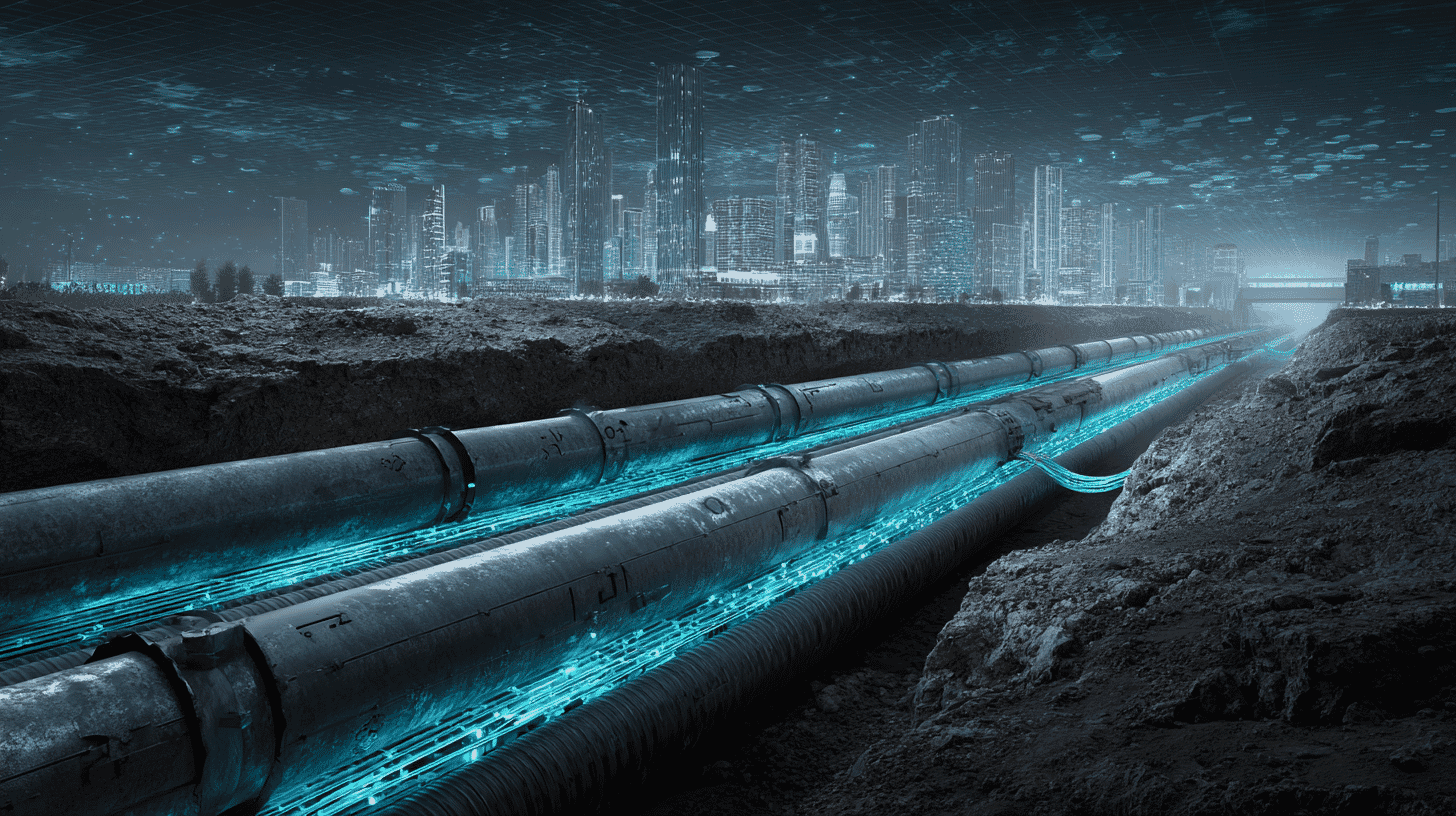
Japan's telecommunications giant NTT Group is advancing a plan to repurpose its nationwide underground communication infrastructure for hydrogen transportation. The project aims to utilize underground conduits that have seen declining usage rates due to the proliferation of fiber optic cables, transforming them into a network for transporting hydrogen, a next-generation clean energy source.
As Japan works toward achieving carbon neutrality by 2050, hydrogen is expected to play a crucial role. However, one of the biggest challenges in hydrogen adoption is establishing transportation infrastructure. NTT's concept answers that challenge by repurposing assets it already owns.
NTT's Massive Underground Infrastructure Network
NTT Group possesses an extensive communication infrastructure built up since the days of the Nippon Telegraph and Telephone Public Corporation. The scale breaks down as follows:
Key Infrastructure Assets:
- Underground conduits (pipelines): Approximately 600,000 km
- Tōdō (tunnel-type passages): Approximately 650 km
- NTT communication buildings: About 7,000 locations nationwide
The underground conduits, pipes designed to house communication cables, stretch a total distance equivalent to circling the Earth roughly 15 times. The tōdō are larger tunnel-type facilities where people can walk through, with approximately 290 km running beneath Tokyo alone.
Previously, metal cables (copper wires) were the primary medium for telecommunications, but today, thin fiber optic cables have become standard. Since more lines can now be accommodated in conduits of the same diameter, utilization rates have dropped to around 40%. NTT's concept leverages this "empty space" for hydrogen transportation.
Double-Pipe Technology for Safety
The core of NTT Anode Energy's hydrogen transportation technology development is the "double-pipe method." This approach transports hydrogen using a dual structure consisting of an inner pipe for hydrogen transport and the existing communication conduit as the outer pipe.
Benefits of the Double-Pipe Method:
- Significant cost reduction by utilizing existing conduits
- Reduced risk of damage to hydrogen transport pipes
- Direct detection capability within the hollow layer if hydrogen leaks from the inner pipe
- Potential elimination of "odorization" typically required in conventional gas transportation
Particularly noteworthy is the leak detection system utilizing optical fiber sensing technology. A "composite detection technology" has been developed that leverages the explosion-proof properties and distributed sensing capabilities of optical fibers to immediately detect and respond to hydrogen leaks.
Joint Demonstration with Tokyo Metropolitan Government and AIST
From July 2024 to March 2025, NTT Anode Energy conducted demonstration experiments in the underground common duct of the Tokyo waterfront subcenter area, in collaboration with the Tokyo Metropolitan Government Port Bureau and the National Institute of Advanced Industrial Science and Technology (AIST).
For safety considerations, helium, which has leakage behavior nearly identical to hydrogen, was used for the following verifications:
- Construction feasibility verification - Confirming installation and connection workability in common ducts
- Leaked gas diffusion behavior verification - Understanding diffusion processes during leakage at closures (connection points)
- Air purge verification - Measuring the effectiveness of diluting leaked gas with compressed air
- Advanced optical fiber sensing verification - Confirming leak detection technology through acoustic vibration detection
Hydrogen Supply Chain Demonstration at Osaka-Kansai Expo 2025
At the Osaka-Kansai Expo 2025, which ran from April to October last year, NTT Anode Energy and Panasonic jointly implemented a "hydrogen supply chain model."
Electricity generated by perovskite solar cells on the NTT Pavilion roof produced green hydrogen through a water electrolysis unit. The hydrogen was stored in metal hydride tanks and piped roughly 200 meters underground to the Panasonic Group Pavilion, where a pure hydrogen fuel cell turned it back into electricity for the pavilion's nighttime LED lighting.
NTT Anode Energy aims to commercialize this hydrogen supply chain model by 2028.
Update: NTT Anode Energy president Teruyuki Kishimoto has since said the company plans to begin hydrogen transport trials in Tokyo during fiscal 2026, working on technical standardization in parallel.
Cost Reduction Effects and Expected Economic Viability
If NTT's concept is realized, significant cost reductions in hydrogen infrastructure development can be expected.
Reduction Effects Compared to Building New Pipelines:
- Initial costs: Can be reduced to 50% or less
- Construction period: Significant shortening possible
The common hydrogen transport methods today, truck-borne high-pressure cylinder bundles and tube trailers, carry limited volume per vehicle and do not scale. While liquid hydrogen tankers have higher transportation efficiency, they face challenges with high plant construction and operation costs.
Pipeline-based hydrogen transportation is considered the most economical method for short-distance, high-volume transport. NTT's utilization of existing infrastructure has the potential to accelerate this realization.
Domestic and International Collaborative Projects
NTT's hydrogen pipeline concept is linked to several major projects.
Tokyo Airport Waterfront Area Project (Agreement signed September 2024): Based on an agreement with the Tokyo Metropolitan Government Bureau of Industrial and Labor Affairs, business viability analysis and roadmap development for the hydrogen supply chain are being conducted for 2030 and 2050. Individual studies are being carried out for each phase: "producing," "transporting," and "using."
Himeji Area-Origin Project (Adopted June 2024): A collaborative hydrogen transportation and utilization survey involving six companies: Kansai Electric Power, JR West, JR Freight, NTT, NTT Anode Energy and Panasonic. The project promotes technological development of hydrogen transportation methods utilizing existing infrastructure such as railways and communication conduits.
Position in Japan's Hydrogen Strategy
Japan formulated the world's first "Basic Hydrogen Strategy" in 2017, which was revised in 2023. A supply chain investment plan of 15 trillion yen over 15 years, combining public and private sectors, is under consideration. Hydrogen introduction targets are set as follows:
- 2030: 3 million tons
- 2040: 12 million tons
- 2050: 20 million tons
In the power sector specifically, the aim is to supply 10% of all power sources with hydrogen and ammonia by 2050. NTT's initiatives could become a crucial infrastructure foundation supporting this national strategy.
Comparison with Global Trends
Hydrogen pipeline development has become a global trend. Germany, in particular, is advancing a plan to build a 9,040 km hydrogen pipeline network by 2032, at a cost of approximately €20 billion. About 60% will be converted from existing natural gas pipelines, with 40% being newly constructed. The first 525 km began operation in 2025.
Across Europe, under the European Hydrogen Backbone (EHB) initiative, a goal has been set to develop or convert more than 31,000 km of pipelines by 2030.
What sets NTT's concept apart is the starting material: communication conduits rather than gas mains. Europe converts what already moved gas; Japan would convert what already carried phone calls.
Challenges and Future Prospects
Several challenges remain for the practical implementation of hydrogen pipelines.
Technical Challenges:
- Addressing leakage risks, as hydrogen is the smallest molecule
- Countermeasures against hydrogen embrittlement (phenomenon where metal materials become brittle due to hydrogen)
- Ensuring airtightness and safety assurance in case of leakage
Regulatory Challenges:
- Compliance with the Gas Business Act and other regulations
- Development of new safety standards and technical criteria
- Accumulation of scientific evidence necessary for legal framework development
Business Viability Challenges:
- Creating and expanding hydrogen demand
- Setting appropriate hydrogen selling prices
- Building collaboration systems with consumers
What NTT Anode Energy brings to these problems comes straight from the telephone business: round-the-clock operational monitoring, network surveillance technology refined since the public corporation era, and repair crews stationed across the country. The plan is to point all of it at hydrogen.
If communication conduits end up carrying hydrogen, Japan will have answered a question every industrialized country eventually faces: what to do with infrastructure that has outlived its original purpose.
What strategies are being considered in your country for utilizing infrastructure toward decarbonization? Are there any initiatives to convert existing facilities into new energy infrastructure? We'd love to hear about them!
References
- https://journal.ntt.co.jp/article/32102
- https://journal.ntt.co.jp/article/23106
- https://www.ntt-east.co.jp/release/detail/20240920_02.html
- https://www.nikkei.com/article/DGXZQOUC025UE0S5A001C2000000/
- https://group.ntt/jp/expo2025/green/
- https://www.mirait-one.com/miraiz/5g/column102.html
- https://www.nikkei.com/article/DGXZQOUC196DF0Z11C25A2000000/
- https://globalenergymonitor.org/report/europe-gas-tracker-2025-hydrogen-edition/
- https://www.cleanenergywire.org/news/hydrogen-start-flow-pipelines-germany-2025








Global Discussion
16 comments