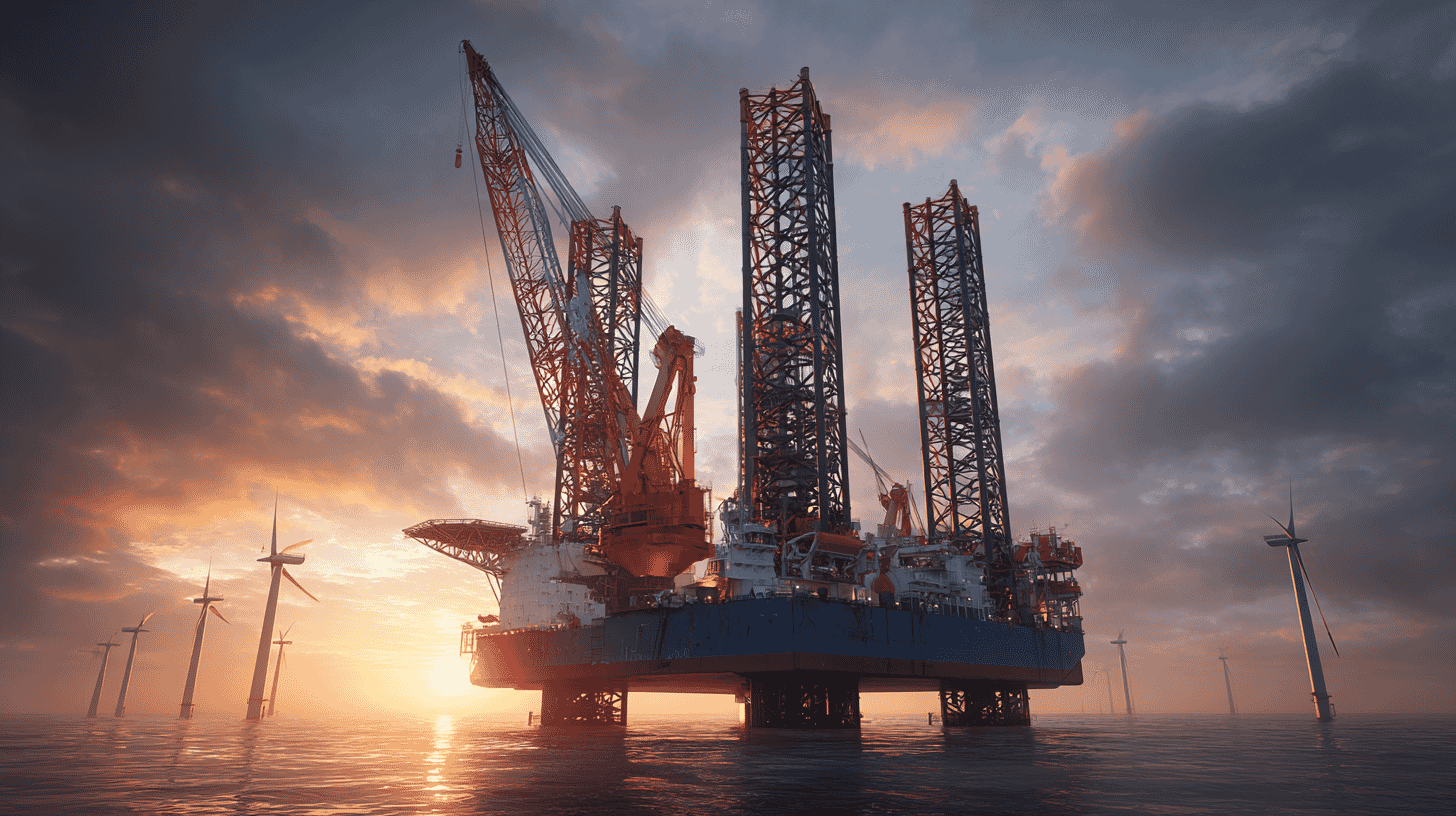
A "moving giant island" has appeared off the coast of Kyoto. With four legs reaching more than 100 meters to the seafloor, it lifts its entire hull clear of the waves. Built for about 50 billion yen (roughly $330 million), Shimizu Corporation's BLUE WIND is one of the world's largest SEP vessels, and it is set to shape the future of Japan's offshore wind. Here is an inside look at the vessel and its role in the country's energy transition.
What is a SEP Vessel: Ships That "Stand" on the Ocean
SEP vessels (Self-Elevating Platforms) are specialized ships unlike any conventional watercraft. They feature four massive legs that extend to the seafloor, using hydraulic jacks to lift the entire hull above sea level.
This unique design provides critical advantages for offshore construction. By eliminating wave-induced motion entirely, SEP vessels enable precision work that would be impossible on standard ships. Installing offshore wind turbines requires millimeter-level accuracy, a feat achievable only when the work platform is rock-solid.
The stable platform also allows these vessels to carry massive cranes. Lifting heavy loads from an unstable ship risks crane tipping. With the hull fixed to the seabed, SEP vessels can safely hoist components weighing thousands of tons.
BLUE WIND: World-Class Specifications
Completed in January 2023, "BLUE WIND" represents Shimizu Corporation's approximately ¥50 billion ($330 million) investment in offshore wind construction capability. Japan Marine United (JMU) built the vessel at its Kure shipyard.
The specifications are remarkable. At 142 meters long and 50 meters wide, the vessel displaces approximately 28,000 gross tons. Its legs extend to roughly 109 meters, enabling operations in water depths of 10 to 65 meters.
The main crane boasts a maximum lifting capacity of 2,500 tons, the largest among Japanese SEP vessels. For comparison, Penta-Ocean Construction's "CP-8001" handles 800 tons, Obayashi/TOA's "Hakkaku" manages 1,250 tons, and the Penta-Ocean/Kajima/Yorigami "CP-16001" lifts 1,600 tons. BLUE WIND stands in a class of its own.
Maximum hook height reaches 158.5 meters (at 1,250-ton capacity), accommodating today's largest commercial turbines at 15MW. The design even anticipates GE Vernova's announced 18MW turbines.
Critically, BLUE WIND is "self-propelled." Cruising at 11 knots (approximately 20 km/h), it eliminates the need for tugboats, significantly reducing project timelines.
Proven Track Record: Four Projects Completed
Since becoming operational in 2023, BLUE WIND has steadily built its portfolio across Japan and Asia.
Its first project was the Nyuzen Offshore Wind Farm off Toyama Prefecture, where it installed three turbines. Completed in October 2023, the facility was among Japan's early commercial fixed-bottom offshore wind farms.
Next came the Ishikari Bay New Port Offshore Wind Farm in Hokkaido. BLUE WIND assembled all 14 units of 8MW turbines, creating Japan's largest offshore wind facility at 112MW capacity (approximately 99MW grid connection). Despite typhoons and torrential rain, the crew maintained millimeter-level precision throughout.
Internationally, BLUE WIND has contributed to Taiwan's offshore wind expansion. At the Yunlin Offshore Wind Farm, it installed monopiles for all 80 units of 8MW turbines, completing work in July 2024. The vessel has also been deployed to the Hai Long Offshore Wind Project.
Japan's Offshore Wind Ambitions
In December 2020, Japan's government set ambitious targets: 10GW by 2030 and 30-45GW by 2040. With cumulative installed capacity at approximately 42MW as of 2024, rapid expansion lies ahead.
The 2019 "Act on Promoting Utilization of Sea Areas for Renewable Energy Power Generation" established a framework for general sea area projects. However, the three Round 1 sites off Akita and Chiba, awarded to a Mitsubishi Corporation-led consortium, were abandoned in August 2025 when the company withdrew, citing soaring costs; the government is revising the system ahead of a new tender.
Round 2 projects, including areas off Akita's Oga, Katagami, and Akita cities, plan to install 15-18MW class turbines. Shimizu's Vice President Takeshi Sekiguchi notes: "The turbine sizes that match BLUE WIND's capabilities arrived faster than we expected."
Construction in general sea areas is expected to accelerate from fiscal 2027. Penta-Ocean Construction has announced plans for a massive Heavy Lift Vessel with 5,000-ton crane capacity, signaling industry-wide preparation for growth.
Significance of the Kyoto Port Call
In January 2026, BLUE WIND arrived at JMU's Maizuru shipyard in Kyoto Prefecture for maintenance. Having entered port on January 6th, the vessel's towering presence is visible from Maizuru's city center.
Maizuru City's official social media encouraged residents: "Please experience its overwhelming presence!" Regular maintenance in Japan's shipyards ensures the vessel maintains peak performance for demanding offshore operations.
BLUE WIND has designated Muroran Port in Hokkaido as its home base, strategically positioned for ongoing and future offshore wind projects in northern Japan.
Building a Domestic Supply Chain
JMU, a major Japanese shipbuilder, constructed BLUE WIND. Shimizu Corporation insisted on domestic manufacturing, prioritizing the development of Japan's offshore wind supply chain.
Currently, four major SEP vessels operate in Japan: Penta-Ocean's "CP-8001" and "CP-16001," Obayashi/TOA's "Hakkaku," and BLUE WIND. This fleet forms the backbone of Japan's offshore wind construction capacity.
Further expansion is underway. Penta-Ocean Construction and Fuyo General Lease have announced a ¥120 billion ($800 million) investment in a 5,000-ton capacity Heavy Lift Vessel, scheduled for delivery in March 2028.
Challenges Ahead: Costs and Human Capital
Significant challenges remain. Rising material and labor costs have triggered project cancellations and reductions across Europe and the United States. Mitsubishi Corporation recorded ¥52.2 billion in impairment losses on three offshore wind projects off Akita and Chiba, and later withdrew from them.
Motoshi Igari of the Floating Offshore Wind Technology Research Association points to a critical gap: "Unfortunately, Japan lacks sufficient personnel to support offshore wind development." Installing large turbines requires specialized skills and experience, making human capital development an urgent priority.
Despite these hurdles, offshore wind remains central to Japan's 2050 carbon neutrality goals. Vessels like BLUE WIND represent essential infrastructure for achieving this vision.
Japan is expanding its offshore wind capacity with world-class SEP vessels like BLUE WIND. What technologies or vessels does your country use for offshore wind development? Is offshore wind a significant part of your nation's renewable energy strategy?
References
- https://trafficnews.jp/post/629081
- https://www.shimz.co.jp/company/about/news-release/2022/2022046.html
- https://www.shimz.co.jp/sep/
- https://www.jmuc.co.jp/news/2023/01/bluewind.php
- https://www.enecho.meti.go.jp/about/special/johoteikyo/yojohuryokuhatuden2025.html
- https://www.penta-ocean.co.jp/news/2025/250127-1.html



Global Discussion
15 comments