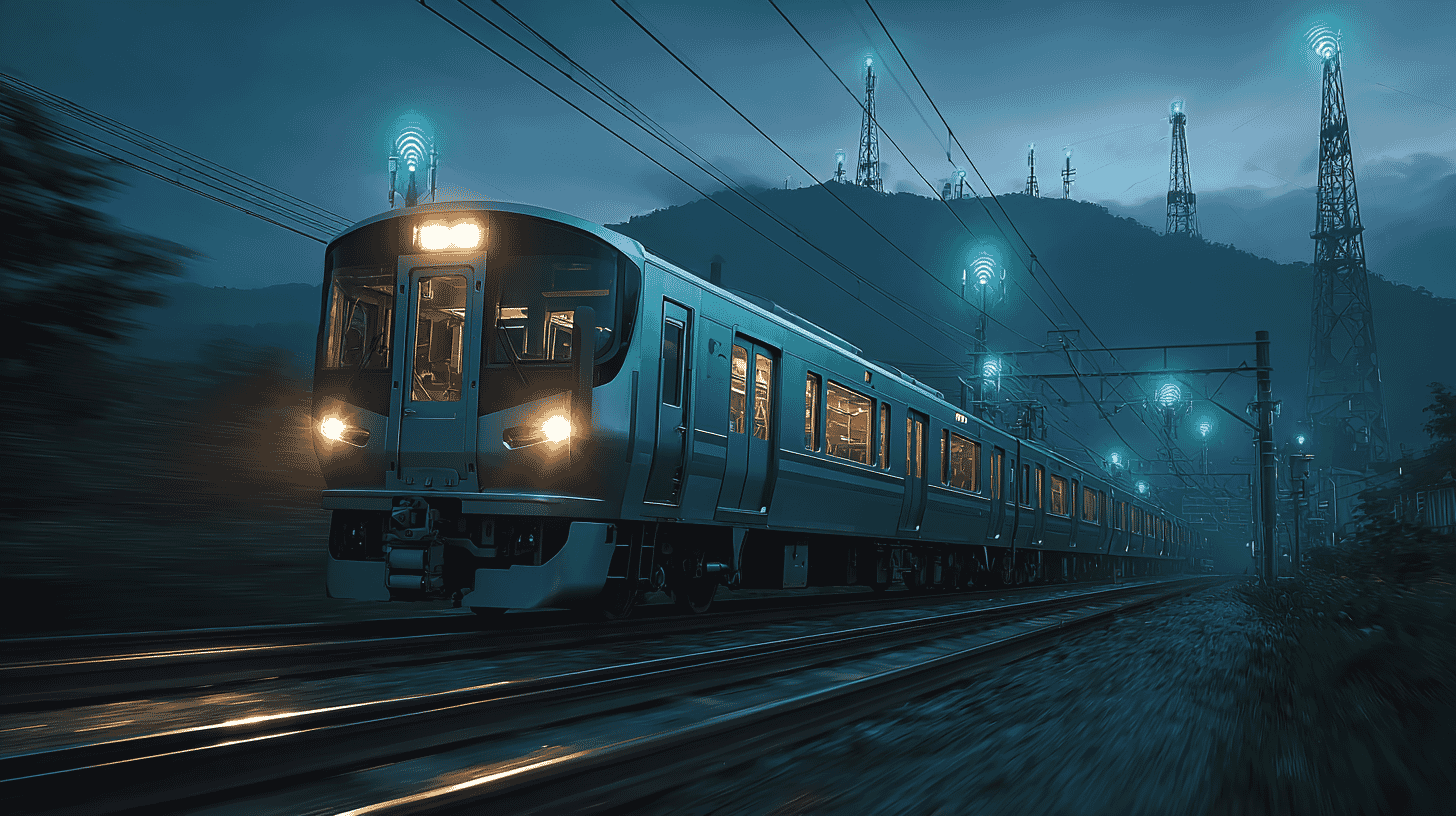
Rows of trackside signals, endless kilometers of communication cables, hardwired crossing systems: the familiar "ground-side equipment" of railways could soon vanish. The key to making it disappear? The very same cellular network your smartphone is using right now. Starting in fiscal year 2028, JR Kyushu will roll out a train control system called RK, the first commercial train control system in Japan, and among the very few in the world, to run trains over a regular public mobile carrier network.
What Was Announced
On April 15, 2026, Kyushu Railway Company (JR Kyushu) announced the rollout of a wireless train control system called the RK System (short for "Radio communication Kyushu system") that transmits control signals over public cellular networks.
Deployment will proceed in stages. The first section is the Nagasaki Main Line between Kikitsu and Urakami (via Nagayo), going live in fiscal year 2028. Expansion follows to the Nagasaki Main Line between Isahaya and Nagasaki (via Ichifu) in FY2032, and to the Omura Line between Huis Ten Bosch and Isahaya in FY2033.
From 2024 through 2025, an "RK System Implementation Review Committee" composed of academic experts and research institutions assessed the technology. The Railway Technical Research Institute (RTRI) performed safety evaluation, wireless environment measurements were taken along the actual line, and real-world running tests confirmed stability. The committee concluded that the system provides sufficient safety and reliability for revenue service.
Why "Just Use a Cell Signal" Is Actually Revolutionary
At first glance this might sound mundane. We all use smartphones over cellular networks every day, so why is it a big deal for trains?
In the railway world, this is a radical inversion of how things have always been done.
Traditional train control systems connect the control center, stations, trackside signals, and level crossings via dedicated cables the railway itself has laid. Trackside equipment stretches for kilometers, and a small army of engineers is required just to maintain the wired network that binds it all together.
RK System tears up that playbook. Control authority moves from the ground (trackside) to the vehicle (onboard the train itself), and information transfer happens over a commercial mobile carrier's network. In JR Kyushu's architecture diagram, the web of trackside signals that used to tangle across the landscape is simply gone. This slashes both installation costs and long-term maintenance expenses.
The vehicle-side logic is elegantly simple. Onboard equipment transmits wheel-rotation data; a central system uses that to pinpoint the train's location and grants a movement authority for each section. If the train tries to enter an unauthorized zone, its brakes engage automatically.
Why This Is a "Japan First"
Wireless train control itself isn't new in Japan. JR East and Tokyo Metro already use CBTC (Communications-Based Train Control) on certain lines. So where's the novelty?
The answer is the network itself. CBTC as deployed by JR East and Tokyo Metro runs on dedicated wireless networks the railways built themselves: radio licenses, reserved frequency bands, custom hardware from specialized vendors. The upfront investment is enormous.
JR Kyushu's RK System, by contrast, rents the existing cellular infrastructure of commercial mobile carriers. In effect, JR Kyushu is outsourcing the heavy lifting of wireless infrastructure to telecom operators that already cover all of Japan, dramatically reducing its own capital burden. This is the first time in Japan that a public cellular network will be used for a live, revenue-service train control system.
Tokyo Metro had previously run a test using commercial 5G based on the FRMCS specification, and Seibu Railway conducted stationary trials on LTE. Both stayed in the pilot stage. JR Kyushu is the first to commit to it in actual operation.
How This Compares to Europe's ERTMS
For international context, consider Europe's dominant framework: ERTMS/ETCS (European Rail Traffic Management System / European Train Control System).
From Level 2 onward, ERTMS maintains continuous radio communication between trains and a trackside Radio Block Center. The communication layer has traditionally been GSM-R, a railway-tailored adaptation of the old GSM cellular standard, using frequency bands reserved for rail. The idea was to ride the cost curve of mass-produced cellular equipment. But the mobile industry moved faster than the rail industry, GSM became obsolete, and Europe is now migrating to a next-generation system called FRMCS (Future Railway Mobile Communication System).
Notice the pattern: Europe has always adopted "rail-dedicated networks based on mobile-industry technology." JR Kyushu is taking the next step, skipping the dedicated rail network entirely and riding directly on the public carrier's infrastructure.
The Contrast With America's PTC
In the United States, the Rail Safety Improvement Act of 2008 mandated nationwide rollout of Positive Train Control (PTC). The cost has been staggering: CSX estimated its PTC installation at roughly $2.4 billion, Union Pacific at about $2.9 billion. For commuter rail operators, the collective cost was estimated at more than $2 billion, and several services had to cut back on repairs, capital improvements, and operations just to fund compliance.
PTC was driven by a safety mandate (preventing collisions, derailments, and speed violations), and cost-efficiency was never the headline. RK System starts from a different premise: maintain or improve on current safety levels, but make cost reduction the explicit primary goal. The difference between these two systems reflects how differently Japanese and American railways approach the same underlying technology.
The Real Driver: Japan's Shrinking Population
Why is JR Kyushu pushing this so aggressively? The answer is demographic.
Japan's regional railways have long struggled with chronic deficits. According to data from the Ministry of Land, Infrastructure, Transport and Tourism, of Japan's 95 small railways (services outside urban areas and major regional corridors), 91 were operating at a loss in the early 2020s. Even giant JR East has reported losses of roughly ¥68 billion (about $430 million) a year on 66 of its most problematic rural sections. Between fiscal years 1996 and 2025, 1,366 kilometers of regional rail lines were closed across the country.
At the same time, Japan's rail network retains enormous infrastructure built during the high-growth era: track, signals, communication cables, level crossings, station buildings. Maintaining all of it requires staffing levels that Japan's shrinking workforce can no longer support.
RK System is one answer to this double squeeze. If trackside equipment can be stripped down to the essentials, there's less to maintain. With fewer assets and fewer people required per kilometer of line, railways can stay operational for longer into a depopulating future.
In its announcement, JR Kyushu states the intent plainly: the company is "streamlining operations while maintaining and improving safety, in order to sustain the transport network over the long term amid declining birthrates, aging population, and population decrease."
But What If the Network Goes Down?
A reasonable skeptic will ask: public cellular networks aren't infallible. Earthquakes, typhoons, and nationwide carrier outages have all happened in Japan within recent memory. What happens if the signal cuts out mid-journey?
JR Kyushu has developed a communication-loss safety mechanism as one of the system's new technologies. The specifics haven't been publicly detailed, but the standard approach for wireless train control is a fail-safe design: if a new movement authority doesn't arrive within a certain time window, the train decelerates and stops.
A second new technology addresses cybersecurity. Using a public network theoretically widens the attack surface, so RTRI's safety review explicitly evaluated this dimension. The committee concluded the system meets the bar for revenue service.
What If This Model Goes Global?
The direction RK System points toward may well be a prescription for railway operators around the world.
The UK, Germany, and France all face worsening profitability on regional lines. In the US, some passenger services were scaled back specifically because of PTC compliance costs. Emerging economies building rail from scratch might find that cellular-based control is the natural low-cost baseline, no need to build dedicated radio infrastructure when modern mobile networks already cover most populated areas.
As a nation at the leading edge of population decline, Japan producing one of the first real-world answers to "how do we keep running rail cheaply?" carries broader significance. If RK System accumulates a good operational record, it could become a Japanese technology export story.
And about that name: "RK" comes from Radio communication and Kyushu. JR Kyushu, already known for putting regional flavor into its rolling stock designs, has kept the branding personal right down to the acronym.
That's How It Works in Japan. What About Where You Live?
Trackside cables vanishing, signals disappearing, trains running on the same cellular network your phone is on, a future that sounds like science fiction is about to begin in Nagasaki in 2028.
How does your country handle railway infrastructure costs? Are regional lines holding on, or being shut down one after another? When you hear "trains controlled by public cellular signals," does it sound reassuring or unsettling? We'd love to hear your perspective.
References
- JR Kyushu introducing Japan's first "cellular-controlled" train system (Norimono News via Yahoo Japan)
- Press release: Public-network wireless train control system (JR Kyushu via PR TIMES)
- JR Kyushu to wireless-control trains over public networks (Nikkei)
- JR Kyushu to introduce next-gen RK System (Japan Railfan Magazine / railf.jp)
- Positive Train Control (PTC): Overview and Policy Issues (Congress.gov)
- ETCS Levels and Modes (European Commission)
- Japan Cuts 1,366 km Rural Lines and Opens 1,156 km Shinkansen (Railway News)







Global Discussion
15 comments