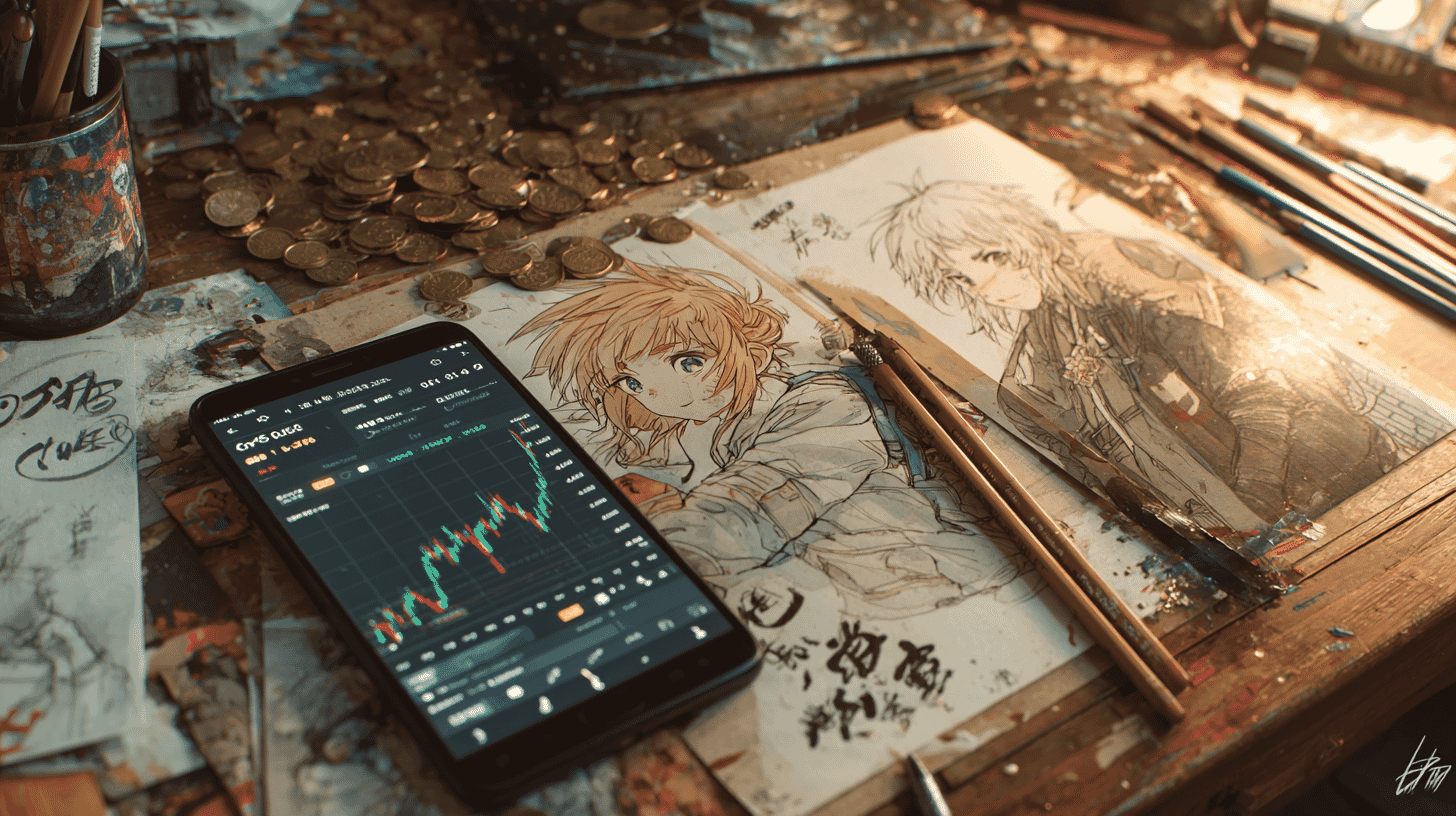
Japan's anime industry has reached its largest-ever global market size, roughly $25 billion. That's more than double the figure from a decade ago, with overseas revenue alone growing ninefold in 12 years. Behind the staggering numbers lies a story of mega-mergers reshaping the industry while animators still earn under $17,000 a year. Here's a look at the light and shadow of anime's golden age.
$25 Billion and Counting: Japan's Anime Market Shatters Records
According to the Japan Animation Association's "Anime Industry Report 2025," the global market for Japanese anime reached ¥3.84 trillion (approximately $25 billion) in 2024, setting a new all-time record. This figure represents more than double the market size from just ten years ago, cementing anime's position as a cornerstone of Japan's content industry.
The overseas market has been the primary growth engine. At ¥2.17 trillion ($14.1 billion) in 2024, international revenue now significantly outpaces the domestic market of ¥1.67 trillion ($10.9 billion). Over the past 12 years, the overseas market has expanded an astonishing ninefold, a pace that few cultural industries anywhere in the world can match.
The catalyst for this explosion has been the global proliferation of streaming platforms like Netflix and Crunchyroll. By making it easy and affordable to watch anime across borders, these services introduced Japanese animation to audiences who previously had no access. The COVID-19 pandemic's stay-at-home era further amplified this trend, creating a worldwide surge in anime fandom virtually overnight.
From Sideshow to Main Stage: A Corporate Strategy Shift
Beyond streaming infrastructure, there's been a fundamental change in how Japan's major entertainment companies view anime. For decades, anime was treated as a niche segment: profitable but secondary. That perception has completely flipped.
Sony Group led the charge. In its 2018 mid-term strategy, Sony explicitly identified anime as a core pillar of its overall business for the first time. Around the same period, Toho, Japan's biggest film studio, declared anime its "fourth pillar" alongside live-action films, theater, and real estate. Broadcasters, advertising agencies, and publishers quickly followed suit, all scrambling to strengthen their anime operations.
The primary tool they've used to execute this strategic shift? Mergers and acquisitions.
The Upside of M&A: Turbocharging Global Expansion
Sony's M&A playbook has redrawn the anime industry map. In 2017, it acquired Funimation, North America's largest anime distributor, for roughly $150 million. Then in 2021 came the blockbuster deal: the acquisition of Crunchyroll, the world's largest anime streaming platform, for $1.175 billion. The fact that a billion-dollar M&A deal could happen in what was once considered a "niche" entertainment sector speaks volumes about how dramatically the market has evolved.
In December 2024, Sony invested an additional ¥50 billion ($325 million) in KADOKAWA, becoming its largest shareholder. The strategic alliance aims to leverage KADOKAWA's vast IP library, including franchises like Sword Art Online, Re:Zero, and Elden Ring, through Sony's global distribution networks. Sony has earmarked ¥1.8 trillion ($11.7 billion) for growth investments, including M&A, through its current mid-term plan ending March 2027, signaling that the acquisition spree is far from over.
Sony isn't alone in this race. In 2024, KADOKAWA acquired Doga Kobo, the studio behind Oshi no Ko. Bandai Namco bought Eight Bit, known for Blue Lock. CyberAgent acquired Nitroplus, a content creator with deep IP experience. Broadcasters have been snapping up production studios as well, with the entire industry racing to secure creative resources.
These deals have delivered tangible results: faster overseas market entry, more stable production pipelines, and more efficient IP monetization across anime, games, merchandise, and live events. Crunchyroll's paid subscriber base has continued to grow post-acquisition, dramatically expanding the global audience for Japanese animation.
The Downside of M&A: The Distortions of Consolidation
However, rapid industry consolidation has also created new problems.
The widening gap between large and small studios is perhaps the most visible concern. As deep-pocketed corporations acquire studios and IP, independent small studios find it increasingly difficult to secure talent and projects. Major studios are booked with productions three to four years in advance, while smaller players struggle to land contracts at all.
Creative conservatism is another consequence. Under Japan's "production committee" (seisaku iinkai) system, where multiple companies jointly fund a project, there's inherent pressure to greenlight only "safe" adaptations of popular manga or light novels. As organizations grow larger through M&A, the appetite for risky original projects tends to shrink further. The result: more adaptations of proven source material, fewer original anime productions.
IP concentration is a deeper structural risk. When a handful of mega-conglomerates control both major IP catalogs and global distribution channels, independent creators and studios may find it harder to reach audiences, potentially stifling the very creativity that made anime a global phenomenon in the first place.
Are the Creators Seeing Any of the Money?
The most pressing issue in this $25 billion industry is that the boom's financial rewards aren't reaching the people who actually create the content.
A government-commissioned survey ("Animation Creator Working Conditions Survey 2023") found that the average annual income across all anime production roles was approximately ¥4.55 million ($29,500), close to the national average. But this figure includes higher-earning roles like producers and sound directors. For animators who actually draw the frames, the picture is starkly different. "In-between" animators, who create the transitional frames that bring movement to life, earn an average of about ¥2.63 million ($17,000). New hires often earn less than ¥2 million ($13,000).
The root cause is structural. Under the production committee system, even when an anime becomes a massive hit, merchandise revenue and streaming profits flow primarily to the investing companies, not to the studios or individual animators who made the show. A layered subcontracting system (prime contractor → subcontractor → sub-subcontractor) further compresses what reaches the frontline workers.
Between 50–70% of animators work as freelancers, meaning many lack social insurance, workers' compensation, or any safety net. Most are paid per piece rather than per hour, so a single illness can mean zero income. The UN Human Rights Council has flagged Japan's anime production conditions as potential "labor exploitation," a characterization that landed hard across the industry in Japan.
What the Industry Needs Next
The Japanese government has set an ambitious target of growing the content industry's overseas market to ¥20 trillion ($130 billion) by 2033. In 2024, a government-and-industry council was established to tackle production-floor working conditions and other challenges. The government has positioned content exports, worth roughly ¥5.8 trillion in 2023, as comparable in scale to steel and semiconductor exports, and designated the sector a core national industry.
Industry-led initiatives are also emerging. The anime labor organization NAFCA was established in 2023 to advocate for better working conditions. Sony's Aniplex division is developing custom software specifically for anime production, aiming to digitize key workflow steps and reduce the grueling hours that have long plagued the industry. AI-powered startups are beginning to offer tools that could dramatically cut production time.
But sustainable growth requires more fundamental structural reform: transparent revenue sharing, legal protections for freelancers, fair production budgets, and room for diverse creative visions. Without these changes, the "$25 billion market" rests on a fragile foundation.
The creative power that captivates audiences worldwide comes from the passion and skill of countless individual creators, many of whom remain anonymous and underpaid. Whether the industry can build a system that fairly shares the fruits of growth with these artists will be the defining question for Japanese anime's next decade.
In Japan, the anime industry's explosive growth and wave of mega-mergers are sparking intense debate. Some celebrate the global expansion these deals enable, while others insist that "only the executives are profiting while nothing changes on the ground floor." In your country's animation or creative industries, do the people who actually make the content benefit when the industry booms?








Global Discussion
15 comments