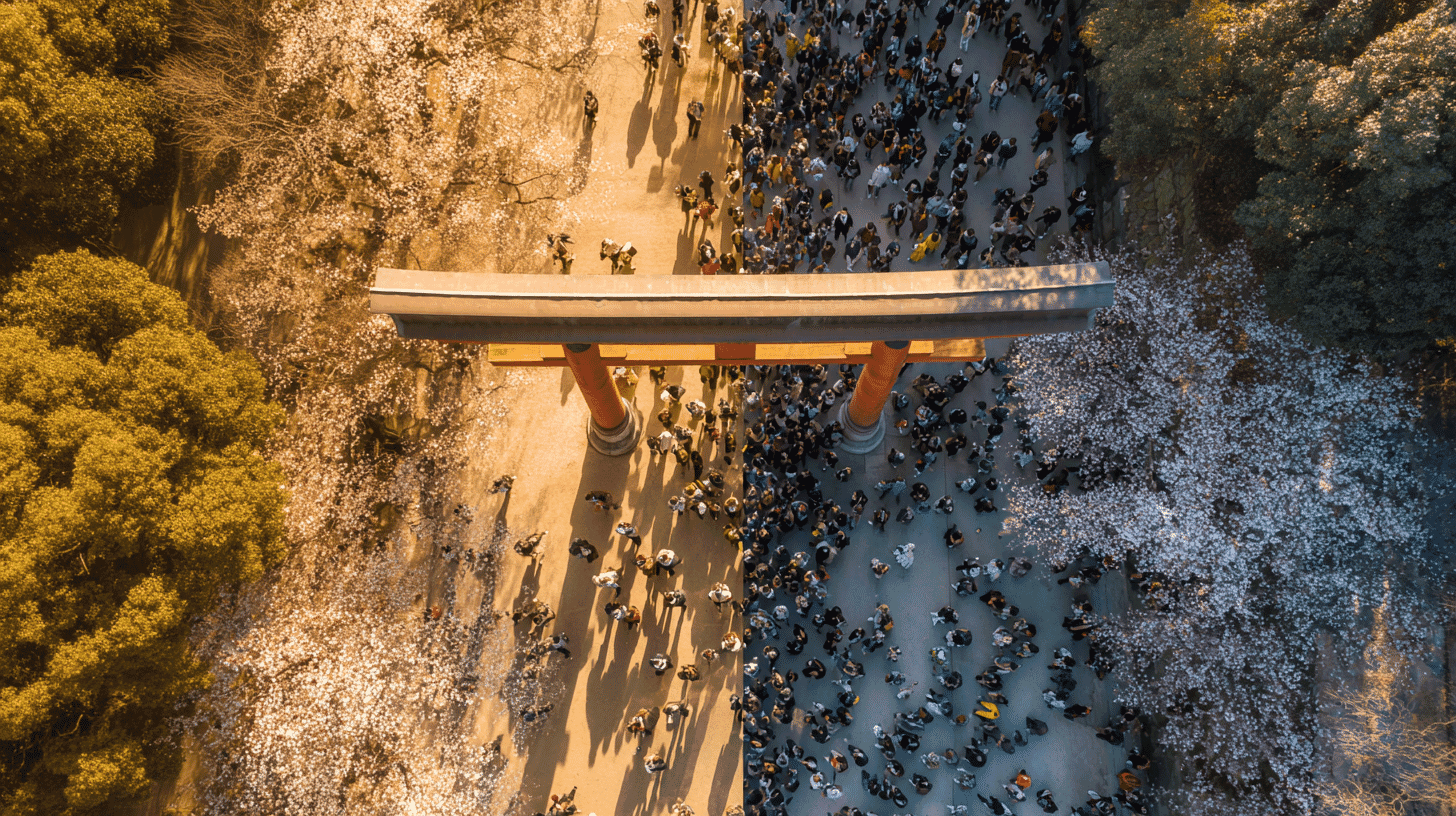
We want tourists to come, and we also want to protect residents' daily lives. Making both of those true at once is what Japan's new tourism plan, approved in March 2026, is trying to do: welcome more than 42 million foreign visitors a year while maintaining quality of life across 100 regions. Coexistence rather than exclusion.
Japan Approves New 5-Year Plan to Tackle Overtourism Nationwide
On March 27, 2026, Japan's Cabinet approved the fifth Tourism Nation Promotion Basic Plan, covering fiscal years 2026 through 2030. At its heart is a large expansion of overtourism countermeasures.
The headline number: Japan aims to double the number of regions implementing anti-overtourism measures from 47 today to 100 by 2030. The indicator itself is new, and this is the first time the government has attached a numerical target to overtourism at all.
The plan also triples the international departure tax, introduced in 2019, from ¥1,000 ($7) to ¥3,000 ($19) per person from July 1, 2026. The additional revenue will fund subsidies for local governments fighting overcrowding, infrastructure improvements, and crackdowns on illegal private lodging operators.
Yet Japan isn't backing away from growth. The plan holds its targets of 60 million annual foreign visitors and ¥15 trillion ($94 billion) in tourism spending by 2030. Provisional figures put 2025 arrivals at a record 42.68 million. New alongside those headline numbers: a target of 40 million repeat visitors, two-thirds of the 60 million total, and 130 million overnight stays in regional Japan. The reasoning is that repeat visitors are more inclined to go beyond the usual circuit, which spreads the load.
Understanding the Real Problem
The Japanese term for overtourism is sometimes translated as kankō kōgai (観光公害, literally "tourism pollution"), but Japan's Tourism Agency has pushed back on this framing. The issue isn't that tourism itself is harmful. It's that visitors concentrate in specific places at specific times, overwhelming local capacity.
Japan faces a unique dimension of this problem. During the COVID pandemic, the tourism and hospitality industry lost massive numbers of workers who never returned. Domestic travel demand recovered first, and when international visitors surged back on top of that, the system was pushed past its breaking point. Foreign tourists aren't the sole cause; they are the tipping point in an already strained system.
That said, international visitors do tend to cluster at famous spots, and cultural differences can make manner problems more visible. Reports of geisha and maiko (apprentice geisha) being chased and photographed without consent in Kyoto, littering on Mt. Fuji, and tourists wandering into private residential areas in Kamakura have become recurring headlines.
How Japan's Hotspots Are Fighting Back
Kyoto: Steep Tax Hikes and the "Three Dispersals"
As of March 2026, Kyoto City implemented a major overhaul of its accommodation tax. The new rates hit luxury stays hardest: guests at accommodations charging ¥100,000+ ($625+) per night now pay ¥10,000 ($63) in lodging tax alone, the highest in Japan.
Kyoto's broader strategy is built around what officials call the "three dispersals", spreading visitors across different locations, time slots, and seasons. An AI-powered congestion prediction system broadcasts real-time crowding levels. Tour buses are redirected away from peak areas. A "hands-free tourism" initiative encourages visitors to ship their luggage ahead rather than hauling large suitcases onto crowded city buses.
The city has also published the "Kyoto Tourism Moral" guidelines, a written code of conduct for both businesses and visitors, emphasizing respect for cultural heritage and residential neighborhoods.
Mt. Fuji: Gates, Fees, and No More "Bullet Climbing"
Japan's iconic mountain introduced formal climbing restrictions in summer 2024. On the popular Yoshida Trail, a gate at the 5th Station now caps daily climbers at 4,000 and charges a trail fee of ¥4,000 ($28) as of 2025. The trail is closed from 4 PM to 3 AM to prevent "bullet climbing", the dangerous practice of hiking through the night to catch sunrise without proper rest or acclimatization.
In a widely publicized incident, the town of Fujikawaguchiko erected a black screen to block a convenience store viewpoint that had gone viral on social media, drawing massive crowds that disrupted local life. It was a painful decision, a community forced to "seal off" its own scenic attraction.
Kamakura: Priority Boarding and Crowd Control
Kamakura, already a beloved day-trip destination from Tokyo, saw a new wave of attention after a railway crossing featured in the anime Slam Dunk went viral internationally. The Enoden rail line's Kamakura-Kōkōmae crossing became so overwhelmed with photo-seeking tourists that normal traffic and resident life were disrupted.
In response, the Enoshima Electric Railway tested a resident-priority boarding system. Since most Kamakura visitors are day-trippers, the city is focused on dispersing crowds across times, locations, and seasons.
Himeji Castle: Dual Pricing
On March 1, 2026, Himeji Castle introduced dual pricing. City residents pay ¥1,000 ($6), everyone else ¥2,500 ($16). The split is by address, not nationality: a foreign national living in Himeji pays ¥1,000, a Japanese visitor from outside the city pays ¥2,500. Under-18s are free wherever they live. The outside rate is the highest of Japan's twelve surviving castle keeps. An earlier proposal to charge foreign visitors more was dropped in favor of the residency test.
Shirakawa-go: Responsible Tourism in a Living Village
Shirakawa-go, a UNESCO World Heritage site of traditional thatched-roof farmhouses, receives over 2 million visitors annually, despite the village having only about 1,600 residents. The community adopted a "Responsible Tourism" framework with five rules published in five languages: no fire, take your trash home, no nighttime tourism, no drones, and be considerate when photographing.
Winter light-up events are now fully reservation-based. Without a booking, you can't even enter the parking lot.
Miyajima: A Visitor Tax for Shrine Island
Since October 2023, visitors to Miyajima island (home of the iconic floating torii gate at Itsukushima Shrine) pay a visitor tax added to their ferry ticket. Revenue funds toilet and rest area improvements, enhanced cleanup efforts, and multilingual signage.
Japan's Unique Approach: Community-Driven, Not Top-Down
What sets Japan's strategy apart from European approaches is its emphasis on coexistence rather than restriction. Cities like Barcelona and Venice have imposed taxes and entry fees primarily to reduce tourist numbers. Japan, by contrast, is trying to manage the flow while keeping the door wide open.
The government's "Pioneer Model Region" program requires participating areas to establish multi-stakeholder consultation bodies including local government, transportation operators, accommodation providers, retailers, and, critically, residents. Solutions must emerge from community consensus, not bureaucratic decree.
Twenty-six pioneer regions have been selected, each pursuing context-specific measures: Kyoto redirecting tourists to subway systems, Hakone using digital maps for crowd dispersal, Iriomote Island enforcing entry restrictions under ecotourism law, Aso promoting EVs and bicycles to reduce environmental impact, and Sado Island improving local transit networks.
The Tourism Agency's budget for fiscal 2026 expanded to ¥138.3 billion (roughly $865 million), 2.4 times the previous year. Within that, funding specifically for overtourism prevention and tourism infrastructure jumped 8.34-fold to ¥10 billion.
How Visitors Can Help
If you're planning a trip to Japan, here are practical ways to be part of the solution rather than the problem:
Avoid peak times. Skip Kyoto during cherry blossom and autumn foliage seasons if possible, or visit on weekdays. Many tourist areas now publish real-time congestion data online.
Look beyond the Golden Route. Tokyo-Fuji-Kyoto-Osaka is spectacular, but regions like Tohoku, Hokuriku, Shikoku, and Kyushu offer equally stunning experiences with far fewer crowds. The government is actively investing in making these areas more accessible.
Respect residential spaces. Don't enter private property, keep noise down in neighborhoods, and ask before photographing people, especially maiko and geisha. Japan's famous omotenashi (hospitality) rests on the goodwill and patience of local residents.
Use public transit. Rental cars contribute to congestion. Trains and buses are efficient, scenic, and lighten the load on local roads. Many cities now offer luggage delivery services so you don't need to navigate crowded stations with heavy bags.
Check the rules first. Many areas have specific guidelines published in multiple languages. Spending five minutes reading them before you visit shows respect and prevents misunderstandings.
Do 60 Million Visitors and 100 Regions Add Up?
Read head-on, the plan puts two numbers side by side that do not obviously fit: a growth target of 60 million visitors, and overtourism countermeasures in 100 regions. More people, less crowding.
The hinge is the pair of new targets: 40 million repeat visitors and 130 million regional overnight stays. Raise the total, but scatter the destinations away from the Golden Route, and the load on any single place falls. The logic holds. Whether repeat visitors actually go to the regions is the open question, and it will be settled at the local level rather than in Tokyo.
Does your country face similar overtourism challenges? How do popular destinations near you balance tourist crowds with the daily lives of residents? We'd love to hear about the situation where you live.
References
- https://www.japantimes.co.jp/news/2026/03/27/japan/japan-overtourism-measures/
- https://www.nippon.com/en/news/yjj2026032700357/
- https://japantoday.com/category/national/japan-approves-plan-for-overtourism-measures-in-100-areas-by-2030
- https://www.mlit.go.jp/kankocho/seisaku_seido/kihonkeikaku/jizoku_kankochi/jizokukano_taisei/overtourism.html
- https://www.travelvoice.jp/20250109-156983





Global Discussion
14 comments