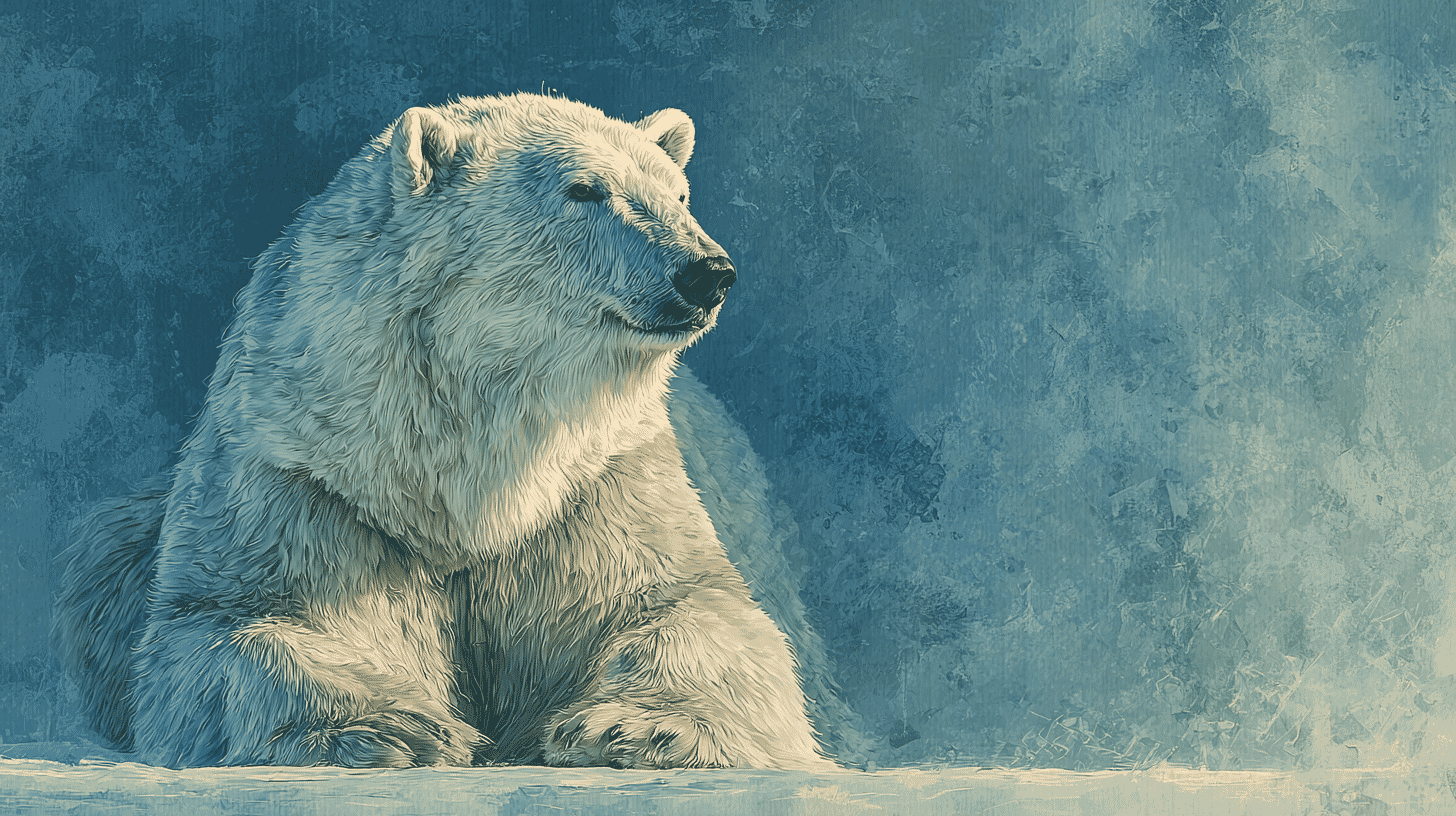
🐻❄️ On a quiet morning in mid-May, Japan's Empress Masako stood in front of a polar bear enclosure in rural Ehime, watched a 26-year-old female munching contentedly on an apple, and softly told her keepers: "What a calm, happy girl she is." Then, as the imperial visit was wrapping up, she turned back toward the bear, waved, and said three words that have since echoed across Japanese social media: "Nagori-oshii": "I hate to leave."
The bear's name is Peace. She holds Japan's longevity record for a hand-raised polar bear. She was born in this same town more than a quarter-century ago, abandoned by her mother, and saved by a young keeper who took her home and raised her like one of his own children, in a third-floor apartment that didn't allow pets.
Even by the standards of Japan's many beloved zoo animals, Peace's story is something else entirely.
A miracle that almost didn't happen
Peace was born on December 2, 1999, at the Ehime Prefectural Tobe Zoo. She weighed 680 grams, about as much as a paperback book. Her twin was born at the same time, but their first-time mother, a Danish-born polar bear named Barriba, panicked and bit one of the cubs almost immediately. Despite emergency treatment, the second cub died two hours later. Barriba then refused to care for Peace, growing increasingly aggressive.
This was a near-death sentence. At the time, Japan had documented 122 polar bear births in captivity, but only 16 cubs had ever survived past six months. The longest any hand-raised cub had lived was 104 days. There were zero documented successes of fully hand-rearing a polar bear in Japan.
The zoo placed Peace in an incubator. By every statistical measure, she was unlikely to make it.
The keeper who took her home
What changed her odds was a then-29-year-old keeper named Atsuhiro Takaichi, who had been working at Tobe Zoo since 1988. Takaichi insisted, over considerable institutional hesitation, that he be allowed to attempt full hand-rearing.
The first wall was milk. He tried a marine-mammal formula intended for seals; Peace developed diarrhea. He switched to diluted puppy formula and slowly adjusted the concentration until he found a mix her tiny system could tolerate.
The second wall was time. Newborn polar bear cubs are catastrophically fragile and need round-the-clock care. Working hours alone were not enough. So Takaichi did something almost no one would do: he started bringing Peace home with him at night.
There was one problem. His family lived in a public-housing block where pets were forbidden. So they hid her. They wrapped her in baby supplies and smuggled her in and out. Takaichi's wife and their two young children (a daughter then around 8, a son around 6) became part of the operation, taking turns feeding and watching the cub. The daughter, it's said, often slept beside Peace at night.
The third wall was temperature. As Peace grew, she kept overheating. The family progressively cooled her environment: first by turning off heaters, then opening windows in the dead of winter, until the keeper room had to be moved outdoors entirely. For months, the Takaichi family slept with their windows open through one of the coldest winters of their lives.
By the time Peace was around 110 days old, she had outgrown the apartment. She moved into the bear house at Tobe Zoo for good. But by then, something more important than survival had happened: Peace had imprinted on Takaichi as her parent.
A quarter-century later, she still recognizes him.
What it means to "succeed"
Peace's hand-rearing was, scientifically, a landmark. Takaichi kept exhaustive daily logs of every feeding, every measurement, every milestone. That diary later became the de facto manual for hand-rearing polar bears at zoos across Japan. When other facilities have faced similar situations (a rejecting mother, a fragile cub), they have turned to the Peace files.
But "success" in this case is more complicated than survival statistics suggest. Polar bears in the wild typically live 15 to 18 years by SeaWorld's reckoning, with very few reaching 25. In zoos, life expectancy is closer to the early-to-mid 20s, with rare individuals reaching their late 30s or even 40s; the global record is Debby, at Winnipeg's Assiniboine Park Zoo, who was born in 1966 and died in 2008 at 42. Peace, at 26, is well past the average for her species in captivity, and she got there despite a string of serious health setbacks.
She developed epilepsy at age 3. The seizures have been serious enough that, on one occasion, Takaichi reportedly rescued her from drowning when a fit struck while she was in the water. She underwent surgery for an umbilical hernia at 7. In late March 2026 an infected wound on her right foreleg left her unable to stand; she came off display on March 27, had the wound cleaned and stitched under general anesthesia on March 30, and returned to public view on April 7. Her ongoing medication regimen is hard on her liver, and routine blood draws, once requiring full anesthesia, are now done with her cooperation: she calmly extends an arm through the bars while Takaichi works.
That last detail is the part that quietly devastates people who follow her story. It is not just an old animal humoring her keeper. It is a 250-kilogram apex predator, with every instinct to fight or flee, choosing to trust the man who once smuggled her past a no-pets-allowed sign.
"What a calm, happy girl"
This is the context for the Empress's visit on May 17, 2026.
The imperial couple were in Ehime for the 76th National Tree-Planting Festival, an annual event with a long tradition of imperial attendance. The Tobe Zoo stop was a side visit, but a clearly meaningful one. The Empress asked careful questions about Peace's appetite ("Is she still eating well?"); the Emperor asked Takaichi whether her epilepsy was a constant worry. By the zoo's own account, he also said he was glad to hear she had recovered from the March scare, and the Empress told the keepers she had watched Peace on television and had dreamed of meeting her. When Takaichi walked them through the 26 years, the Empress was moved to tears. They watched Peace work through a favorite apple, posed for a photo, and called her by name.
It was a small moment. But the line that traveled afterward, "穏やかで幼いころから可愛がられて幸せな子ですね", roughly "What a calm, happy child, cherished since she was tiny", landed because it captured exactly what people who have followed Peace for 26 years have always thought about her: that whatever else can be said about polar bears in captivity, this particular bear has been profoundly loved.
And then, as the Empress left, came the word that made the news.
Nagori-oshii is hard to translate. The closest English equivalents are clumsy: "reluctant to part," "I hate to say goodbye," "this is hard to leave behind." It carries a small ache. It is the kind of word a Japanese guest uses when leaving a meal they wish would continue, or when saying farewell to someone they may not see again. Used in front of a 26-year-old polar bear with epilepsy, it carries a slightly different weight.
The harder conversation that runs underneath
It would be tidy to end the story here. But honest reporting on Peace has to acknowledge the harder layer underneath the wave goodbye.
Polar bears are listed as Vulnerable on the IUCN Red List. Their wild populations are in trouble largely because of climate change shrinking sea ice, a phenomenon happening fastest in the Arctic, very far from Ehime. Modern zoo ethics around large predators have shifted significantly since 1999; many zoologists question whether polar bears should be kept in temperate-climate enclosures at all, particularly in countries where summers regularly exceed 35°C.
These are real debates. They are not settled by saying "but Peace is loved." They sit alongside her story, not against it.
What Peace's life arguably does provide is data. The records from her artificial rearing (the milk formulas, the temperature management, the seizure care, the slow buildup of trust required for unanesthetized medical procedures) have measurably helped Japanese zoos manage subsequent polar bear cubs. That is a small contribution to a species in trouble, but it is a contribution.
It is also, perhaps, what the Empress was registering. Not just the cute bear having an apple, but the entire 26-year project sitting behind her: the family that broke their housing rules, the keeper who is now in his mid-50s and still showing up every day, the painstaking diary that became a textbook, and the bear who learned to give blood without restraint.
What's it like in your country?
In your country, is there a single zoo animal whose name everyone of a certain generation knows? A creature whose story (the rescue, the unlikely survival, the keeper who became family) quietly became part of the national memory? We'd love to hear about them. Peace is Japan's. But she is probably not the only one.
References
- 天皇皇后両陛下 県立とべ動物園を視察 ホッキョクグマとご対面 「名残惜しい」(テレ朝NEWS)
- 天皇皇后両陛下が"奇跡のシロクマ"「ピース」と対面(FNNプライムオンライン / Yahoo!ニュース)
- Emperor and empress meet with disaster-affected people in Ehime (The Japan Times)
- ピースのおいたち(愛媛県立とべ動物園 公式)
- ピース (ホッキョクグマ) / Wikipedia
- 祝21歳!いくつになってもキュートなピース(とべもり+)
- Polar Bear Lifespan & Captivity Records (SeaWorld Parks)
- The imperial visit to Tobe Zoo (Tobe Zoo official)
- Peace returns to public view, April 7 (Tobe Zoo official)





Global Discussion
0 comments