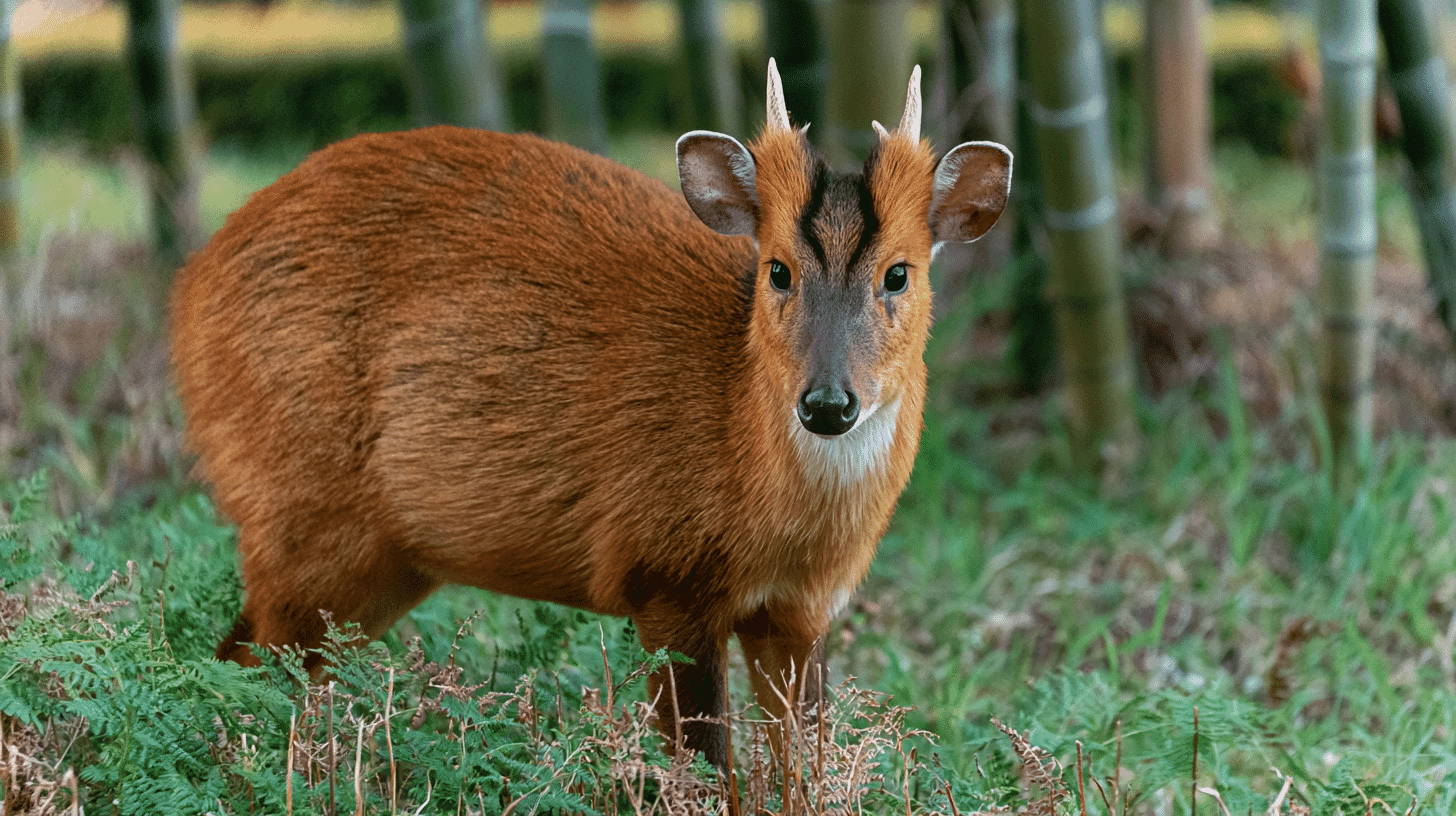
🦌 WANTED: Reeves's muntjac. Reward: ¥2,000 (about $13) for a usable photo or video. Issued by: the Ibaraki Prefectural Government, Japan. That's the actual policy, not a parody. In late April, a 45-year-old farmer in southwestern Ibaraki filmed one, the prefecture's first confirmed muntjac sighting in two years and five months. He turned the money down. To understand why a Japanese prefecture is offering cash for snapshots of a small, deer-eyed mammal that looks like it walked out of a children's book, you need to know what this animal does once it settles in.
What is a muntjac, exactly?
Reeves's muntjac (Muntiacus reevesi) is a small deer native to southern China and Taiwan. Adults stand about 50 centimeters at the shoulder, roughly the size of a medium dog, and weigh about 10 to 18 kilograms. Their coat is a warm russet brown, with a white patch on the throat. Males have short, two-pronged antlers. They have dark gland-marks under each eye that give them a wide, plaintive expression. If you saw one in a forest, you would almost certainly want to take a picture.
They make a distinctive call when alarmed, a sharp, dog-like bark that can repeat for minutes. In English they're sometimes called "barking deer." In Japanese, they're called kyon.
They look harmless. They are not.
Why Japan is paying ¥2,000 per sighting: what this animal actually does
A single muntjac is, on its own, no threat to anything bigger than a vegetable patch. The problem is what happens when there are 90,000 of them. Once a breeding population establishes, four things start going wrong at once.
Crops, gardens, and the cost of small bites. Muntjac don't trample rice paddies the way wild boars do. They graze quietly, low to the ground, eating the tender parts: cabbage heads, daikon greens, carrot tops, strawberries, fresh lettuce, garden flowers. In Chiba Prefecture's official accounting, muntjac-specific crop damage has run between a few million and about ¥9 million a year, modest compared to wild boar, but news outlets and local growers report a much wider economic hit when home gardens, ornamental plantings, and abandoned farmland are factored in. Some local reports put real-world losses around ¥100 million (about $630,000) a year. The character of the damage isn't dramatic destruction. It's a slow, persistent erosion of every cultivated thing within reach.
Forests that don't grow back. This is the part biologists actually worry about. Muntjac browse the forest understory, the shoots, the seedlings, the herbaceous plants that should eventually become the next generation of trees. Where muntjac density is high, woodland regeneration stops happening. The canopy you see today is the canopy you'll see in thirty years, except a little older and a little thinner. Britain, which has had muntjac since 1925 thanks to escapes from Woburn Abbey, has measured this effect for decades. Bluebells, dormice, and songbird nesting habitat all decline in muntjac-heavy woods. Japan's environment ministry has been blunter than usual on this point: the worry is permanent biodiversity loss, not just temporary inconvenience.
Ticks and a disease that kills humans. This is the new and most uncomfortable concern. Muntjac, like other deer, carry ticks. Some of those ticks carry SFTS (Severe Fever with Thrombocytopenia Syndrome), a viral disease first identified in China in 2011, present in Japan since 2013, and reportable as a Class IV infectious disease. SFTS has a domestic case fatality rate of roughly 27 percent. That is not a mild illness. As of July 31, 2025, Japan had logged 1,185 cumulative cases. A 2021 study found antibodies against the SFTS virus in wild deer and boar in Chiba, confirming the virus circulates in the same wild-mammal communities muntjac belong to. As muntjac push into residential gardens and farmland in Chiba, the surface area where humans, pets, ticks, and the SFTS virus can meet expands. No one is saying muntjac are the cause of SFTS. They are, however, exactly the kind of mid-sized, garden-tolerant mammal that helps tick-borne diseases find new hosts.
Cars and the road. This isn't speculation either. In England, where muntjac have spread for a century, the species now accounts for roughly 25 percent of all reported deer-vehicle collisions, the third most-involved species after fallow and roe deer. The UK as a whole sees an estimated 40,000 to 74,000 deer-vehicle collisions per year, costing the economy up to £50 million. Muntjac are small, fast, and active at dawn and dusk. They are exactly the wrong size to spot at 50 km/h on a country road.
So no, the ¥2,000 isn't really for the photo. It's for the system that the photo helps build.
What's already happened next door: the Chiba lesson
Reeves's muntjac arrived in Japan from two leakage points: Izu Oshima Island off Tokyo, and the Boso Peninsula in Chiba, where animals are widely believed to have escaped from a now-defunct leisure park called Namegawa Island between the 1960s and 1980s.
For decades, no one took it seriously. They were "cute." They were "just a few." Japan's environment ministry didn't designate them as a specified invasive alien species until much later. Then the numbers caught up.
The Chiba prefectural government estimated about 13,300 muntjac in 2006. Its latest figure for fiscal 2024 is 94,100, roughly seven times more in under two decades. Established populations have been confirmed in 18 municipalities across the southern peninsula, up from five in 2004. The "distribution expansion prevention line" that Chiba drew across the middle of the peninsula has already been breached in places. Muntjac have been confirmed north of it in Mobara, and further north still in Narita and parts of Chiba City. In its third control plan, adopted in March 2026 and covering fiscal 2026 onward, Chiba raised its annual capture target from 8,500 to over 18,000 animals. The plan is candid about what that buys: culling 18,000 a year is what it would take to bring the population down to roughly 80 percent of the fiscal 2024 estimate by the end of fiscal 2030. Five years of intensified culling for a twenty percent reduction.
This is what an invasion looks like in slow motion.
What happens if nobody stops them: the British future
If Japan wants a preview of what "we'll deal with it later" looks like fifty years on, Britain has the receipts.
A handful of muntjac escape from one English estate around 1925. Nobody pays much attention. By the 1960s they are still considered a charming oddity in a few southern counties. By 2016, they occupy 887 separate 10-kilometer-square grid cells, almost all contiguous, across England, and have begun appearing in Wales, Northern Ireland, and increasingly continental Europe. The British population has roughly tripled since 1995. The species is now listed by the EU as an Invasive Alien of Union Concern, and biologists estimate that annual culls of up to 30 percent of the population are needed just to keep numbers stable, not to reduce them.
England now spends meaningful public money on a deer it never wanted. Ancient woodlands are visibly degraded. Bluebell carpets are thinner. Garden owners across southeast England describe muntjac the way Japanese drivers will eventually describe muntjac: as a fact of life, like rain or potholes.
This is the trajectory Ibaraki is trying to abort. Not because muntjac are uniquely evil, but because the British experience suggests that the window between "occasional sighting" and "permanent fixture" is roughly one human generation. Japan's environment ministry, Ibaraki's biodiversity center, and Chiba's wildlife management division all use the same word: eradication. They use it only because, in Ibaraki, it might still be technically possible. In Chiba, that word has quietly been replaced with control. In Britain, it was never on the table.
Source: Ibaraki Prefectural Government
A bamboo grove, a deer, and a phone camera
Now the actual event in Ibaraki.
On April 27, in the Tsukazaki neighborhood of Sakai (a small town in the southwestern corner of Ibaraki Prefecture, across the Tone River from Saitama), a resident phoned the town office to report that "a muntjac has been hanging around the garden." Municipal staff arrived to find an adult male grazing on undergrowth in a nearby bamboo grove.
The town placed a box trap. The animal ignored it. Officials describe muntjac as nervous and wary, a fitting reputation for an animal whose only real defense is vanishing into thick cover. On May 11, the same animal was spotted again at a different house in the same area. Police and town officials tried to catch it with a net. It slipped through. Sakai is now considering a foot snare.
This was the fifth confirmed muntjac sighting in Ibaraki since 2017, and the first in roughly two and a half years. All five animals confirmed in the prefecture have been male. None has been a female. That distinction is the entire ballgame: a solitary male in unfamiliar territory dies alone. A breeding female changes the calculus for the whole prefecture.
The farmer who first saw it filmed the animal on his phone. Under Ibaraki's bounty rules, the video qualifies. He told the Ibaraki Shimbun he wouldn't be filing for the reward. "I don't want the money," he said. "I called because if my fields get torn up, I'll be in trouble."
¥2,000 per photo: how the bounty actually works
Ibaraki launched the program in May 2024. It pays ¥2,000 per submission for any video or still image, taken inside the prefecture from April 2024 onward, that clearly shows the whole body of a live muntjac. Screenshots from TV broadcasts or the internet don't count. The image needs to be the citizen's own. A parallel scheme pays ¥30,000 for each animal captured.
The logic is straightforward and the precedent is invasive-species 101: eradication is exponentially cheaper at the invasion-front stage than after a breeding population establishes. But you can't dispatch traps and hunters if you don't know where the animals are. Salaried biologists can't be everywhere. Farmers, gardeners, and dog-walkers can, if you give them a reason to look and a clear channel for reporting what they see. The ¥2,000 isn't a salary. It's a thank-you nudge designed to lower the friction of picking up the phone.
Florida, dealing with invasive Burmese pythons in the Everglades, runs a similar logic but inverted. The Florida Python Challenge pays cash for kills, not photos, and at this scale of invasion, that's the only intervention that still moves the needle. More than 27,000 Burmese pythons have been reported removed from Florida since 2000, over 11,000 of them by the contracted removal teams launched in 2017. The annual competition drew 934 participants in 2025 and took a record 294 snakes. Florida no longer talks about eradicating pythons. They talk about ecological triage. Japan, at this stage in Ibaraki, can still afford to be more ambitious, for now.
Why Ibaraki is the front line
A small deer escapes a leisure park in southern Chiba in the 1970s. Why is Ibaraki, on the north side of greater Tokyo, where the line is being drawn?
Because muntjac are slow but persistent. Their natural range expansion is on the order of one kilometer per year, but they get help: occasional unrecorded transports, the ability to slip through ordinary fences, and a willingness to inhabit surprisingly urban environments. The Chiba "absolute defense line" across the middle of the peninsula has already been breached. Once muntjac cross the Tone River into Ibaraki, or get carried across it accidentally, they enter the Kanto Plain, the densely populated lowland that holds most of greater Tokyo, with no obvious natural barrier until they reach Tohoku.
The first confirmed muntjac in Ibaraki was found dead on a bridge over the Tone in 2017. Since then, the prefecture has logged sightings in Kamisu, Ishioka, Chikusei, Shimotsuma, and now Sakai. All males. All isolated. The fifth in eight years is either a string of unrelated escapes the system catches in time, or the early frames of the same movie Chiba has been playing for fifty years. Nobody knows yet which.
What's next
Sakai will keep trying to remove the Tsukazaki muntjac. A foot snare, more patience, perhaps an infrared camera. The bounty program will keep running whether anyone claims it or not. The serious question is whether Chiba's containment line holds, and whether the muntjac in Ibaraki today is the last one, or the first one anyone bothered to film.
Hidden inside the farmer's refusal is a second question worth holding onto. The first qualifying citizen in Japan's first invasive-species photo bounty system was someone who didn't want the cash. The program worked anyway: he picked up the phone. But it's a quiet reminder that the most durable early-warning network for invasive species might not be the one driven by money. It might be the one driven by people who refuse to watch their fields, their gardens, and their woods be quietly erased.
Update. On May 31, 2026, a muntjac wandered into a greenhouse in Shimo-Ono, Koga, and local hunting-association members and city staff drove it into a box trap and killed it. A limp and other markings matched the Sakai animal, and it is believed to be the same deer. It was the first muntjac ever captured in Ibaraki (Ibaraki Shimbun, June 2, 2026). The prefecture's confirmed count now stands at six animals as of June 4, 2026.
How does early warning for invasive species work where you live? A network of professional biologists? A citizen science app? A bounty for the kill, like Florida? Or just whoever happens to be paying attention?
References
- Ibaraki Shimbun: Muntjac sighted in Sakai-machi (Japanese)
- TV Asahi News report on the sighting (Japanese)
- Tokyo Shimbun: Launch of Japan's first muntjac photo reward (Japanese)
- Ibaraki Prefecture muntjac sighting reward program (PDF)
- Chiba Prefecture muntjac control plan (PDF)
- Daido Life Welfare Foundation: SFTS antibodies in wild deer and boar in Chiba (PDF)
- Japan Institute for Health Security: SFTS surveillance report
- RSPCA: Deer-vehicle collisions in the UK (PDF)
- Ward, Richardson & Mergeay (2021): Reeves' muntjac populations continue to grow and spread across Great Britain
- South Florida Water Management District Python Elimination Program






Global Discussion
4 comments