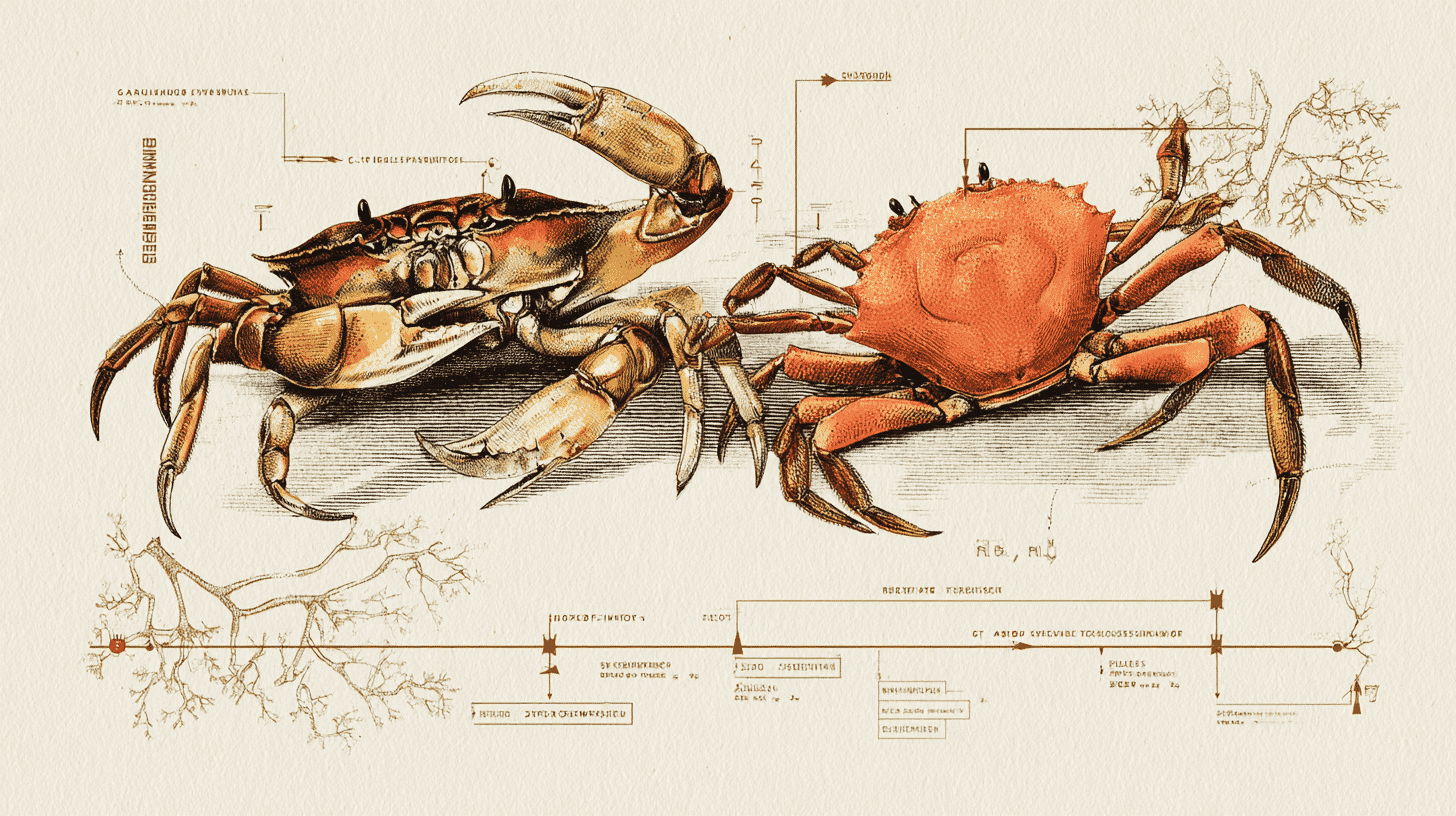
In Japanese, "kani aruki" (crab walking) is shorthand for moving sideways, but that universal image isn't actually universal. Not every crab walks sideways. So when did this strange habit start, and why? An international team from Japan, the United States, and Taiwan, led by Nagasaki University, has traced the origin to a single evolutionary event around 200 million years ago: the early Jurassic, just after the end-Triassic mass extinction. Their finding, published in eLife, suggests that one quirky shift in how a small group of crustaceans walked may have helped seed the roughly 7,900 species of crabs alive today.
Why "sideways walking" is biologically weird
The crab-walks-sideways trope is so common that few people stop to ask whether it's actually unusual. It is. Across the animal kingdom, from vertebrates to insects, sideways locomotion as a default is essentially nonexistent.
And not even all crabs do it. Primitive groups such as the frog crab (asahigani) and several deep-sea species walk forward. The closely related hermit crabs (infraorder Anomura) also move forward. So within the true crabs (infraorder Brachyura), sideways walking is dominant but not universal, and in their nearest relatives it is the exception.
That raises a deceptively simple question: when, and how many times, did sideways walking evolve?
Filming 50 species, then mapping them onto a family tree
The research team, led by Associate Professor Yuuki Kawabata (fish behavioral ecology) of Nagasaki University's Graduate School of Integrated Science and Technology with graduate students Junya Taniguchi, Tasuku Inoue and Kano Furuhara, plus collaborators in the US and Taiwan, gathered 50 species of crabs.
Each species was placed individually in a circular tank designed to mimic its natural habitat and recorded for ten minutes. Analyzing the direction of travel, the team classified 35 species as "sideways walkers" and 15 as "forward walkers."
The clever part comes next. The team mapped these behavioral classifications onto the most up-to-date molecular phylogeny of crabs: the 344-species, 10-gene tree published by Wolfe et al. (2024). A phylogenetic tree is a kind of family tree built from DNA evidence, showing how groups of organisms are related and roughly when their lineages split. By overlaying walking behavior onto each branch and applying ancestral state reconstruction, they could estimate, with statistical probability, whether the common ancestor at every node likely walked forward or sideways.
Hermit-crab cousins split off, then 70 million years later, sideways walking suddenly appeared
The reconstruction told a clean story.
The shared ancestor of crabs and hermit crabs, a group called Meiura, is estimated to have diverged around 270 million years ago. The reconstruction puts that ancestor as a forward walker, along with all of its direct descendants leading to modern hermit crabs.
Then, around 200 million years ago, in a lineage called Eubrachyura, sideways walking appeared. From that single innovation, the behavior spread, and was almost never lost, even as the descendants diversified into thousands of forms across the world's oceans, rivers and shorelines.
In other words, sideways walking wasn't a recurring "useful trick" that evolved over and over again. It was a one-time evolutionary jackpot that stuck.
The timing matches a global reset
The 200-million-year mark isn't arbitrary. It sits right after the end-Triassic mass extinction (~201 million years ago), one of the "Big Five" extinction events in Earth's history. That extinction wiped out a large fraction of marine life, leaving ecological niches wide open in the early Jurassic seas.
It was also a period when the supercontinent Pangaea was breaking apart, opening up new shallow-sea habitats around the world. The combination of empty niches and expanding shallow habitats was a generous opportunity for any group of animals with a new trick to exploit.
The Nagasaki team suggests that this rich early-Jurassic seascape is exactly what allowed the new "sideways walking" lineage to spread, diversify, and stick around.
What's so good about walking sideways?
Sideways locomotion has several plausible advantages:
- Quick lateral changes of direction in either direction
- Movements that are harder for predators to predict
- The ability to slip into rock crevices or thread between sand grains using the body's narrowest dimension
Early Jurassic shallow seas were teeming with new fish lineages and cephalopods, many of them serious predators of small invertebrates. A crab that could dart left or right unpredictably had a meaningful edge in not getting eaten. Over millions of generations, that edge can compound.
Behavior, not just bodies, drives evolution
The implications go beyond crabs.
When most people think about evolution, they imagine changes in shape, size or colour, the visible structural traits. This study highlights something subtler: behavior itself, the how of moving, can shape what evolves and what flourishes. Animals don't just adapt their forms; they sometimes adapt how they use those forms, and that change alone can open up entirely new ecological possibilities.
Today's roughly 7,900 crab species inhabit deep oceans, intertidal zones, freshwater rivers and even land. The fact that this radiation may trace back to one behavioral tweak 200 million years ago is a striking link between behavioral ecology and paleontology.
Why this resonates in Japan
Japan has an unusually intimate relationship with crabs. Snow crabs (zuwai-gani), king crabs (taraba-gani, which are biologically hermit crabs and walk forward), hairy crabs (kegani), swimming crabs (watari-gani) and freshwater crabs (sawagani) all carry seasonal and regional meaning: winter hot pots, summer river play, festive gifts. The country's coastal cuisine is hard to describe without crabs.
Kawabata puts it in numbers: of roughly 7,900 crab species worldwide, only about 400 primitive ones, the frog crab among them, still walk forward. The remaining 7,500 or so descend from lineages that switched to sideways walking, though a handful later reverted. The frog crab, found in Japanese waters too, is the classic old-school holdout.
What's still unsettled
The team is upfront about the open questions:
- How well does the fossil record back this up? Trace fossils (footprints), exoskeleton symmetry, and limb-joint mechanics in extinct crab groups all need closer examination.
- Does sideways walking measurably improve survival or reproductive success in living species? That requires controlled experiments: predator-prey trials, energy-cost measurements and so on.
- How much do large swimming crabs such as the gazami (Japanese blue crab) differ from bottom-dwelling sideways-walkers in speed and precision?
Combining fossil data with behavioral and genetic experiments on living crabs will eventually let researchers quantify how much "behavioral evolution" really contributed to the success of crabs.
The paper was published as a Reviewed Preprint in eLife on April 21, 2026, by the Japan-US-Taiwan collaboration. It is a small but elegant example of a growing trend: reading evolution not from form alone, but from how creatures actually behave.
Now we're curious: what's it like in your country? Are crabs synonymous with sideways walking where you live, or do you have local species that proudly walk forward? Whether it's a market favorite, a tide pool encounter, or something you spotted on a riverbank, we'd love to hear which crabs are part of your everyday landscape.



Global Discussion
14 comments