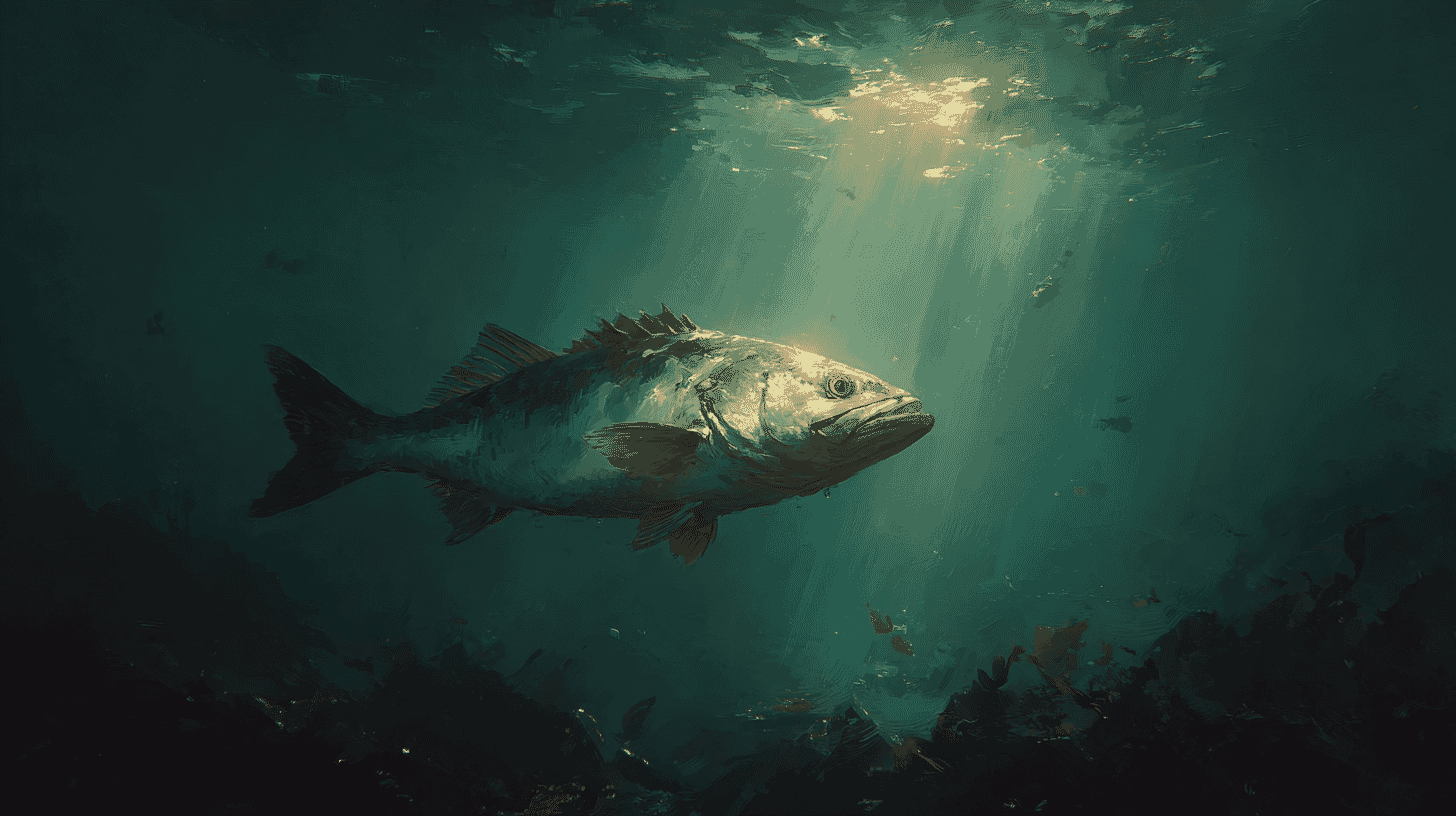
🐟 Getting a mackerel to spawn bluefin tuna sounds like a bad joke. In a Tokyo lab it has been a serious engineering problem for over twenty years, and half of it is already solved: a one-kilogram fish has produced working tuna sperm. The eggs are the part that still refuses to cooperate.
Borrowing another fish's body
The technique has an unglamorous name, "surrogate broodstock," and a fairly simple premise. Take the stem cells that eventually become eggs and sperm out of one species. Inject them into the newly hatched larva of a different species. Wait. If it works, the host grows up and produces gametes that are not its own, and its offspring belong entirely to the donor.
Goro Yoshizaki of the Tokyo University of Marine Science and Technology has been building this method since the early 2000s. Two quirks of fish biology make it possible. Newly hatched larvae have immune systems too undeveloped to reject foreign cells, so a transplant that would fail in an adult slips through unchallenged. And the injected cells, dropped into the body cavity rather than placed surgically, find their own way to the gonads, drawn by chemical signals the host is already emitting.
There is a second quirk that makes the whole thing far more useful. A germ stem cell takes its cue from where it lands, not from where it came from. Cells harvested from a male's testis will become eggs inside a female host. So a single donor testis, which is dense with these cells, can seed both sides of the equation.
The appeal for tuna is arithmetic. A Pacific bluefin needs three to four years and an enormous amount of feed before it can spawn. Kawakawa, a small relative in the same family, reaches maturity at roughly a kilogram. If the small fish can be persuaded to carry the big fish's germ line, the tank shrinks, the feed bill collapses, and the breeding cycle shortens from years to months.
Twenty years, and the females still won't lay
In September 2024, Yoshizaki's group announced that an interspecific kawakawa hybrid had produced functional bluefin tuna sperm at eight months old. The fish weighed about a kilogram. DNA analysis of the next generation confirmed the bluefin genome had come through. The paper ran in Nature Communications that October.
Sperm, though, is the easy half. An egg is not just a nucleus; it comes wrapped in yolk and membrane built from material the mother's body supplies. The donor cell has far less say in the outcome. As Yoshizaki put it to FRIDAY magazine this month, the males make tuna sperm but the females will not lay. Mackerel, spotted mackerel, and various other relatives were all tried as hosts and none of them worked. The team is now testing yet another species.
Even getting to the point of failure takes years. Fish in the mackerel family are migratory, and they spend their lives chasing a narrow band of temperature, salinity, and oxygen. Building a tank system that keeps them comfortable enough to mature in captivity took three to four years for most species Yoshizaki tried, and seven for kawakawa. Twenty years disappear quickly at that rate. Even so, the Nikkei reported that as of October 2024 the team was aiming to produce a surrogate-born bluefin within roughly five years.

Source: gonodactylus / iNaturalist via Wikimedia Commons (CC BY 4.0)
A trout that spawns king salmon, over and over
The salmon side of the work has already crossed the finish line.
Chinook salmon, the largest and most valuable of the Pacific salmon, take three to seven years to mature and then spawn exactly once. After spawning, they die. Rainbow trout, a relative that biologists consider more primitive, mature in a year for males and two for females and keep spawning annually for the rest of their lives.
Yoshizaki's team transplanted Chinook germ stem cells into rainbow trout larvae whose own germ cells had been removed. The result, reported in Science Advances in May 2024, was a trout that produced Chinook eggs and sperm year after year. Females kept it up for three years, males for four. Fertilise those gametes and you get healthy Chinook salmon, from a surrogate parent that never had to die to make them.
The finding also answered a basic question about why salmon die after spawning. Rainbow trout, it turns out, always hold back a reserve copy of their germ stem cells. Chinook do not. Put Chinook cells inside a trout and the cells stop exhausting themselves, which suggests the one-shot life cycle is not written into the cells so much as into the tissue around them.
For anyone farming salmon, the implication is blunt. A brood fish that spawns once is a brood fish you have to replace every generation. One that spawns four years running is closer to a piece of equipment.
The 32-year alternative, and a survival rate of 0.0006 percent
Kindai University began working on bluefin tuna in 1970 under a government contract. Other institutions dropped out when the money ran out. Kindai kept going and, in June 2002, became the first in the world to close the Pacific bluefin's life cycle: hatchery-raised fish that grew up, spawned, and produced a second hatchery generation with no wild fish involved. It took 32 years.
From 3.2 million eggs collected in 1995 and 1996, twenty fish survived to become the parents that spawned in 2002. That is a survival rate of 0.0006 percent. The university's own account calls it close to a miracle. Commercial shipments of the resulting "Kindai tuna" began in 2004.
Surrogate broodstock is an attempt to skip most of that. If a small, already-domesticated species can carry the germ line of a difficult one, you inherit that species without solving its husbandry from scratch. Yoshizaki's team has also shown that germ stem cells survive in a dead fish for 12 to 24 hours after death, which means a rare specimen that arrives at the lab already dead is still usable. Conventional cryobanking preserves sperm and nothing else; a germ stem cell becomes eggs or sperm depending on the host it lands in.

Source: Opencage via Wikimedia Commons (CC BY-SA 2.5)
Norway's forty-year head start
The Chinook that come out of those trout are, genetically speaking, wild animals. Norway's farmed Atlantic salmon are not. A national breeding programme launched in the early 1970s drew on fertilised eggs taken from over 40 river populations across Norway and has been selecting ever since, generation after generation, for growth, disease resistance, age at maturity, and flesh quality. Improved stock now grows roughly twice as fast as wild salmon on about 25 percent less feed.
Norway produced 8,000 tonnes of farmed salmonids in 1980. By 2022 it was around 1.6 million tonnes, more than half of the global farmed salmon supply, and a large share of what Japan eats.
Asked about that gap, Yoshizaki was candid with FRIDAY: he does not expect to close four decades quickly. His fish win on breeding speed; they do not yet carry forty years of selection in the meat.
Producing an endangered or difficult species is one problem. Producing one that a supermarket buyer will actually choose is a different one, and the second problem has historically taken longer.
Bringing back a fish that was declared extinct
Where the technology already earns its keep is conservation.
Kunimasu, a black-fleshed salmon, lived only in Lake Tazawa in Akita Prefecture. In 1940, acidic water from the Tamagawa river was diverted into the lake to feed a hydroelectric scheme. The fish disappeared and was formally listed as extinct. Then in 2010, nine specimens turned up in Lake Sai in Yamanashi, several hundred kilometres away, descended from 100,000 eggs shipped there in 1935 for a stocking experiment nobody had followed up on. In March 2018, Yamanashi's fisheries technology centre announced it had produced kunimasu using kokanee salmon as surrogate parents.
Freeze the germ stem cells of a threatened species in liquid nitrogen and, in principle, you can hold them indefinitely without the genetic drift that comes from breeding a captive population for generations. Yoshizaki's group has done this with the Tokyo bitterling, an endangered freshwater fish, producing eggs and sperm from thawed cells via a surrogate of a different species. He has said the goal from the start was to be able to bring a fish back whenever you needed it.
The approach is not confined to Japan. Researchers at the University of California, Davis have worked out germ cell recovery, cryopreservation, and transplantation protocols for white sturgeon, North America's biggest freshwater fish, explicitly as a conservation aquaculture tool. A separate international team, with Japanese co-authors, established intraperitoneal germ cell transplantation for the critically endangered Chinese sturgeon using a hardier sturgeon relative as the recipient. The IUCN calls sturgeon the most threatened group of species it has assessed: 25 of the 27 species are threatened with extinction and two are already gone. They are also slow, long-lived, and hard to breed, which is exactly the profile the technique was built for.
Pacific bluefin tuna itself is no longer the poster child here. International quota management worked. The IUCN moved the species from Vulnerable to Near Threatened in 2021, and the stock hit its rebuilding target roughly a decade early. The species that most need a surrogate are the small, obscure, freshwater ones that nobody eats.
Out of the lab and onto the plate
In July 2023, Yoshizaki co-founded Sakana Dream with Shunichiro Hosoya, a former Marubeni trader, to commercialise the technique. The company raised 1 billion yen (about $6.3 million) in a Series A in September 2025, bringing its total to roughly 1.2 billion yen (about $7.5 million).
Its pitch is not tuna. Japanese waters hold more than 4,000 fish species. Farmed finfish leans on a handful of them: in 2024, yellowtail (132,100 tons) and red seabream (68,400 tons) alone made up roughly 80 percent of Japan's 251,200 tons of farmed finfish. Plenty of the rest taste excellent and are simply too hard to catch reliably or farm at all. Sakana Dream's first product, Yume-aji, crosses a scarce species called kaiwari with a prized local horse mackerel; it sold out repeatedly in test runs and has appeared on Michelin-starred menus.
Hosoya has argued that fish breeding spent decades optimising for what producers want, faster growth and fewer diseases, rather than for what eaters want. Put a wild fish and an engineered one side by side in a shop, Yoshizaki has said, and most shoppers reach for the wild one. Beating that requires the engineered fish to be noticeably better, not merely cheaper.
Japan's national mackerel catch peaked at 1,625,866 tons in 1978 and fell to 255,875 tons in 2024, the second-lowest year since the series began in 1956 and just 710 tons above the 1991 record low of 255,165 tons. It recovered to 284,000 tons in 2025, still under a fifth of the peak. Japanese flying squid hit its own record low in 2022. Fish that were cheap enough to be a weekday dinner are drifting toward luxury.
The argument is unresolved. One camp says a technology that can rebuild a species from frozen cells is exactly what a warming, overfished ocean requires, and that refusing it on instinct is a luxury nobody can afford. The other says biotechnology aimed at rare fish treats the symptom, and that the money would do more good spent on habitat and honest quota enforcement.
Japan has largely settled on trying both at once. If a lab could bring back a fish your rivers lost fifty years ago, would your country want it to?
References
- https://news.yahoo.co.jp/articles/2696e4999dda25160113e898eeb598582a0bd26d
- https://www.kaiyodai.ac.jp/upload-file/4c6ea14f0863d972ad2827f7ac3dce3669a4f39f.pdf
- https://www.kaiyodai.ac.jp/upload-file/e9980a29af48e728f01be9ba042d42d4c0871050.pdf
- https://www.nature.com/articles/s41467-024-52393-4
- https://www.maff.go.jp/j/tokei/kouhyou/kaimen_gyosei/pdf/gyogyou_seisan_25.pdf
- https://www.e-stat.go.jp/stat-search/files?tclass=000001024930&cycle=0&layout=datalist
- https://iucnsos.org/initiative/sos-sturgeons/
- https://www.nikkei.com/article/DGXZQOSG303470Q4A930C2000000/
- https://www.kindai.ac.jp/rd/research-center/aqua-research/aquaculture/tuna/topic02.html
- https://doi.org/10.1111/raq.70088
- https://worldfishcenter.org/publication/breeding-programs-atlantic-salmon-norway-lessons-learned
- https://www.pref.yamanashi.jp/miryoku/shizen/kunimasu/index.html
- https://www.nature.com/articles/s41598-023-44079-6
- https://xtech.mec.co.jp/articles/9864
- https://bio.nikkeibp.co.jp/atcl/release/25/09/02/25474/






Global Discussion
4 comments