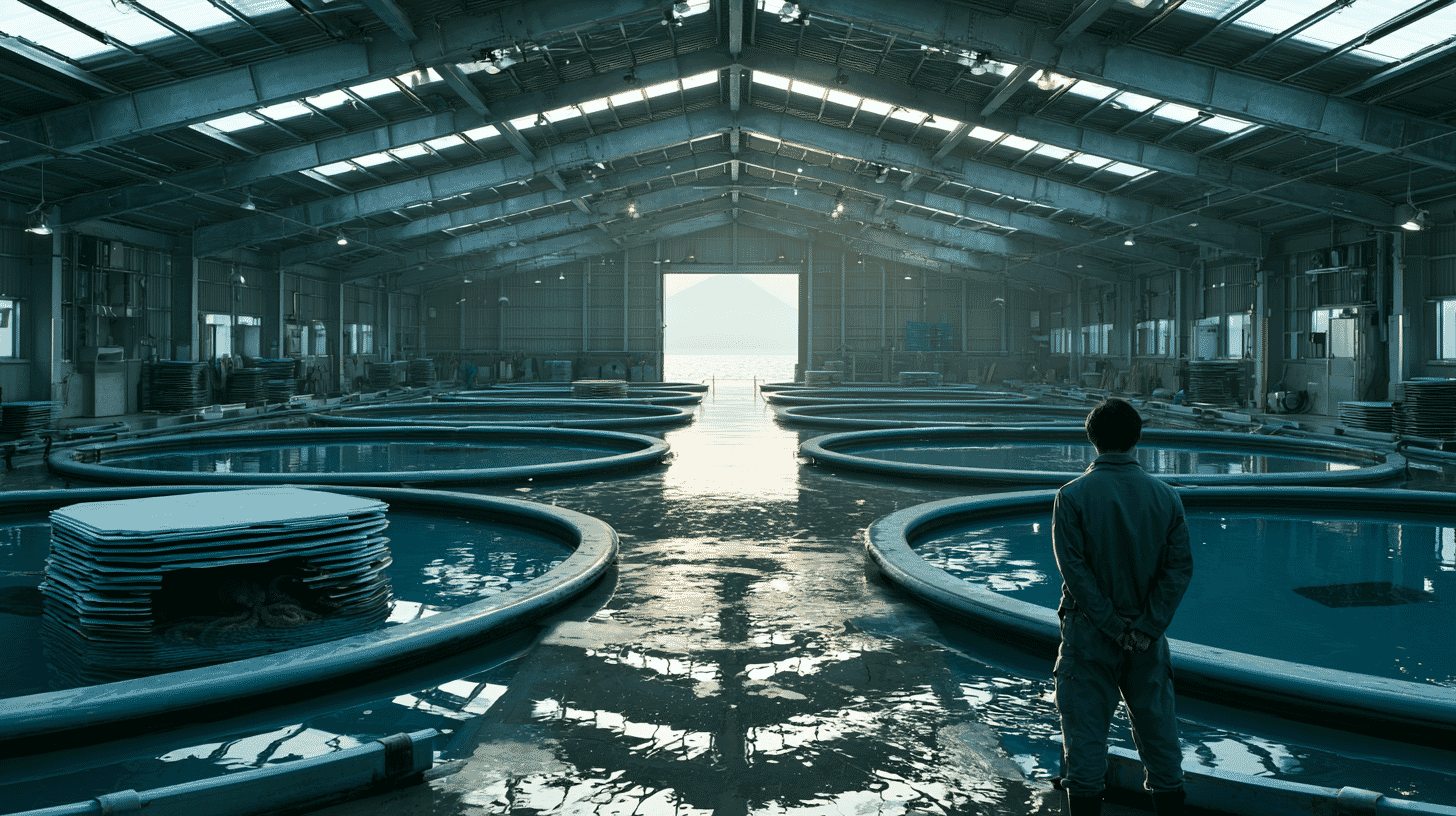
🐙 Octopus shows up almost everywhere on a Japanese table: in takoyaki, in sushi, in chilled summer salads. But the octopus itself is getting harder to catch, and the price keeps climbing. In a quiet research yard near Mount Fuji, one university has spent roughly 15 years chasing a goal that has defeated companies and governments around the world: raising octopus on land, all the way through its life cycle. Here is why it is so difficult, and why the same idea has triggered farming bans abroad.
The animal that refuses to be farmed
Among aquaculture researchers, the octopus has a reputation. It is widely considered one of the hardest sea creatures to raise.
The problem starts with sheer numbers. A female common octopus lays hundreds of thousands of eggs at once. In the wild, almost none survive; typically just one or two from a single brood reach adulthood. The rest are eaten or starve. That gap between "hundreds of thousands of eggs" and "two adults" is the canyon any octopus farm has to bridge.
Three traits make the bridge especially treacherous. Octopuses are escape artists; a small one can squeeze through a surprisingly narrow gap and, given the chance, will climb the tank wall and be gone by morning. They are territorial loners, so crowding them together leads to fighting, and fighting between hungry octopuses turns into cannibalism. And they are fussy eaters whose tastes change sharply as they grow, which makes designing a single reliable feed almost impossible.
This is not a small club of failures. National research institutes in Japan and rival projects overseas have all run into the same walls. Octopus farming has been attempted for decades; nobody has yet turned it into a stable, commercial, land-based operation.
A tower called the "octopus apartment"
The team trying to change that is at Tokai University, on its Shizuoka campus near Suruga Bay. The lead researcher, Professor Nobuhiko Akiyama, has spent his career on land-based aquaculture, working with everything from salmon and bigfin reef squid to seahorses.
His group's advantage is geography. Around the Miho peninsula, the university can pump up underground seawater that stays at a stable temperature year-round and is naturally low in oxygen, which means it carries almost no parasites. Fish raised in it tend not to fall sick, a quiet but real edge for any farm.
The team's most quoted invention has a nickname: the "octopus apartment." It is, in essence, a stack of plastic boards spaced at intervals, inspired by the surfaces used to settle baby abalone. Stood upright the boards were ignored; laid flat, they filled up, with octopuses crawling into the gaps, and here is the strange part, several will share a single gap without attacking each other. One tank can now hold close to a hundred octopuses. The shelter was patented in 2019.
Why does it work? The honest answer from the lab is that they do not fully know. The same goes for another fix: when adult octopuses kept fighting, the researchers slid a simple partition into the tank, and the fighting stopped. Asked why, Akiyama essentially says it is a mystery. Some of this breakthrough is rigorous science; some of it is patient trial and error with an animal that still surprises the people studying it.
Feeding was solved with similar ingenuity. Wild octopuses love crabs and shellfish, partly, the team suspects, because of the shells. Real crab and shellfish are too expensive and leave debris fouling the tank, so the researchers built an artificial feed wrapped in a collagen membrane, the same idea as the casing on a fish sausage. The octopuses grip it, bite in, and clean out the contents without dirtying the water.
The wall they still have not climbed
It is worth being precise about where the research actually stands, because some headlines have run ahead of it.
Tokai's team has cleared several major hurdles: mass rearing in shared tanks, the artificial adult feed, and getting captive octopuses to spawn and hatch. But "full-cycle aquaculture" means closing the entire loop, hatching eggs, raising the young to adulthood, and having those farm-raised adults spawn the next generation, with no need to take anything from the wild. That loop is not closed yet.
The sticking point is the larval stage. Newly hatched octopuses are a few millimetres long and drift in the water; only later do they "settle" onto a surface and start growing into recognizable little octopuses. Tokai found that artificial feed sinks while the larvae will only eat food that floats, so they engineered a rearing tank with a water current that keeps the feed suspended. Even so, survival drops sharply around the settlement stage, and the cause is still not pinned down. Reliable, large-scale production of juveniles, the thing a real farm needs, has not been achieved.
In short, this is a research project closing in on a world first, not a finished one. The university and its industry partner are aiming for commercial operation around 2030.
Why octopus now costs as much as tuna
The reason anyone is pouring 15 years into this is economic. Octopus is caught in a global squeeze: demand is rising while the catch is not.
According to UN Food and Agriculture Organization data cited by Reuters, the value of the global octopus trade more than doubled between 2010 and 2019, from about 1.3 billion to 2.7 billion US dollars, while the volume landed rose only around 9 percent, to roughly 380,000 tonnes. More buyers, not much more octopus.
Japan feels this acutely. The country cannot catch enough octopus for its own appetite and imports the gap, with roughly 70 percent coming from two West African nations, Mauritania and Morocco. Those supplies are shaky: in one recent year, Mauritanian frozen-octopus imports fell by about a third over the January–July period, and import prices ran 30 to 50 percent higher than the year before, in the range of 1,200 to 1,400 yen per kilogram (roughly 7 to 9 US dollars). Domestically, the famous octopus grounds off Akashi in Hyogo Prefecture have seen catches fall to roughly a tenth of their peak. Add a weak yen, and octopus has at times sold for more than tuna.
For ordinary eaters, the worry is concrete: takoyaki, the street-food staple, depends entirely on a steady, affordable octopus supply.
A takoyaki chain behind the science
The project's industry partner is unexpected. It traces back to the 2011 Great East Japan Earthquake. Hottoland, the company behind the nationwide takoyaki chain Tsukiji Gindaco, which runs around 500 stores, moved its headquarters to Ishinomaki in disaster-hit Miyagi Prefecture as part of the recovery effort, and began research on the common octopus with Tohoku University and Miyagi University. Tokai University was brought in to develop the land-based farming side, with support from the Japan Science and Technology Agency's A-STEP program. A street-food brand worried it might one day run out of its core ingredient is, in effect, helping fund the science.
The elephant in the tank
There is a harder question underneath all of this: should octopus be farmed at all?
The debate has been loud abroad. The Spanish seafood company Nueva Pescanova proposed what would have been the world's first commercial octopus farm in Gran Canaria, a roughly 65-million-euro facility designed to produce about 3,000 tonnes, close to a million animals, per year. Local authorities in the Canary Islands rejected its environmental application and demanded a fuller assessment. A petition against octopus farming gathered hundreds of thousands of signatures, and more than 100 scientists signed a letter in the journal Science arguing the practice is inhumane.
The objection centers on the octopus mind. These are problem-solving, curious, behaviorally complex animals, a point the Oscar-winning documentary "My Octopus Teacher" pushed into mainstream view. Critics argue that confining solitary, intelligent invertebrates in tanks causes real suffering, and that intensive farming raises environmental and food-safety concerns too. The argument has had legal force: Washington became the first place in the world to ban octopus farming in 2024, California followed, a federal bill is in Congress, and several more US states have bans pending.
Tokai's "octopus apartment" is interesting precisely because it tackles the aggression and crowding that welfare campaigners cite. But a clever shelter does not settle the deeper question critics raise, whether a creature this intelligent belongs in intensive aquaculture at all. Akiyama frames his work as filling a gap: take only a sustainable amount from the wild, he argues, and make up the shortfall through farming, for octopus and for seafood generally. Reasonable people land in very different places on this, and that tension is part of the story, not a footnote to it.
Octopus, after oysters and sea urchin
Land-based aquaculture is becoming something of a Japanese specialty. The same closed-tank approach has been pushed into oysters, sea urchin, salmon and more, and there is a national policy interest in exporting these systems as a food-technology package. Octopus, the hardest case, would be a marquee addition to that portfolio.
Japan tends to debate this as a food-security and price problem: keep takoyaki affordable, reduce dependence on distant and unstable suppliers. In other countries, the same project reads first as an ethics problem.
So here is the genuine question, with both halves attached. If land-based aquaculture technology like this matured, would you want it brought to your own country to shore up its food supply? And where do you come down on farming an animal as intelligent as an octopus, does a smarter solution to a food shortage have a line it should not cross?
References
- https://news.yahoo.co.jp/articles/5a64cc1800a63b4cead70bcb11055c774df3deb1
- https://news.yahoo.co.jp/articles/258cb98e04e4d44d74c872327a887a7c3b5de755
- https://www.at-s.com/life/article/ats/1600484.html
- https://www.tokainewspress.com/contents.php?i=3337
- https://www.u-tokai.ac.jp/facultyguide/faculty/2303/
- https://www.seafoodsource.com/news/aquaculture/us-senators-renew-efforts-to-ban-commercial-octopus-farming
- https://en.wikipedia.org/wiki/Washington_octopus_protection_law
- https://www.fra.affrc.go.jp/topics/20180216/01.pdf







Global Discussion
4 comments