
🔦 Here is a fish that lights up the dark with a soft blue glow from its belly. Now read its entire genome, all 625 million letters of DNA, and the gene that should make that light simply isn't there. So where does the glow come from? It eats it. A team in Japan has just proven, letter by letter, that this little fish is the only animal known to steal a working protein from its dinner and put it to use.
A glow with no instructions
The fish is the pygmy sweeper (Parapriacanthus ransonneti), called kinmemodoki in Japanese. It's tiny, about 7 centimeters, semi-transparent, and drifts in schools of thousands along Japan's Pacific coast. You'll find it in aquarium tanks all over the country, though almost nobody notices what it can do: in dim water, seen from below, its underside glows blue. The light is faint enough that the naked eye misses it; only a high-sensitivity camera picks it up.
Most luminous animals pull this off in one of two ways. Some, like flashlight fish, house colonies of light-making bacteria. Others, like fireflies, carry their own genes for luciferase, the enzyme that powers the chemical reaction behind living light. The pygmy sweeper does neither. In 2020, this same research group reported something odd: the luciferase inside the fish's light organs was a perfect molecular match for the luciferase of its prey, a tiny bioluminescent crustacean known as a sea firefly. The fish wasn't building the enzyme. It was lifting it, intact, off its food, together with luciferin, the fuel molecule the reaction actually burns.
They gave the trick a name: kleptoprotein, literally "stolen protein." It was a third route to glowing, one no other animal was known to take.
The trouble with proving a "no"
There was a catch. Showing that the fish's luciferase matched the prey's didn't quite close the case. A skeptic could still ask: what if the fish also carries its own copy of the gene, tucked away somewhere in its DNA and simply switched off? Ruling that out isn't a matter of checking the obvious spots. You have to read the whole genome, every chromosome and dim corner, and show the gene is nowhere at all. Proving something is absent is far harder than catching it present.
Reading 625 million letters to confirm a blank
That is what the team set out to do. Led by Manabu Bessho-Uehara of Tohoku University's Frontier Research Institute for Interdisciplinary Sciences, working with the National Institute for Basic Biology, the University of the Ryukyus, the Okinawa Churaumi Aquarium, and Keio University, the group turned to long-read sequencing, a newer approach (PacBio HiFi) that reads long, accurate stretches of DNA in a single pass instead of stitching together thousands of tiny fragments. The payoff was a high-quality genome of roughly 625 million base pairs, closely matching the fish's independently estimated genome size. The results were published in Scientific Reports on April 1, 2026.
Then came the hunt. They combed everything: the assembled genome, the full catalog of genes, the non-coding stretches in between, even the raw sequencing data from before assembly. There was no trace of the sea firefly's luciferase anywhere. They also tested whether the fish might have copied the gene straight out of its prey, a phenomenon called horizontal gene transfer, where genes jump directly from one organism into another. No sign of that either.
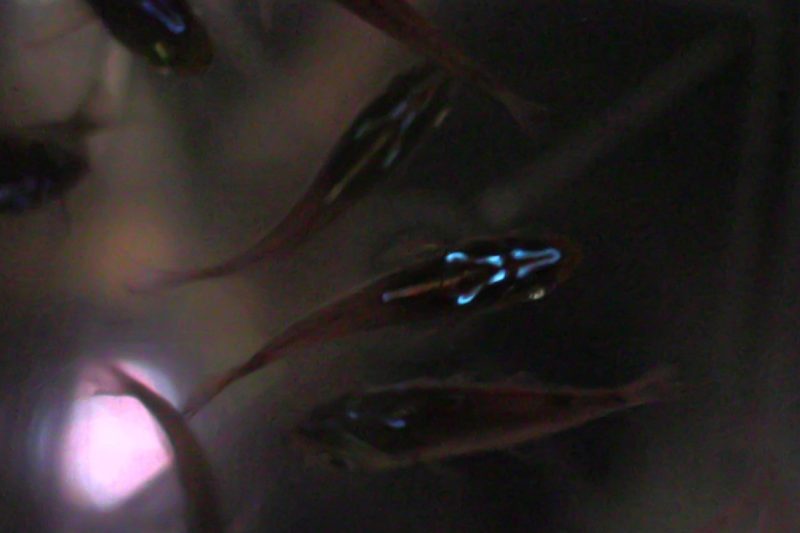
Credit: Okinawa Churaumi Aquarium / Ocean Expo Park
The verdict was clean: the pygmy sweeper has no gene of its own for light. Its glow is borrowed hardware from beginning to end.
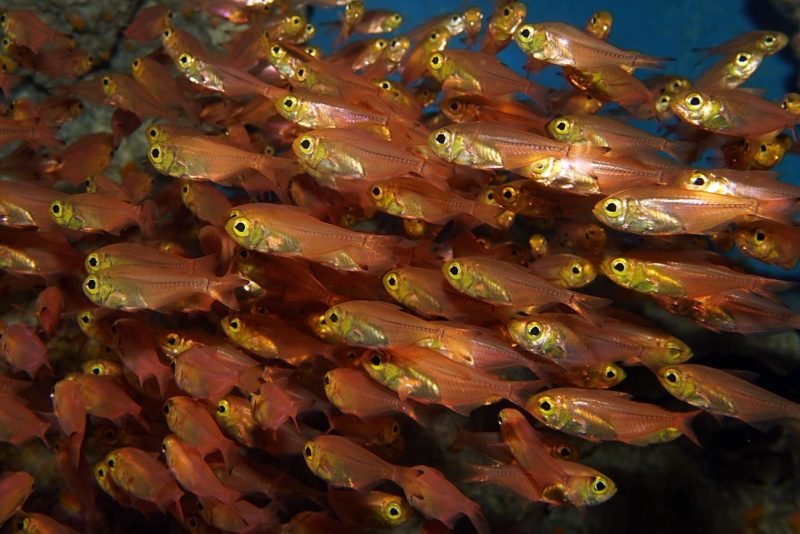
Credit: Okinawa Churaumi Aquarium / Ocean Expo Park
Why glow at all? The leading explanation is camouflage. At night, even faint light filtering down from the surface throws a shadow beneath a fish, and a predator lurking below can pick out the silhouette. By lighting its own belly to match the glow overhead, the sweeper erases its outline, a tactic called counter-illumination.
From a glowing fish to a pill you could swallow
This is where it stops being a curiosity. Swallow a protein and your stomach pulls it apart: acid and digestive enzymes chop it into amino acids. That is exactly why protein-based drugs, from insulin to antibody cancer therapies, have to be injected. They would never survive the trip through the gut.
The pygmy sweeper does the supposedly impossible version of this every day. It takes a working enzyme in through its mouth, declines to digest it, ships it to one specific organ, and keeps it functional for months. If researchers can read out of this genome how the fish shields that protein and routes it where it belongs, whether some unknown protective molecule, a special receptor, or a way of sidestepping its own immune system, the same mechanism could, in principle, be borrowed for medicine: injectable biologics you might one day take as a pill. The team also points to agricultural uses, like feed that delivers useful enzymes intact into farmed fish or livestock.
That is a long road, and the authors are careful to call it a direction rather than a promise. But it begins with a 7-centimeter fish in an aquarium tank, and the strange fact that its light was never really its own.
On the day the paper appeared, April 1, 2026, the Okinawa Churaumi Aquarium put the fish on display alongside high-sensitivity camera footage of it glowing. In Japan, this odd little thief had been sitting in display tanks for years, glowing with someone else's protein. Is there a creature where you live that turns out to be doing something far stranger than anyone ever noticed?









Global Discussion
4 comments