
💡 Forget pushing electrons through a wire. A team in Japan has built a magnetic memory that you write to by flashing it with light. One pulse of laser, and a 1 flips to a 0. The trick was getting it to work on CoFeB, the standard alloy that commercial magnetic memory is already built from.
Most computer memory still works the way it has for decades: shove an electric current somewhere, and the current does the writing. That current is also the problem. It heats things up, it wastes power, and there's a floor on how fast you can switch a bit before the heat catches up with you. As AI and cloud services pile on more and more data to move around, that floor is starting to feel uncomfortably close.
So a group led by Seiji Sakai at the Takasaki Institute of Japan's National Institutes for Quantum Science and Technology (QST), working with the University of Hyogo, the Japan Synchrotron Radiation Research Institute (JASRI), the Institute of Science Tokyo and NTT, tried something that sounds almost like a movie prop: skip the current entirely, and write the data with a flash of light. On June 8 they announced that it works, and the paper ran in Applied Physics Letters as an Editor's Pick.
How magnetic memory remembers with tiny magnets
Magnetic memory stores information in the direction a magnet points. Zoom all the way down to the electrons inside a magnetic material and each one behaves like a minuscule compass needle, a property physicists call spin. Line enough of those spins up the same way and you get a magnet with a definite orientation: point it "up" and call that a 1, point it "down" and call it a 0.
The appealing part is that the magnet stays put after you cut the power. The memory doesn't forget, and it doesn't burn energy just sitting there holding onto your data. That's why magnetic memory is already creeping into car microcontrollers and edge devices. The catch has always been the writing step. Today you flip those spins with electric current, and current means heat, and heat means limits.
The wall: why light bounced off CoFeB
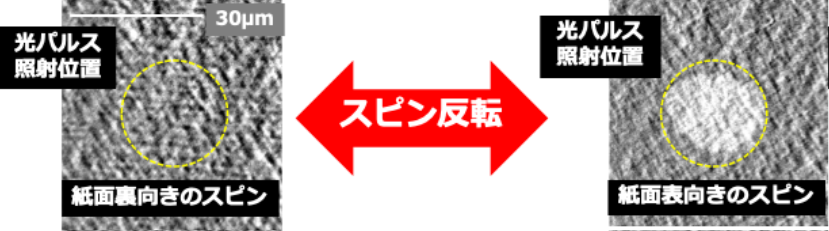
There's a known phenomenon that gets around the current problem. Hit certain magnetic materials with an ultra-short laser pulse and the spins flip on their own: no current, no wire. It's called all-optical switching, and because light can act on a magnet far faster than current can, the switching it produces is reckoned to be on the order of 1,000 times quicker than the electrical kind, using a tiny fraction of the energy.
The materials that did this trick, though, were a particular family of ferrimagnets that made lousy memory. Their spins weren't cleanly aligned, so when you tried to read the bit back, "up" and "down" looked too similar to tell apart reliably. Useless for storage.
The material that makes a great memory is CoFeB, an alloy of cobalt, iron and boron. Paired with magnesium oxide it gives almost perfectly aligned spins, which means a clean, confident readout. The frustrating thing was that CoFeB simply ignored light. Shine a laser at it and nothing happened. For years the two qualities you wanted (switchable by light, and readable as memory) seemed to live in different materials that wouldn't combine.
The three-layer answer
The QST team's move was to stop treating CoFeB as a single material and start treating it as one layer in a stack. They built what they call an artificial ferrimagnet: a sandwich of cobalt, gadolinium and CoFeB, layered so that neighboring layers point in opposite directions. Get the proportions right and the stack as a whole behaves like one of those light-sensitive ferrimagnets, while the CoFeB layer keeps the clean readout that made it valuable in the first place.
"Right" turned out to be brutally precise. Each layer had to be controlled to within a tenth of a nanometer, smaller than a single atom, and the whole structure tuned over a span under ten nanometers. To see what was happening inside the sandwich, the team used beamline BL13U at NanoTerasu, the 3 GeV synchrotron facility QST helps operate on Tohoku University's Aobayama campus, whose soft X-rays run around a hundred times brighter than those of older machines. They paired it with X-ray magnetic circular dichroism, which reads the spin state of each individual element in the stack. That atomic-scale picture is what let them dial the design in until a single femtosecond laser pulse flipped every layer at once, reliably and repeatedly, without degrading.
One detail sets this apart from earlier attempts: in previous light-switchable stacks, the CoFeB layer was held at arm's length, separated from the active layers by a non-magnetic spacer. Here, every layer including CoFeB is coupled directly to its neighbors. That direct contact is a big part of why it works.
Source: National Institutes for Quantum Science and Technology (QST) press release
What it could change
It's worth being clear about the stage this is at. The team demonstrated the basic operation of the material: proof that the switching happens and repeats. A finished memory chip, with the device shrunk down and a manufacturing process behind it, is still somewhere down the road.
What makes the result interesting is less the speed number and more the bridge it builds. CoFeB is the material the existing memory industry already knows how to use. Showing that this material can be written with light, rather than some exotic compound nobody manufactures, is what turns "neat physics" into "a thing engineers might actually build on." And because the data is now being written by light, it points toward chips that sit naturally at the seam between optical communication (the fiber that carries the internet) and the electronic circuits that do the computing. Data centers, where electricity use has become a genuine headache, are the obvious place such a memory would matter.
A magnet that wasn't supposed to budge now flips with a single flash of light. That alone is enough to be worth watching.
What stage is next-generation memory research at where you live, and would you trust a chip that writes with light?
References
- QST press release (June 8, 2026): https://www.qst.go.jp/site/press/20260608.html
- S. Li et al., "All-optical switching in CoFeB-based artificial ferrimagnets," Applied Physics Letters 128, 232402 (2026): https://doi.org/10.1063/5.0328535
- ITmedia NEWS: https://www.itmedia.co.jp/news/articles/2606/10/news084.html









Global Discussion
0 comments