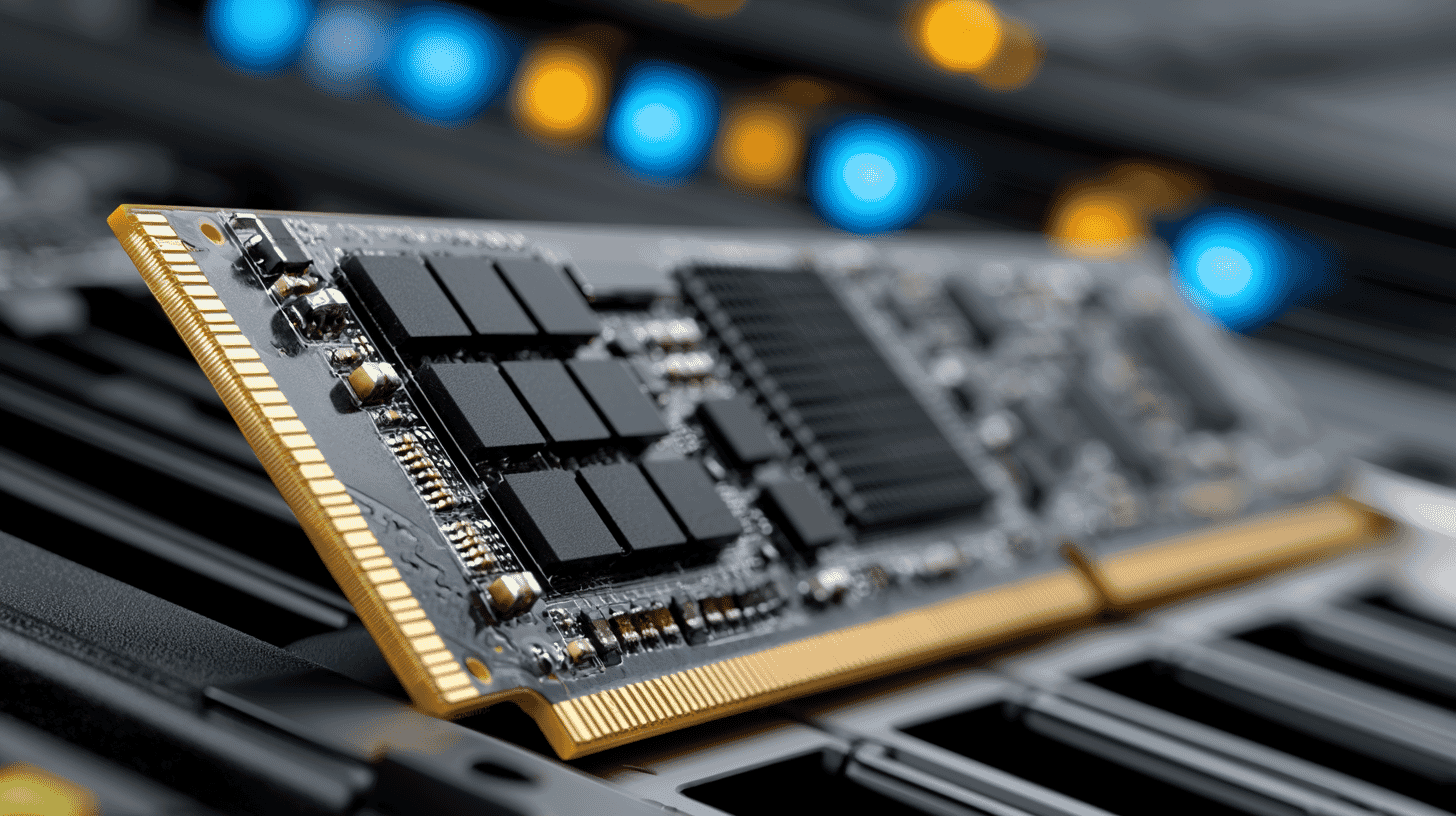
💾 The world is running out of memory. AI data centers are swallowing DRAM faster than anyone can make it, and prices have risen every quarter. Japan's Kioxia thinks part of the answer is a chip that was never supposed to be memory at all.
Flash memory, promoted to memory
On August 3, 2026, Kioxia announced the KIOXIA XL1 series, a memory expansion module. Kioxia showed it at its own booth during FMS: the Future of Memory and Storage, held August 4-6 in Santa Clara, California, and evaluation samples are due to ship to industry ecosystem collaborators during August 2026.
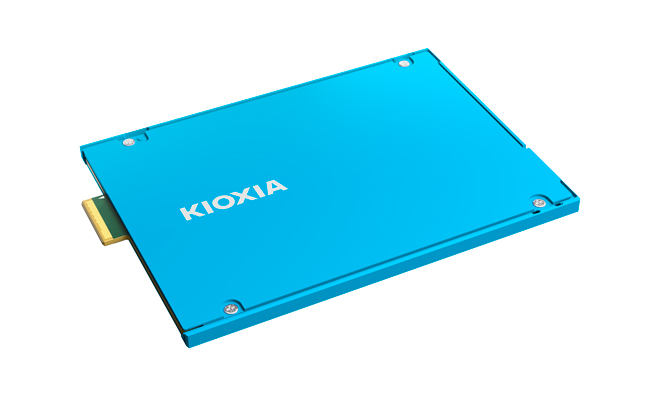
Source: Kioxia
The XL1 pairs XL-FLASH, Kioxia's low-latency flash memory, with a CXL interface. CXL, short for Compute Express Link, is the industry standard that lets a processor talk to memory and peripherals over a fast shared link. The idea is simple: park data that nobody touches very often on the flash, and keep scarce DRAM free for the work that actually needs it. Kioxia frames it as closing the gap in speed and in price that sits between ordinary DRAM and SSDs, so hyperscale operators can add capacity without adding DIMMs.
AI is eating the world's memory
Research firm TrendForce put conventional DRAM contract prices up 58-63% quarter on quarter in 2Q26, with NAND flash up 70-75%. In 3Q26 the increases narrowed to 13-18% for DRAM and 10-15% for NAND, but not because supply loosened. Contract prices are already at record highs, and PC and smartphone makers have hit the ceiling of what they can absorb. The brakes are on the buyer's side, not the seller's.
There is a hard physical limit to how much DRAM you can put in a single server. AI workloads blow past it without trying, and whatever spills over lands in storage, where reads are slower by orders of magnitude. That cliff is what the industry calls the memory wall.
Five microseconds is fast. It is still not DRAM
XL-FLASH is the flash memory Kioxia designed for low latency. It splits the die into 16 planes to cut read and write waiting times, and Kioxia puts read latency at under 5 microseconds. Page size is 4KB, and dies come in 128 gigabit SLC and 256 gigabit MLC versions.
A DRAM read generally lands around 100 nanoseconds, roughly a tenth of a microsecond. Under 5 microseconds is far faster than an ordinary SSD and nowhere near DRAM. The XL1 is not a DRAM replacement. It is a cheaper rung slotted underneath DRAM, and how much it is worth depends heavily on whether the software above it can correctly work out which data is cold.
Kioxia followed up on August 4 with a related product, the KIOXIA GP1 series. It is a PCIe 6.0 SSD designed for direct GPU access, built on second-generation XL-FLASH, hitting 10 million random-read IOPS on 512-byte blocks. Future generations target up to 100 million IOPS. Evaluation samples are scheduled to reach select customers by the end of 2026.
Build on DRAM, or build on flash
Expanding memory over CXL is not a Kioxia invention. Samsung Electronics has been building out CMM-D, a CXL-compatible DRAM module, and plans to mass-produce CMM-D 3.0 on the latest CXL 3.2 specification within 2026. SK hynix showed samples of a second-generation CMM-DDR5, also on CXL 3.2, in June 2026 and has entered supply discussions with customers, though it has not disclosed a production timeline. Micron brought out its CXL 2.0 module, the CZ120, back in 2023.
The Korean makers are working the flash angle in parallel. Samsung put DRAM and NAND on a single card as CMM-H, first shown at FMS in 2022 as a Memory-Semantic SSD, using DRAM as a cache and NAND for capacity; as of July 2026 it was still reported to be in development. SK hynix, per TrendForce, has described an architecture called IMTE that places CXL hybrid memory between HBM or DDR and SSDs, claiming a 35.7% improvement in inference efficiency.
What differs is the mix. Companies that make both DRAM and NAND start from DRAM and add NAND to it. Kioxia, which has no DRAM, starts from the flash itself. The hand each company was dealt is showing up in the shape of the product.
A country without DRAM attacks from the flash side
TrendForce puts Samsung on top of the NAND flash revenue rankings in 1Q26 with 31.6%, followed by the SK hynix group at 17.6% and Kioxia third at 13.9%, on revenue of US$5.96 billion. In NAND, Japan sits near the front.
DRAM is another story. Japan no longer has a domestically owned company producing DRAM in volume. The only DRAM production site in the country is the Hiroshima plant of Micron Memory Japan, the operation that inherited the old Elpida Memory. Micron broke ground on a new cleanroom there in July 2026 as part of a plan to invest ¥1.5 trillion, about $9.5 billion at the early-August 2026 rate of ¥157.6 to the dollar, with Japan's Ministry of Economy, Trade and Industry providing up to ¥536 billion, roughly $3.4 billion, in subsidies. The company doing the building is American.
Japan cannot answer a global DRAM shortage by making more DRAM. If it is going to answer at all, the route open to it runs through the memory hierarchy itself, approached from the flash side, where it is strong. The XL1 reads as that strategy turned into a product.
Still, the XL1 is a reference exhibit, with no announced module capacities or pricing, and Kioxia notes that the samples include functions that have not been fully tested and that specifications may change. CXL memory in general remains, as of 2026, largely allocated to major cloud providers rather than something you can simply order for an ordinary server.
In Japan, the memory squeeze has started arriving in everyday life as higher PC and smartphone prices. How is it playing out where you are, and are AI data centers a live argument in your country yet?
References
- https://www.kioxia.com/en-jp/business/news/2026/20260803-1.html
- https://www.kioxia.com/en-jp/business/news/2026/20260804-1.html
- https://www.kioxia.com/en-jp/business/memory/xlflash.html
- https://ai.watch.impress.co.jp/docs/news/2130186.html
- https://www.trendforce.com/presscenter/news/20260331-12995.html
- https://www.trendforce.com/presscenter/news/20260703-13134.html
- https://www.trendforce.com/presscenter/news/20260525-13058.html
- https://www.trendforce.com/news/2026/07/21/news-samsung-reportedly-targets-2026-cxl-3-2-mass-production-sk-hynix-advances-new-ai-memory-architecture/
- https://www.storagenewsletter.com/2024/03/22/samsung-cxl-solutions-cmm-h-or-memory-module-hybrid-device/
- https://en.sedaily.com/finance/2026/07/19/token-usage-to-surge-24-fold-by-2030-making-cxl-next-ai
- https://pc.watch.impress.co.jp/docs/news/2122472.html







Global Discussion
4 comments