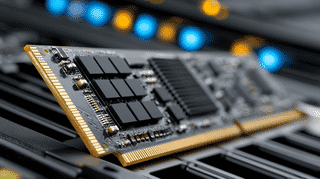
Kioxia's XL1 module pulls flash memory into the memory hierarchy over CXL to ease the DRAM crunch in AI data centers. What it can and cannot do, and why it matters for a country that no longer makes DRAM.
Toshiba reported record net profit of 1.9673 trillion yen (about $12.5 billion) for fiscal 2025, a sevenfold jump driven by gains from selling its stake in Kioxia and a structural surge in transmission and HDD demand from AI data centers. Nearly two years after the JIP-led privatization, what has Japan's biggest private-equity restructuring actually changed? We compare it with Blackstone's Hilton success and the cautionary tale of Toys R Us.
Kioxia forecast a 48-fold jump in Q1 net profit to 869 billion yen ($5.5 billion), making the Japanese NAND maker Japan's single-largest AI beneficiary on a quarterly basis after Toyota. We unpack the US ADS listing plan, the supercycle reshaping NAND prices, the HBM gap with Samsung and SK Hynix, and what it all means for Japan's broader semiconductor revival.
Kioxia and Sandisk have achieved a world-first technological milestone toward 3D NAND flash memory exceeding 1,000 layers. Their multi-stacked cell array CMOS (MSA-CBA) structure with wafer-to-wafer Cu direct bonding successfully demonstrated QLC operation, and will be unveiled at the VLSI Symposium 2026 in Hawaii this June. We break down the technology, the three-way stacking race against Samsung, SK hynix, and Micron, and what soaring AI data center demand means for the NAND market.
On April 23, 2026, the Nikkei 225 crossed 60,000 intraday for the first time in history. We compare this milestone with the 1989 bubble peak at 38,915 yen, examining USD-based performance, the foreign ownership shift from 5% to 32.4%, the PER drop from 60x to 16x, and the heavy concentration in just a handful of AI and semiconductor stocks like SoftBank Group, which surged 9.6%.
Kioxia has developed foundational 3D DRAM technology using IGZO oxide semiconductors, signaling the NAND-only maker's bold entry into the DRAM market. Behind this challenge: exploding AI demand and the physical limits of current memory. We break down the competition with Samsung, SK hynix, and China's CXMT.
Kioxia's Q4 net profit surged 17x year-over-year as NAND flash prices skyrocket. AI-driven demand for HBM is squeezing memory supply for smartphones, PCs, and automobiles — creating a global shortage that may last until 2028. We analyze the competitive landscape with Samsung, SK Hynix, and Micron, and Kioxia's post-IPO growth strategy including its NVIDIA partnership for next-gen AI SSDs.
Japan's Kioxia is set for consecutive record-breaking years, with revenue exceeding $14 billion for the first time. NAND production capacity for 2026 is already "sold out" as AI data center demand far outpaces supply. From a rocky IPO to the world's best-performing stock of 2025 with a 540% gain, we explore Kioxia's remarkable turnaround and what it means for Japan's semiconductor renaissance.