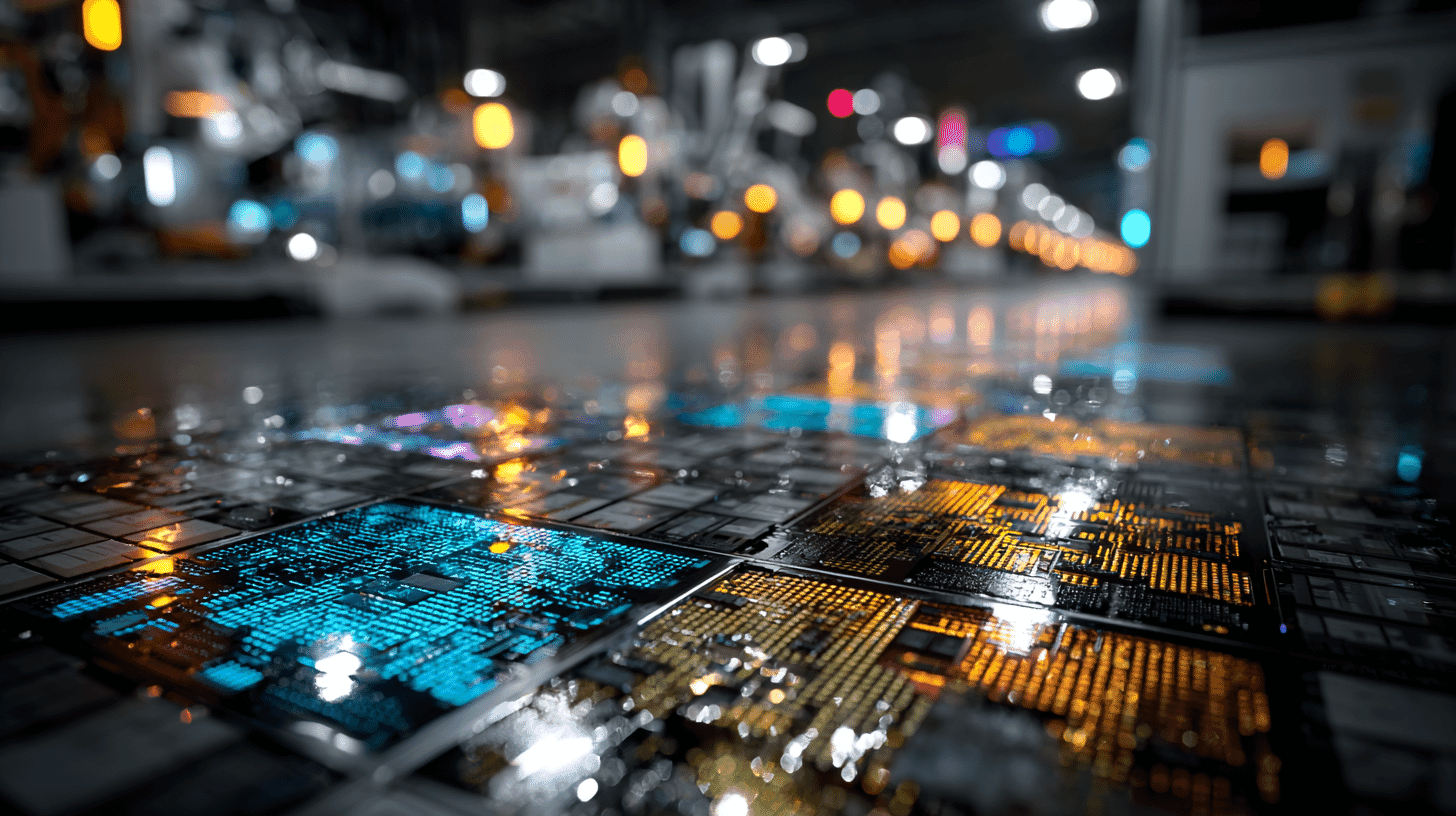
AI doesn't run on brainpower alone. Without massive amounts of memory to store data, even the smartest AI is useless.
Right now, the NAND flash memory market that powers AI's "memory" is experiencing an unprecedented boom, and a Japanese company called Kioxia is at the center of it all. Its stock climbed more than fivefold in the year after its late-2024 listing, one of the standout performers among major global stocks in 2025. Its NAND production for 2026 is already nearly sold out. And in fiscal 2025 its revenue topped ¥2 trillion (about $15 billion) for the first time. Here's how a company that was once dismissed as a struggling IPO became the unlikely star of the AI revolution.
"Demand Is Expected to Exceed Supply": The NAND Market in 2026
On February 12, 2026, Kioxia Holdings announced its full-year forecast for fiscal 2025 (April 2025 – March 2026). The forecast called for revenue of approximately $14.8 billion (up 30.3% year-on-year), and operating profit of about $5 billion (up 67%), both records for the second straight year.
The driving force behind this explosive growth is insatiable demand from AI data centers. Kioxia's CFO Hideki Hanazawa emphasized during the earnings call that selling prices are rising at a dramatic pace. The company's outlook for the NAND market was unequivocally bullish, stating that "demand is expected to exceed supply through 2026."
Long-term contracts with customers are nearly finalized, and some hyperscalers (the tech giants like Microsoft, Google, and Amazon that operate massive data centers) are even proposing contracts extending to 2027-2028, along with prepayment arrangements. In other words, the world's biggest tech companies are scrambling to secure memory supply years in advance.
Why Is NAND in Such Short Supply?
NAND flash memory is a type of storage chip that retains data even when powered off. It's used in everything from smartphone storage to PC solid-state drives (SSDs) and, crucially, in the massive storage systems that run data centers.
Three main factors are driving the current supply crunch.
First, demand for AI inference, the process where AI uses its trained knowledge to make decisions and generate responses, is expanding rapidly. As generative AI services like ChatGPT become mainstream, the volume of data processed in data centers has exploded. AI processors from NVIDIA and AMD consume enormous amounts of memory, meaning every GPU sold creates corresponding demand for NAND storage.
Second, enterprises are continuing to replace aging servers as part of digital transformation initiatives, creating steady baseline demand independent of the AI boom.
Third, shortages of high-capacity hard disk drives (HDDs) are pushing customers toward QLC SSDs, which store four bits of data per cell for far higher capacity.
On the supply side, memory manufacturers are being cautious. The industry carries painful memories of previous supply gluts that crashed prices and caused enormous losses. Samsung and SK hynix, in particular, are prioritizing investment in DRAM (a different type of memory used for real-time processing), leaving NAND production capacity expansion on the back burner. This supply-demand gap is driving NAND prices sharply higher.
From Struggling IPO to World's Best-Performing Stock
The company traces its origins to Toshiba's semiconductor memory division, which invented NAND flash memory in 1987. After spinning off from Toshiba in 2018 amid the parent company's financial crisis, the division was renamed Kioxia (a coined word combining the Japanese word for memory, kioku, with the Greek word for value, axia).
Following years of delays and three IPO attempts, Kioxia finally listed on the Tokyo Stock Exchange Prime Market in December 2024. The timing seemed terrible. The semiconductor industry was in a downturn, and the company carried heavy debt from its private equity ownership era. Investors were skeptical.
Then everything changed. The explosion in AI demand sent memory prices soaring, and Kioxia's stock climbed more than fivefold in the year following its listing, ranking among the standout performers in global equity markets in 2025. After the February 13, 2026 earnings announcement, shares jumped as much as 15% in a single day to ¥24,420, pushing the market cap above ¥10 trillion (roughly $67 billion).
Cutting-Edge Technology: 8th Generation BiCS FLASH
Kioxia's competitive edge lies in its proprietary 3D flash memory technology called BiCS FLASH. The company is currently transitioning to its 8th generation, and has shipped ultra-high-capacity SSDs using 2-terabit QLC chips, including 122TB and 245TB models, for customer qualification, with mass production expected to begin in 2026.
In the most recent quarter (October–December 2025), the SSD & Storage segment accounted for 55% of total revenue at approximately $2 billion, with data center and enterprise SSD sales hitting all-time highs.
According to research firm TrendForce, Kioxia recorded the highest growth rate among the top five NAND suppliers in Q3 2025, with revenue jumping 33.1% quarter-on-quarter to surpass Micron and claim the third-place market position. Unlike competitors who focus on finished SSD products, Kioxia directly supplies enterprise-grade NAND dies to cloud service providers (CSPs) who build their own SSDs, a flexible approach that has become a key differentiator.
Japan's Semiconductor Renaissance
Kioxia's surge belongs to a wider story about Japan's chip industry.
TSMC's Kumamoto plant (JASM) is running. Rapidus is working on 2nm logic in Hokkaido. Equipment makers such as Tokyo Electron, SCREEN, and Advantest still hold critical positions in the global supply chain. Kioxia, sold off during Toshiba's crisis and passed through private equity hands, has come back to the front of the same industry it helped create.
Of course, risks remain. The memory industry is notoriously cyclical, and today's boom can quickly turn into a bust. U.S.-China tensions and export restrictions create geopolitical uncertainty. Chinese memory makers like YMTC are investing aggressively to catch up. No one knows how long the current bull run will last.
But one fact remains constant: the technology that makes AI's memory possible was invented in Japan nearly 40 years ago, and the company carrying that legacy is now at the very center of the AI revolution.
[Update, May 2026] Kioxia reported final fiscal 2025 results on May 15, 2026: revenue of ¥2.3376 trillion (up 37.0% year-on-year) and Non-GAAP operating profit of ¥876.2 billion (up 93.4%), both above the February guidance cited above. Operating profit set a record for the first time in eight years, counting the Toshiba Memory era, with an operating margin of 37.5%. The company now expects demand to outstrip supply through 2027 as well. Kioxia also changed presidents on April 1, 2026, with Hiroo Ota succeeding Nobuo Hayasaka.
Is AI-driven memory demand or data center construction a hot topic in your country?
References
- https://eetimes.itmedia.co.jp/ee/articles/2602/13/news060.html
- https://newswitch.jp/p/48367
- https://www.nikkei.com/article/DGXZQOUB120ZR0S6A210C2000000/
- https://www.trendforce.com/presscenter/news/20251203-12813.html
- https://fortune.com/2025/12/31/best-performing-stock-2025-wasnt-nvidia-kioxia-japan-memory-chips/





Global Discussion
13 comments