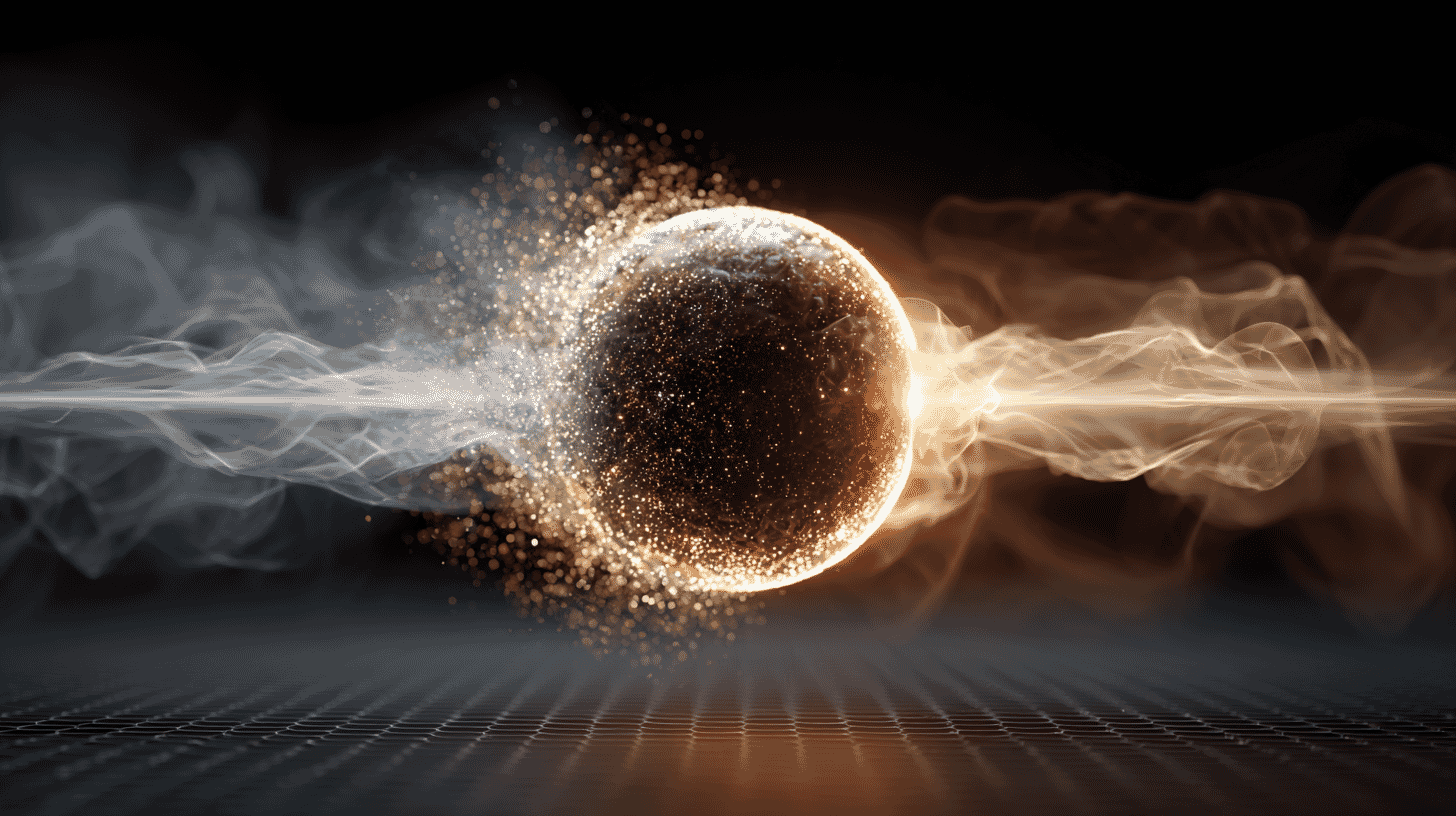
Ordinary particles have antiparticles. The electron has the positron, carrying positive charge. But in 1937, the Italian physicist Ettore Majorana predicted that a particle could theoretically be its own antiparticle. That is the Majorana particle, or Majorana fermion.
In particle physics, whether the neutrino is a Majorana particle remains an open question. In condensed matter physics, Majorana particles are expected to appear as quasiparticles at interfaces between topological insulators and superconductors, in Kitaev quantum spin liquids, and in semiconductor nanowires.
They matter to quantum computing because they hold the key to topological quantum computation. Today's quantum computers throw errors constantly under environmental noise, and correcting those errors demands enormous numbers of additional qubits. Majorana particles could protect quantum information at the hardware level, producing qubits that are intrinsically resistant to error.
A security analogy helps. If a conventional qubit is putting your entire fortune in a single safe, a topological qubit built on Majorana particles distributes the assets across multiple locations. Breaking into one place does not get you the whole thing.
The Japanese Proposal: Catching Majorana with Spin Currents
On March 6, 2025, a joint research group published its results: Associate Professor Yasuyuki Kato of the University of Fukui's Graduate School of Engineering, Associate Professor Joji Nasu of Tohoku University's Graduate School of Science, Professor Masahiro Sato of Chiba University's Graduate School of Science, Project Associate Professor Tsuyoshi Okubo of the University of Tokyo's Graduate School of Science, Project Associate Professor Takahiro Misawa of the University of Tokyo's Institute for Solid State Physics, and Professor Yukitoshi Motome of the University of Tokyo's Graduate School of Engineering. The paper appeared in Physical Review X.
One point deserves precision. This is not a report of successfully observing Majorana particles. It theoretically proposes a new method for detecting the Majorana particles that appear in quantum spin liquid (QSL) states.
The team focused on the spin Seebeck effect (SSE), a phenomenon widely used in spintronics in which a temperature gradient generates a flow of spin, the property that behaves something like an electron's rotation, through a material.
The crux is that Majorana particles carry no charge. Without charge, electrical detection does not work, and no decisive method of control has been found. So the team asked whether spin flow could substitute for charge. That was the starting point.
Large-scale numerical calculation produced something surprising. In a particular magnetic state called a Kitaev quantum spin liquid (KSL), Majorana particles generate spin current by flowing from hot to cold, despite carrying no spin angular momentum. In an ordinary ferromagnet, magnons do that job. Majorana particles doing the same thing runs against expectation.
The team further found that the magnetic field and temperature dependence of the resulting spin current carries behavior characteristic of Majorana particles. The direction of the current, positive or negative, depends on the sign of the Kitaev interaction: positive when ferromagnetic, negative when antiferromagnetic. Measure the spin current and you can read the properties of the Majorana particles hiding in the material.
How Does This Compare to Microsoft's Majorana 1 Chip?
In February 2025, Microsoft announced Majorana 1, billed as the world's first topological quantum processor. Using a new class of material it calls a topoconductor, combining indium arsenide (a semiconductor) and aluminum (a superconductor) with atomic precision in a nanowire, it generates Majorana zero modes at both ends. From this eight-qubit chip, Microsoft is aiming at a scalable machine holding a million qubits on a single chip.
The Japanese approach is fundamentally different. Where Microsoft manufactures Majorana artificially at a semiconductor-superconductor interface, the Japanese team proposes detecting and controlling the Majorana particles that arise naturally in the quantum spin liquid state of a magnetic material, using spin current.
The two are complementary rather than competing. Microsoft's approach is engineering aimed straight at quantum computing hardware. The Japanese work digs into the underlying physics and opens new means of detection and control. With physicists still arguing that Microsoft's chip falls short as a demonstration of topological qubits, building the theoretical foundation strengthens the credibility of the whole field.
The Global Race for Majorana Particles
Research on Majorana particles and Kitaev quantum spin liquids is active worldwide.
In the US, groups beyond Microsoft are attempting to detect Majorana zero modes. In Europe, Delft University of Technology in the Netherlands and the University of Copenhagen in Denmark work with Microsoft on semiconductor-superconductor hybrid devices.
On the materials side, α-RuCl3 (ruthenium chloride) is widely studied as a leading Kitaev quantum spin liquid candidate, with neutron scattering used to observe fractionalized excitations and thermal Hall measurements used to probe the origin of Majorana fermions. Evidence has been reported in recent years that the planar thermal Hall effect in α-RuCl3 originates from Majorana fermions.
What makes the Japanese spin current approach distinctive is that it opens an entirely different window from existing methods like neutron scattering and thermal conductivity measurement. Evidence accumulating from independent measurement techniques is how the existence of Majorana particles gets established with confidence.
Why This Research Matters: A Bridge to Quantum Computing's Future
The significance goes past detection. The team also suggests the possibility of generating and controlling Majorana particles with spin currents, opening a path toward manipulating them with spintronics and ultimately using them for topological quantum computation.
Today's quantum computers run on superconducting circuits at IBM and Google, and on trapped ions at IonQ and Quantinuum. Error tolerance is the hard problem for all of them. Topological quantum computation using Majorana particles could solve it at the hardware level.
To repeat: this is a theoretical proposal. Experimental verification lies ahead. But spintronics is one of the fields Japan leads globally, and the route to testing is visible. It is a step from Japan, opening new ground in quantum technology through basic science.
In Japan, reactions to quantum computing and Majorana particles mix anticipation with caution. How is the quantum computing race, or Majorana research, covered where you live? We'd love to hear about it!
References
- https://www.jst.go.jp/pr/announce/20250306/index.html
- https://www.tohoku.ac.jp/japanese/2025/03/press20250306-03-majorana.html
- https://journals.aps.org/prx/abstract/10.1103/PhysRevX.15.011050
- https://azure.microsoft.com/en-us/blog/quantum/2025/02/19/microsoft-unveils-majorana-1-the-worlds-first-quantum-processor-powered-by-topological-qubits/
- https://www.science.org/doi/10.1126/sciadv.adk3539







Global Discussion
15 comments