
🦋 A butterfly's wing, a firefly's glow, and a drop of ink each make color in a completely different way. Nature spent millions of years inventing those three tricks separately, and most living things use only one at a time. At a Japanese university with roots in a century-old silk school, a research team has now folded all three into a single, ultrathin sheet.
Where silkworms once spun, a scientist now weaves with light
Shinshu University sits in Ueda, a castle town in the mountains of Nagano that grew rich, generations ago, on silk. The university's Faculty of Textile Science and Technology, the only faculty in Japan still to carry the word "textile" in its name, traces back to a sericulture college founded in 1910. A brick warehouse that once stored silkworm cocoons still stands on the campus; it is now a museum.
It is a fitting place for what Koki Sano does. Sano, an associate professor there, has spent his career trying to build materials that behave like living things. Look at the work that has come out of his lab and the names read like a small aquarium: a "dynamic photonic crystal like a tropical fish" that changes color on cue, an anisotropic hydrogel "like joint cartilage," a gel that stiffens and softens "like a sea cucumber," and, in 2021, billions of nanosheets moving together in a traveling wave, "like the beating of cilia."
His stated goal is to build artificial systems that match, and ideally outdo, the elegance of biology. The study published on May 26, 2026 in the journal Nature Communications is, in a sense, the chapter where several of those threads come together. The paper, "Multi-functional photonic crystals of modular nanosheets," is led by Seiya Yui, a graduate student at the university, with Sano as corresponding author.
Nature's three tricks for making color
Before the science, a short detour into how color works, because the achievement only lands once you see it.
There are, broadly, three ways to produce color.
The first is absorption. A red apple, a blue dye, the ink in this sentence: pigments soak up some wavelengths of light and throw back the rest. This is the color most of us picture when we hear the word.
The second is reflection, or, more precisely, structure. A morpho butterfly's wing contains no blue pigment at all. Its blue comes from microscopic ridges, spaced at roughly the wavelength of light, that bounce specific colors back at the eye. A chameleon's shifting skin and the silver flash of a neon tetra work the same way. Scientists call this structural color, and because it comes from shape rather than chemistry, it does not fade.
The third is emission. A firefly reflects nothing; it makes its own light and glows in the dark.
Here is the catch. Living things almost always rely on just one of these. A butterfly does structure. A firefly does emission. A poppy does pigment. Getting all three to coexist in one material, and to cooperate rather than cancel each other out, has been a hard problem for a long time.
One sheet, three kinds of color
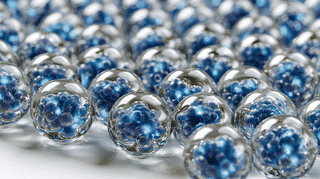
Sano's team started with a building block called a titanium oxide nanosheet: a flake of material so thin (a nanometer is a billionth of a meter) that it is essentially two-dimensional. Peel a layered titanium oxide crystal apart and you get these sheets; they carry a negative electric charge, so they spread out and float happily in water.
The team's key idea is what they call a modular strategy, and it is easiest to picture as LEGO. Take the base nanosheet and attach different functional particles to its surface. Because the sheet is negatively charged, positively charged particles snap on by themselves through simple electrical attraction. Swap the particle, swap the function: attach gold nanoparticles and the hybrid sheet absorbs light to give a red; attach gold nanorods instead and you get a blue; attach tiny fluorescent silica particles and the sheet glows. (The gold trick deserves a word of its own. When light hits a very small gold particle, the metal's loose electrons slosh back and forth in step with it, drinking in particular colors, a phenomenon called a plasmon. It is why gold at the nanoscale looks red rather than golden.)

Source: Shinshu University / JST
Then comes the self-assembly. Left in water under the right conditions, the sheets push each other apart with their matching charges until they settle a few hundred nanometers apart, exactly the gap needed to reflect visible light. No one stacks them. They organize themselves into an orderly, repeating structure: a photonic crystal that produces structural color on its own.
Put the two steps together and you get the result that gives the paper its title. A single photonic crystal in which gold-particle absorption, structural reflection and fluorescent emission all operate at once. The colors blend into shades that no single mechanism can produce: a red drawn from the gold absorbing light, layered over the structural color of the lattice itself.
Color you can switch on and off
A fixed color would be enough on its own. The team also showed that the color can be changed on demand, in two different ways.
The first is magnetism. The titanium oxide sheets can be turned to face a chosen direction by a magnetic field. Hit the material with a powerful field, 12 tesla, far stronger than a hospital MRI scanner, and the sheets swing into alignment, so the structural color can be switched on or off, reversibly, just by changing the field's direction.
The second is light itself. Shine green light, the color the gold nanoparticles absorb, onto the material, and the particles convert that light into heat. The local warming loosens the electrical spacing between sheets, and the structural color shifts toward shorter wavelengths. Turn the light off, the material cools, and the color slides back. A photonic crystal you can repaint with a flashlight.
Seeing the invisible
The achievement the researchers single out as most important is not a color. It is a photograph.
Nanosheets are so thin that an ordinary light microscope cannot see them. The usual fallback is an electron microscope, but that means fixing the sample and drying it out, freezing a living, water-based process into something inert. You can see the structure; you can never watch it move.
By building fluorescence into the hybrid sheets, the team got around this. Using a confocal laser microscope, an instrument that reconstructs 3D images slice by slice, they directly imaged individual nanosheets, in water, while the photonic crystal assembled itself. Because the sheets hold each other at arm's length through electrostatic repulsion, there is enough space between them to tell one sheet from the next. They also captured the structure relaxing back into disorder after a magnetic field was removed.
For the field of 2D materials, this is a quiet but real breakthrough. The self-assembly is no longer a black box. You can watch it happen.
A different bet than the West
Controlling light with nanostructures is one of the hottest races in materials science, and most of the running has been made by a different approach: the metasurface. Pioneered in Federico Capasso's lab at Harvard and commercialized by Metalenz, a company spun out of Harvard in 2016, metasurfaces are flat optical components, "metalenses," etched with millions of subwavelength pillars using the same lithography that makes computer chips. The company says 140 million of its first-generation meta-optics are now in the market, built into 3D-sensing modules in phones and tablets among other products.
The Japanese route is almost the opposite philosophy. A metasurface is carved from the top down, one fixed pattern locked into silicon. Sano's nanosheets build themselves from the bottom up, in water, with no clean room and no etching. And, crucially, the result is not fixed: it can be retuned with a magnet or a beam of light, and it can carry several optical functions at once.
These are not really competitors; they are answers to different questions. A metalens focuses an image. A modular photonic crystal is a reconfigurable, multifunction optical surface. The work is a reminder that the obvious industrial path is not the only one, and that inorganic nanosheets are a field where Japan is quietly strong. One of this paper's co-authors, Takayoshi Sasaki of the National Institute for Materials Science, is a pioneer of the titanium oxide nanosheets this work is built on.
What it could become
It is worth being honest about the distance. This is fundamental research, not a product. There is no display you can buy, no ink on a shelf.
What the team has built is a platform, and a toolkit. The modular strategy means new functions can be added simply by choosing new particles, and the optical behavior can be designed deliberately rather than stumbled upon. The researchers point toward new colorants and inks, anti-counterfeiting features, sensors, and "smart" photonic materials whose appearance responds to their surroundings. The 3D-visualization method may end up mattering just as much, as a new way to study how any nanosheet system organizes itself.
In Japan, some of the most striking work on light and color is happening at a university whose roots are in silk thread, a long thread of its own, running from cocoons to nanosheets. What kind of materials research is quietly going on where you live, and would you ever have thought to look for it in a textile school? Tell us in the comments.





Global Discussion
3 comments