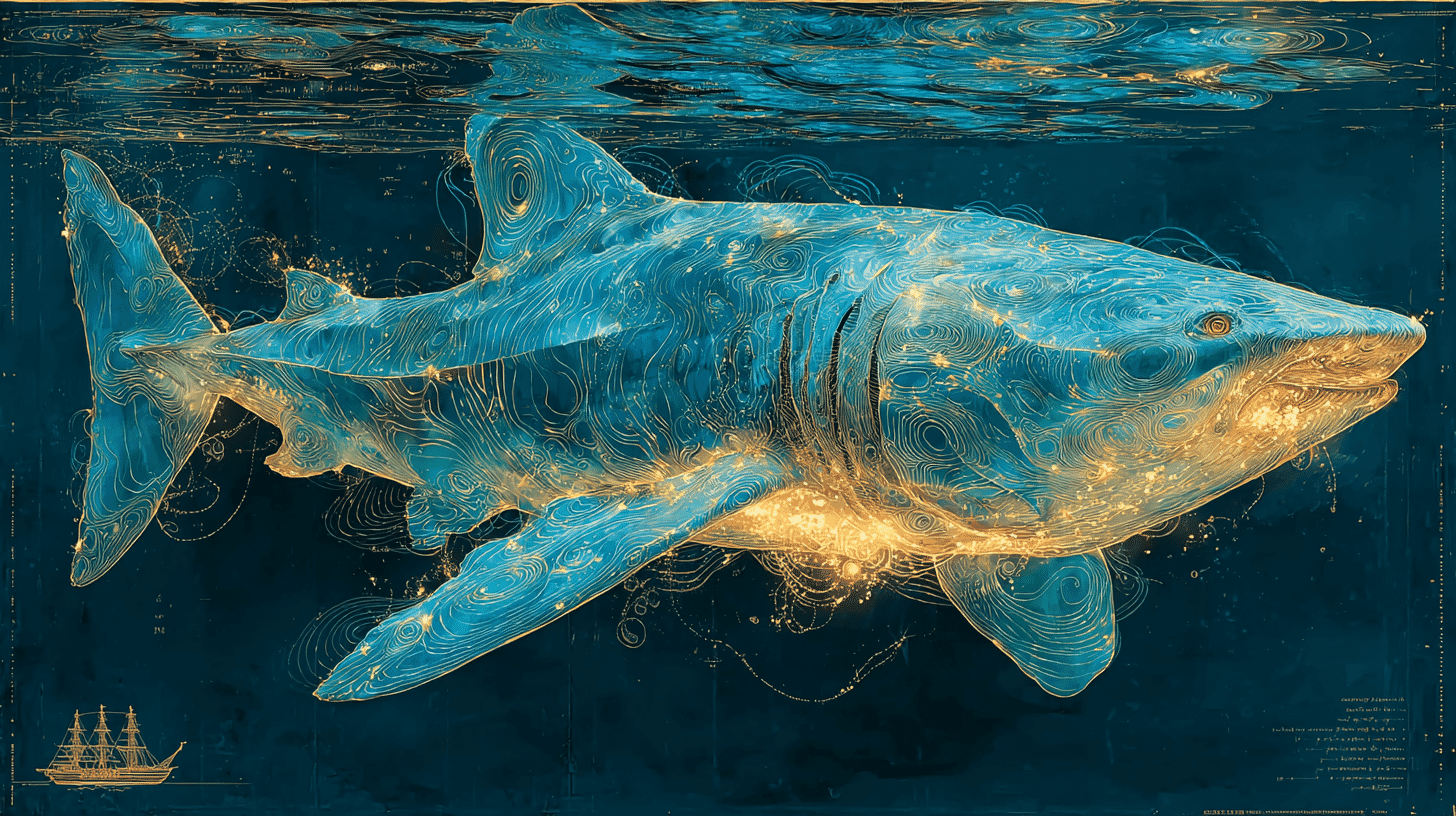
🦈 Somewhere in the black, near-freezing water of the Arctic swims a shark that may have been born around the time of Shakespeare. It grows about a centimeter a year, doesn't reach adulthood until it's 150, and can apparently keep going for four centuries. Nobody knows why. For the first time, a team led by the University of Tokyo has read almost its entire genome, and turned up the first real clues.
A fish that was alive before your country existed
The Greenland shark (Somniosus microcephalus) is not a glamorous animal. It is slow, with a top speed under 3 km/h, which is why fishermen call it the "sleeper shark." Its flesh is so loaded with the antifreeze compound trimethylamine oxide that eating it raw can leave you stumbling and nauseated, a state Icelanders cheerfully call being "shark drunk." (Fermented and dried for months, it becomes the notorious delicacy hákarl.) Most adults are half-blind, their eyes colonized by a parasitic copepod that eats away at the cornea. In the pitch dark of the deep sea, the shark barely seems to notice.
What made this homely giant world-famous was its age. In 2016, a team led by Julius Nielsen at the University of Copenhagen published a study in Science that did something no one had managed before: it put a number on the lifespan of a Greenland shark. The species has almost no calcified tissue to count growth rings on, so the researchers turned to the lens of the eye, whose core forms before birth and never changes. Radiocarbon dating of 28 sharks suggested a minimum lifespan of 272 years. The largest, a five-meter female, came out at roughly 392 years old, give or take 120.

Source: University of Tokyo Graduate School of Agricultural and Life Sciences press release
Sit with that for a second. The oldest shark in that study was most likely alive in the early 1600s, and might even have been born in the 1500s. It outlives the Galápagos tortoise (around 250 years) and the bowhead whale (around 200) by a wide margin, which makes it the longest-lived vertebrate known to science. Yet, as Nielsen admitted at the time, the obvious question stayed wide open: why? Cold-bloodedness and a glacial metabolism are surely part of it, but no one had looked where the answer might actually be written, in the animal's DNA.
Why the genome stayed locked for so long
The problem was never a lack of interest. It was access, on two fronts.
First, the shark itself. This is a creature of the deep, cold North Atlantic and Arctic, rarely seen and hard to reach; living animals were not photographed in the wild until the mid-1990s. Getting fresh, high-quality tissue from a wild Greenland shark is its own expedition.
Second, the genome. Greenland sharks have enormous genomes stuffed with repetitive sequences, like a book in which whole pages repeat almost word for word. Standard sequencing chops DNA into fragments and reassembles them, and when the fragments all look alike, the reassembly collapses into guesswork. A US team posted a genome analysis as a preprint in 2024, but every attempt so far had produced only patchy, incomplete drafts. The blueprint for the longest-lived animal on Earth existed, and nobody had read it cleanly at the chromosome level.
How a Japanese team finally read it
The breakthrough came from a collaboration across three countries and several disciplines. Field researchers in Japan, Canada, and Norway, including teams from the University of Windsor and the Norwegian Polar Institute, managed to collect a skin sample from a wild Greenland shark. From there, a group led by Professor Shigeharu Kinoshita and graduate student Kaiqiao Yang at the University of Tokyo, working with Professor Shigehiro Kuraku of the National Institute of Genetics, Professor Yuuki Watanabe of the Graduate University for Advanced Studies (SOKENDAI), and researchers at RIKEN and Kitasato University, brought modern high-precision sequencing to bear on that repetitive, oversized genome. Collecting the sample took three years; the sequencing itself took about six months.
This time the pages didn't collapse into each other. The team assembled the genome at the chromosome level, the first high-precision, near-complete read of any Greenland shark, and published it in Proceedings of the National Academy of Sciences on May 20, 2026. For the first time, researchers could compare this 400-year animal gene by gene against other sharks, rays, and mammals, and ask what stood out.
The two clues hiding in the DNA
Two things did.
The first involves a protein called a linker histone, part of the scaffolding that packs DNA neatly inside the nucleus and keeps the whole structure stable. In the Greenland shark, the team found a distinctive change in this protein bearing the fingerprints of positive selection (evolution actively favoring a beneficial mutation). The change appears to strengthen how tightly the linker histone grips DNA. That matters because a more stable genome means less DNA damage piling up over time, and slowing that buildup of genetic wear is exactly the sort of thing that could let an animal keep its cells working for centuries.

Source: University of Tokyo Graduate School of Agricultural and Life Sciences press release
The second clue is about iron. The shark carries a strikingly high number of copies of a gene called FTH1b, which builds ferritin, the protein that locks iron away safely inside cells. Loose iron is dangerous: it drives a form of cell death called ferroptosis, now understood to be entangled with cancer, chronic inflammation, and neurodegenerative diseases, the familiar roster of age-related illness. By stockpiling extra ferritin machinery, the Greenland shark may keep its iron tightly managed and its oxidative stress in check, year after slow year.
It's worth being precise about what this is and isn't. The team has not "found the longevity gene." It has found two strong candidates, plausible molecular reasons a body might resist aging, written into the genome of the animal that resists it best. Whether these changes actually drive the 400-year lifespan still has to be tested.
The map is drawn; the expedition starts now
This is the honest shape of the discovery: the genome is the map, not the treasure. The decoding is finished, but the science it makes possible is only beginning. Functional experiments, comparisons with other long-lived species, and the slow work of confirming what each gene really does all lie ahead.
That is also why it matters beyond marine biology. Much of the developed world is now an aging society, Japan more acutely than most, and a great deal of medical research circles the same question from the human side: why do cells age, and can we slow it? A wild animal that has held the problem at bay for four centuries is, in effect, a natural experiment we could never have designed. Reading its genome doesn't hand us the answer, but it tells us where to look.
There is a point that is easy to miss. The Greenland shark matures at around 150 and grows a centimeter a year, which makes it extraordinarily fragile. A population fished down today might not recover for centuries. The animal that may hold clues to living longer is itself listed as vulnerable to extinction.
Working with a 400-year-old shark almost forces you to think in long stretches of time. If your country found the genetic recipe for a longer, healthier life buried in a half-blind deep-sea fish, what would it do with it? And could it think in centuries, the way the shark does?
References
- University of Tokyo Graduate School of Agricultural and Life Sciences press release (May 20, 2026): https://www.a.u-tokyo.ac.jp/topics/topics_20260520-1.html
- Yang et al., "The Greenland shark genome: insights into lifespan extremes and population dynamics," PNAS (2026): https://www.pnas.org/doi/10.1073/pnas.2601272123
- Nikkei (May 29, 2026): https://www.nikkei.com/article/DGXZQOSG259260V20C26A5000000/
- Nielsen et al., "Eye lens radiocarbon reveals centuries of longevity in the Greenland shark," Science (2016): https://www.science.org/doi/10.1126/science.aaf1703









Global Discussion
5 comments