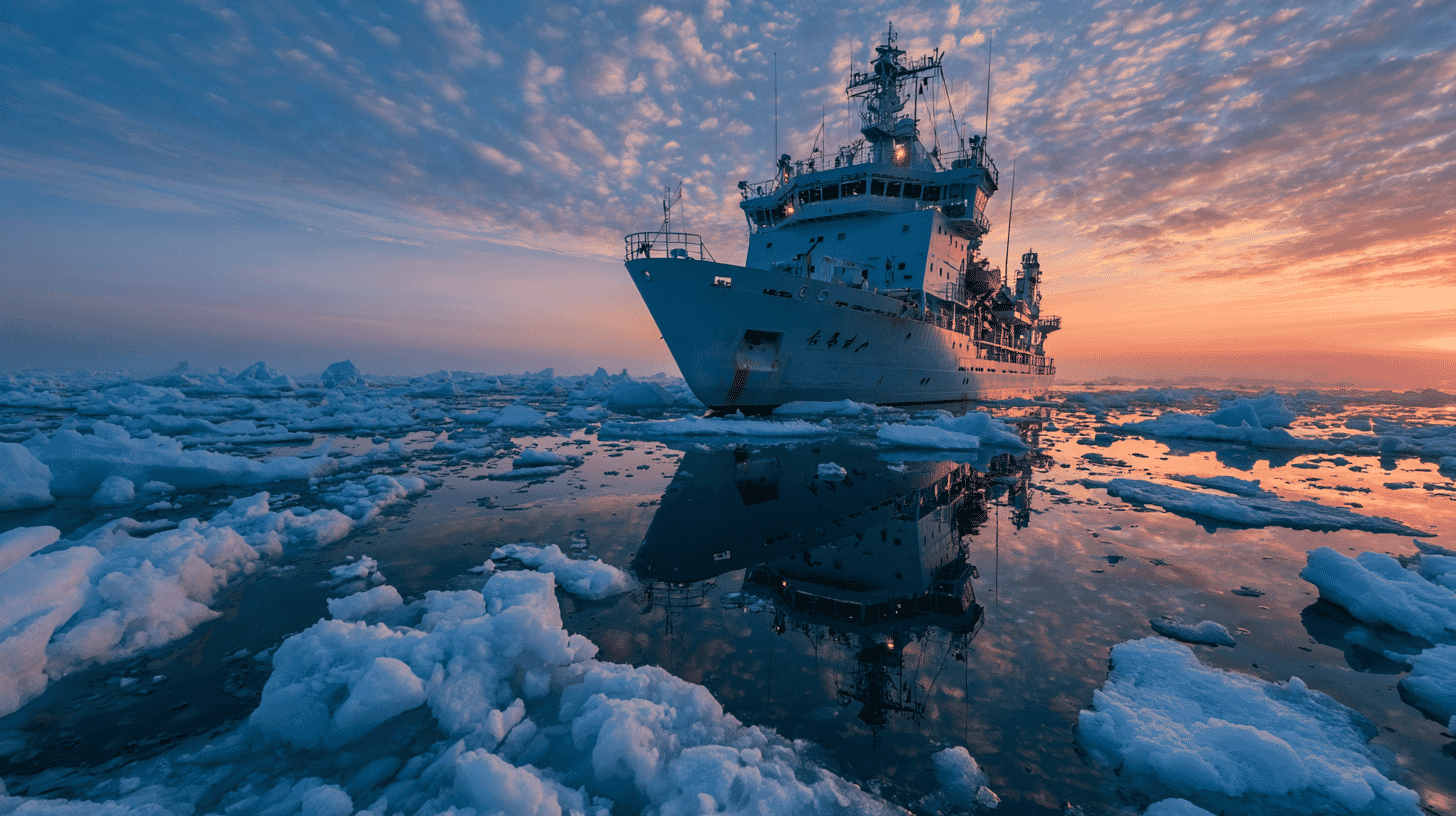
🧊 The far north is quietly being rewritten as the far south. Microbes from warmer waters are slipping past the retreating sea ice, riding currents from the Bering Sea deep into the Arctic Ocean's central basin, and reshaping the nutrient flows that have shaped life there for millennia. A team from the University of Tokyo, JAMSTEC, and Japan's National Institute of Polar Research has produced the first direct observational evidence of this shift, using six years of data gathered aboard the research vessel Mirai. In an ocean warming roughly four times faster than the global average, here's what's actually happening underneath the ice.

Source: National Institute of Polar Research press release
A process textbooks said couldn't happen here
Nitrogen fixation is a process most people will never have heard of, but it props up the entire ocean food web. Nitrogen gas makes up most of the atmosphere, yet almost no organism can use it directly: it is chemically inert. A small minority of microbes can convert that gas into ammonia, the form plants and plankton actually need. They are, in effect, the world's biological fertilizer factories.
Until recently, oceanographers assumed this work happened in tropical and subtropical waters. Cold seas, the textbooks said, were too cold. Global ocean models were built on that assumption.
Then, in 2018, a team led by Jonathan Zehr at the University of California, Santa Cruz documented active nitrogen fixation in the Bering and Chukchi Seas. The culprit was UCYN-A, a cyanobacterium that lives in symbiosis with a tiny haptophyte alga. In the Bering Sea it was fixing nitrogen at rates comparable to subtropical waters, though rates in the Chukchi Sea were low. The textbook assumption began to wobble. UCYN-A2, the organism at the center of the new study, is one lineage of that group.
But one big question remained. UCYN-A2 living in the Bering Sea is a regional curiosity. UCYN-A2 carried hundreds of kilometers north into the Arctic basin itself, where it actually rewrites the local nitrogen budget: that would be something else entirely.
The team led by associate professor Takuhei Shiozaki at the University of Tokyo's Atmosphere and Ocean Research Institute has now taken that next step.
What the Mirai found in 2017

Source: National Institute of Polar Research
For six summers between 2015 and 2020, the R/V Mirai sailed into the Pacific sector of the Arctic, measuring nitrogen fixation rates, nutrient concentrations, and the abundance of UCYN-A2 genes in seawater samples drawn from a network of stations.
One year stood out: 2017.
That year, the sea ice around the Bering Strait broke up unusually early. The earlier the ice goes, the longer and stronger the inflow of Pacific water into the Arctic. Numerical simulations confirmed what the field data hinted at. UCYN-A2, abundant in the Bering Sea, had been pushed deep into the Arctic basin during that early-melt season, spreading across the surface layer of the deep central waters.
It was more than just turning up there. At some stations, nitrogen fixation by UCYN-A2 actually outpaced the slow upward supply of nitrate from deep water, the traditional fuel for Arctic phytoplankton growth. The very source of nitrogen feeding new plankton growth had switched from "ocean depths" to "microbes shipped in from elsewhere."
That same year, surface phosphorus concentrations in the basin dropped below other years' levels, a fingerprint commonly seen in waters where nitrogen fixation runs hot, because the process consumes phosphorus as it works.
"Borealization" reaches the chemistry of the sea

Source: National Institute of Polar Research
Oceanographers already have a name for the Arctic turning into something more like a subarctic sea: borealization. The Pacific-side version is sometimes called Pacification; the Atlantic-side version, where warmer, saltier Atlantic water pushes north, is called Atlantification. NOAA's 2025 Arctic Report Card highlighted atlantification as one of the major transformations now reshaping the Eurasian Basin: diminishing winter sea-ice formation, lifting nutrient-rich water toward the surface, and altering productivity.
Until now, the borealization story has mostly been told through animals: fish ranges creeping north, southern zooplankton appearing where they didn't used to. The Japanese team's contribution is to show that the newcomers have started rewriting the chemistry of the Arctic, not just its biology.
Their paper, published in Global Change Biology in May 2026, frames the finding carefully: "the first evidence that microbes flowing into the Arctic Ocean from outside can alter its material cycles." That cautious phrasing matters in oceanographic circles. It is the first direct observational link between borealization and biogeochemistry in the Arctic.
It is unlikely to be the last. Long-term mooring observations in the Bering Strait have documented a clear upward trend in heat transport from the Pacific into the Arctic in recent decades (Woodgate, 2018). Sea ice continues to retreat earlier. The conditions that pushed UCYN-A2 deep into the basin in 2017 are becoming more, not less, common.
Why the rest of the world should care
A microbial story unfolding off Siberia and Alaska might feel comfortably far from Tokyo, London, or Mexico City. Three reasons it shouldn't.
The first is fisheries. The Bering and Chukchi Seas feed some of the world's most important fisheries (Alaska pollock, snow crab, salmon) and underpin the seafood economies of the United States, Russia, Norway, and Greenland. Changes that begin at the base of the food chain, in phytoplankton growth, eventually propagate upward. This study does not predict a collapse; it does identify the doorway through which one would arrive.
The second is climate. Marine phytoplankton pull CO2 out of the atmosphere through photosynthesis. A fraction of that organic carbon sinks as "marine snow" into deep waters, where it can stay locked away for centuries. This biological pump is a key part of Earth's carbon balance. If nitrogen fixation injects new nitrogen into the Arctic basin, phytoplankton productivity changes, and so does the pump's strength. The Arctic Ocean has historically been a modest contributor, but small shifts there can register globally.
The third is the limits of our models. Most large-scale ocean biogeochemistry models still assume that nitrogen fixation is a low-latitude phenomenon. The Japanese team's data show that this assumption fails in the Arctic. Improving climate projections, the authors argue, will require rebuilding those models with the high latitudes properly included.
The quiet role of Japan's Arctic science
Arctic Ocean research conjures images of icebreakers from Russia, the United States, Canada, or Norway, all members of the Arctic Council, whose territory touches the ocean. Japan is not one of them. Its northernmost point in Hokkaido sits well south of the Arctic Circle. Yet Japan is an Arctic Council observer state and has carved out a real presence in polar science.
JAMSTEC's R/V Mirai is a big part of why. The ship is not an icebreaker, but it ventures regularly to the sea-ice edge, and few non-Arctic countries operate a vessel that can do sustained multidisciplinary work that far north. The new study leans heavily on Mirai's annual cruises. The ship itself, however, was retired at the end of Japan's 2025 fiscal year. Its Arctic work passes to a successor, the research vessel Mirai II, the first Japanese research ship with an icebreaking hull, due for delivery in November 2026 and a first Arctic cruise in the summer of 2027.
Behind the ship sits sustained political will. Japan's Ministry of Education, Culture, Sports, Science and Technology (MEXT) launched the Arctic Challenge for Sustainability (ArCS) program in 2015. Its successor, ArCS III, is now running. Both phases appear in the funding acknowledgements of the new paper: long-horizon budgeting that finally produced a published headline finding.
International cooperation is the other half. The eight Arctic Council member states (the U.S., Russia, Canada, Norway, Denmark via Greenland, Sweden, Finland, and Iceland) set the policy agenda for the region. Geopolitical tensions have made formal council business difficult in recent years, but the physics of the ocean does not respect those frictions. Working scientists across the Arctic Council states and observer countries like Japan and South Korea continue to share data and coordinate observations, because the science only works if everyone does.
What the next ship needs to look for

Source: National Institute of Polar Research
The new paper answered the entry question: can external microbes alter the Arctic's material cycles? Yes, they can, and in at least one year they did, substantially.
The next questions line up easily. How fast will the frequency of UCYN-A2 transport increase? As the central Arctic basin becomes more oligotrophic, or nutrient-poor, at its surface, will the arrival of nitrogen-fixers ultimately raise or lower phytoplankton productivity? When and how will any of this register at the level of commercial fisheries?
The paper closes with a line worth repeating: future research must focus on better understanding the dynamics and on rebuilding the predictive models that govern Arctic forecasts. That call extends well beyond the Arctic. The ocean is a single connected system. What happens north of the Bering Strait propagates, sooner or later, into the Pacific, the Atlantic, and the Indian Oceans, in forms we don't yet fully see.
Satellite imagery has democratized the view from above the ice. The view from below, at the scale of microbes, gene copies, and isotope ratios, still requires people on a ship pulling water samples and running the assays. The quiet, repetitive cruises of vessels like the Mirai are how those underwater changes finally get caught.
Wherever your coast is, Pacific, Atlantic, Mediterranean or Caribbean, how is the ocean off your shore changing? The Arctic's story will reach it eventually, through fisheries, through carbon balance, through the weather. Is anyone watching it as closely?







Global Discussion
4 comments