🪱 One of the more reassuring things about Fukushima's forests has been that the worst of the contamination doesn't travel. Glassy radioactive particles nicknamed "cesium balls" sit in the top few centimeters of soil and shrug off rain. A team from Kyoto University has now found them inside earthworms, and turned up one lodged 15.5 centimeters down, in what looked like a worm's tunnel.
What turned up in 52 earthworms
The team collected 52 earthworms in 2025 from forests in and around Fukushima's difficult-to-return zones, the areas still closed to residents because of contamination from the 2011 Fukushima Daiichi accident. In 39 of them, microparticles were found in the digestive tract. Kyodo News reported the work on August 1, 2026.
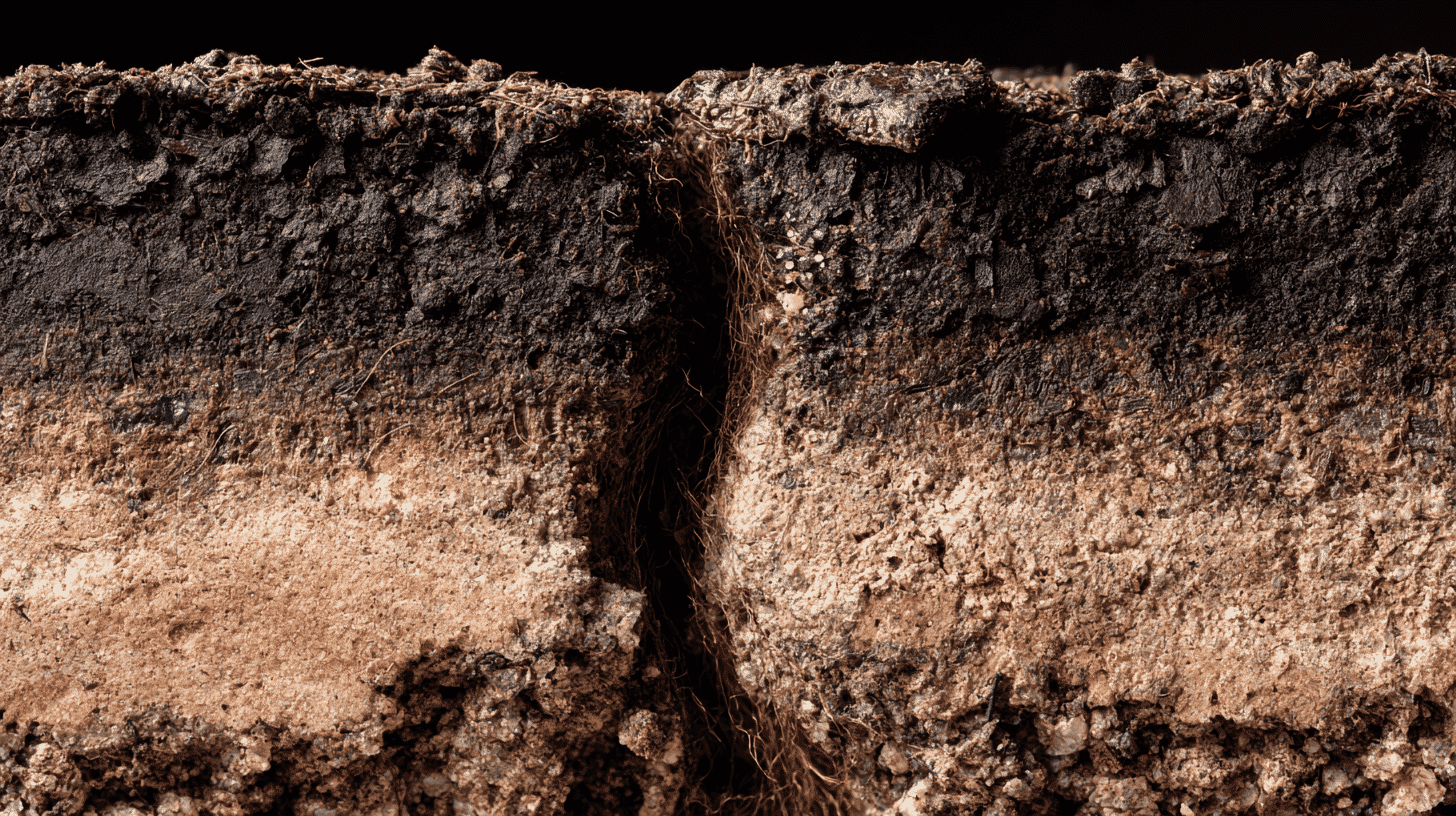
They also cut vertical slices of the soil itself. Most of what they saw matched expectations: 95 percent of the particles sat within the top three centimeters. One did not. It was 15.5 centimeters down, sitting in a gap that had the shape of a worm burrow. The straightforward reading, and the one the team offers, is that a worm swallowed it along with leaf litter and surface soil, carried it down, and left it behind.
What a "cesium ball" actually is
Two kinds of cesium came out of the reactors. Most public discussion has been about the water-soluble kind, which dissolves in rain, binds tightly to clay minerals, and therefore stays near the surface anyway.
Cesium balls are the other kind. Formally they are cesium-rich microparticles: beads of silicate glass a few micrometers across, with iron, zinc and cesium fused into them when the reactor cores melted. They formed only during a short window in March 2011. One analysis published in 2026 traces the bulk of them to a single plume released around 3 a.m. on March 15.
Because the cesium is locked inside glass, water does not leach it out. The particles behave like grit rather than like a dissolved chemical. Gram for gram the material is extraordinarily concentrated, carrying more than 100,000 times the cesium of clay that has simply adsorbed it. But nobody has a gram of them. Individual particles that researchers have picked out and measured have ranged from a fraction of a becquerel to several hundred.
What "it stays put" was holding up
Forests cover 71 percent of Fukushima Prefecture. Decontaminating all of that was never realistic. The Environment Ministry limits forest decontamination to roughly 20 meters from where people live, plus campgrounds and other places people actually walk into. Stripping leaf litter off whole hillsides would loosen topsoil and invite erosion, and the ministry concluded that runoff from forests was not meaningfully changing radiation levels in inhabited areas.
That framework is still in force. Evacuation orders across all the reconstruction base zones were lifted by November 2023, and by February 2026 six municipalities had designated further zones for residents who want to return. Even there, the official decontamination area is defined to exclude forest more than 20 meters from living space.
The working picture has been that the contamination stops within a few centimeters of the surface. That is what makes the untouched 71 percent something you can model and monitor rather than dig up.
Darwin got here first
The mechanism is not exotic. Charles Darwin spent four decades on it and made it the subject of his last scientific book, published in October 1881, six months before he died. He weighed worm castings, tracked how far stones sank into pasture, and went to Stonehenge to see the monoliths settling into soil the worms had turned over. Roman ruins in Hampshire had gone under the same way. His point was that small animals working continuously and invisibly will rearrange a landscape.
Soil scientists call it bioturbation. It is why a coin you drop in a garden ends up deeper than you left it. Radiocesium riding that machinery downward has been studied since well before Fukushima, and researchers working in the difficult-to-return zone had already named it as a process that could carry contamination through the soil profile. What is new is catching the insoluble glass particles in the act.
What the finding does and doesn't show
Downward movement is not automatically bad news. Cesium under fifteen centimeters of soil is cesium partly shielded, and surface dose rates drop as material sinks.
The complications sit elsewhere. Scraping off surface soil no longer captures everything if some of it has gone deeper. And earthworms are food. Nobuhito Ohte, a researcher who has tracked radiocesium through Fukushima's forest food webs, pointed out back in 2012 that earthworms feeding on contaminated leaf litter carried high cesium concentrations. Reptiles that prey on them ran high too, and so did wild boar. A particle that is chemically inert sitting in soil is not necessarily inert once something swallows it, which is why researchers studying these microparticles have flagged internal exposure as an open question.
Ninety-five percent of the particles were exactly where they were expected to be. The deep detection was a single particle. The team describes worm transport as likely rather than measured, and nothing here quantifies how much material moves, how fast, or what dose it would deliver to anything at all.
What it chips at is the working picture underneath fifteen years of leaving those forests alone: that what fell on them would largely stay where it landed. Soil is not a filing cabinet. It is full of animals with their own plans.
Most countries have land they have written off as too remote, too expensive, or too stable to worry about. Do you know what is in yours, and whether anyone is still checking?
References
- https://news.yahoo.co.jp/articles/fbcc560b08dc28626af71bbb438e24ac64ec20e8
- https://www.minyu-net.com/newspack/detail/2026080101000640
- https://josen.env.go.jp/about/efforts/forest.html
- https://www.env.go.jp/chemi/rhm/current/09-05-01.html
- https://www.rinya.maff.go.jp/j/keikaku/genkyou/r4/1.html
- https://link.springer.com/chapter/10.1007/978-981-19-9361-9_19
- https://www.ncbi.nlm.nih.gov/pmc/articles/PMC5511200/
- https://link.springer.com/article/10.1007/s10967-021-08061-8
- https://doi.org/10.1016/j.jhazmat.2026.142180
- https://soil.copernicus.org/articles/9/479/2023/
- https://link.springer.com/article/10.1007/s11368-014-0982-5
- https://www.mizu.gr.jp/fudoki/people/050_ohte.html









Global Discussion
3 comments