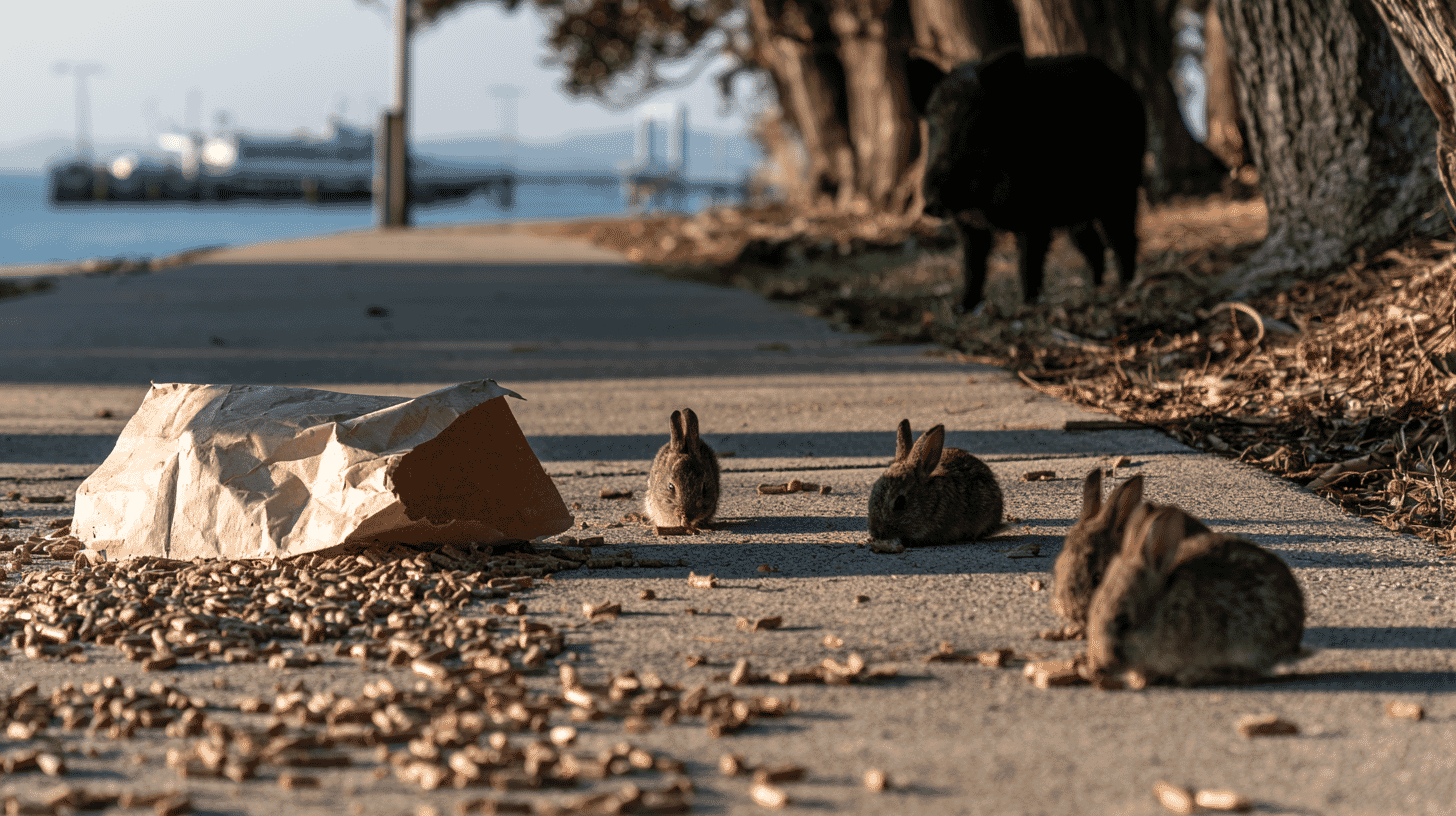
🐰 Every day, ferries drop visitors onto a small island in Japan's Seto Inland Sea carrying bags of pellets, and hundreds of rabbits come running. What almost nobody in those photos notices is that something else on the island has learned to come running too.
A team of Japanese researchers has published the first documented account of wild boars actively hunting healthy rabbits on Okunoshima, the island the internet calls Rabbit Island. Their argument is uncomfortable for anyone who has ever knelt down there with a handful of food: the boars may be doing this because of us.
Three in the afternoon, near the ferry landing
On March 5, 2024, at around three in the afternoon, two male rabbits were fighting close to the pier where visitors arrive. A wild boar walked over to them, took one of the rabbits in its mouth, rolled it with its snout, struck it against stone steps, and carried it off into the forest.
That sequence, reconstructed from interviews with the people who saw it, sits at the center of a paper published on July 30, 2026 in the Journal of Ecotourism. The lead author is Shingo Kaneko, a professor in the Faculty of Symbiotic Systems Science and Engineering at Fukushima University. His co-authors include Asami Ogura, an associate professor at National Institute of Technology (KOSEN), Kure College, plus researchers from Kobe College and members of a local peace-and-environment group.
Illustration: Eri Kondo, via Fukushima University and EurekAlert! (CC BY)
Boars eating rabbits is not itself news. Scavenging carcasses is well documented in the literature. What specialists had doubted was whether a boar would take a healthy, unimpaired adult animal, and Kaneko notes that boars are "not generally regarded as animals that actively hunt live prey." Digging further, the team found that a visitor had witnessed something very similar back in 2017, which suggests this is not a one-off freak event but a behavior that recurs.
The research itself began by accident. Kaneko's group had gone to Okunoshima to investigate where the island's rabbits actually came from, a project that grew out of a picture book called Usagi no Shima, published by Sekaibunka in June 2025. The boar sighting reached them in the middle of that work.
On this island, the rabbits are the outsiders
Okunoshima is tiny, roughly 4.3 kilometers around, and it sits inside Setonaikai National Park. Almost nobody lives there apart from the staff of its single hotel. As of mid-2026 it holds several hundred rabbits, and estimates reported in the Japanese press range from 400 to about 1,000.
Those rabbits are not native wildlife. They are European rabbits, the domesticated pet kind, living in a semi-feral state. The species carries an odd double status: the IUCN lists it among the 100 worst invasive alien species on the planet, while the same organization classified its wild population back home in Iberia as Endangered in a 2019 assessment. The same animal is protected in Spain and culled almost everywhere else.
How they got there is genuinely unsettled. The story usually repeated is that a mainland elementary school released eight rabbits on the island in 1971. Kaneko's team has been investigating that origin rather than assuming it, which is precisely why they were on the island in the first place.
The island's other history is heavier. From the early Showa era until 1945 the Imperial Japanese Army manufactured poison gas here, and Okunoshima was struck from published maps to keep it secret. A museum on the island documents that period. Most visitors today arrive for the rabbits and meet the war ruins by surprise.
The food chain runs through the visitors' bags
Boars are not stranded on Okunoshima. According to Kaneko they swim across from Honshu and Shikoku looking for food, and once they arrive, the island offers a strange abundance.
The researchers lay out a chain rather than a single cause. Unregulated feeding by tourists supports a rabbit population far larger than the island's own vegetation could sustain. On busy days, uneaten feed piles up on the ground. A dense rabbit population also generates a steady supply of rabbit carcasses. Leftover pellets and dead rabbits are both food for an opportunistic omnivore, so boars come, stay, and grow used to being close to people. Somewhere in that sequence, a live rabbit stops looking different from everything else on the ground.
The team is careful about what it is claiming. They do not assert a proven causal link between tourist feeding and boar predation. They present the case to define the questions that need systematic study.
What makes it hard to dismiss is that the government had already flagged the same mechanism. The rules for visitors posted by Japan's Ministry of the Environment in September 2024, drawn up by a local body called the Okunoshima Future Planning Committee, include a plain instruction to watch until the rabbit finishes eating and to carry leftovers home. The stated reasons are that leftover feed rots, that it becomes food for boars and rats, and that boars increasing in number and approaching people is very dangerous. That was written before the paper appeared.
A line drawn at rabbit height
The most visible evidence has nothing to do with boars at all. Walk the island and you can see what the researchers call a rabbit line: on tree after tree, every branch and leaf within reach of a standing rabbit is gone, leaving a clean horizontal edge. A neighboring island without rabbits still has thick undergrowth.
More telling are the gnaw marks the team found on hydrangea and oleander. Both are poisonous. Animals with enough to eat generally do not chew them. That single detail flips the picture. The island that looks like an all-you-can-eat paradise in social media clips is, for much of the year, a place where rabbits are hungry.
The reason is that the food supply tracks the tourist calendar rather than the rabbits' needs. Okunoshima's visitor numbers peaked at 362,336 in 2017, a record announced by Takehara City, driven by a startling surge of overseas travelers who found the island online: 378 foreign visitors in 2013 became 5,564 in 2014. When the ferries are full, feed is everywhere. When they are not, several hundred animals still have to eat.
This is not a story about culling boars
Boars wandering a small island crowded with day-trippers is a real safety problem, and it will require a real answer. But the researchers push back on framing that as the core issue. Removing boars does not change the number of rabbits, the state of the vegetation, or the volume of food arriving by ferry every morning.
Okunoshima is a national park, a war memorial site, and a tourist attraction at the same time, and the team argues that tourism, animal welfare, biodiversity, and visitor safety have to be handled together rather than one at a time. Kaneko's own summing up is that the situation is complicated, that no easy solution will satisfy everyone, and that the way forward is sustained scientific work plus dialogue among the people involved. He has also said plainly what that should lead to: limits on the food visitors bring in, and a rethink of how many rabbits the island's ecosystem can carry.
The island has already shown how exposed it is. From late November 2024, 99 dead rabbits were found over a short period. A man was arrested and later indicted in 2025 over rabbit deaths there, though how much of the whole series he was responsible for has not been established. The Ministry of the Environment has responded by checking and expanding security cameras and strengthening monitoring.
Eri Kondo, the picture book author who has been surveying the rabbits and who drew the reconstruction of the attack, puts the underlying discomfort well. Hundreds of non-native rabbits on an island you can walk around in an hour, surrounded by crowds, was never a natural arrangement in the first place. Feeding them because they are cute, or because they seem to be suffering, is what keeps that arrangement running.
Somewhere near you there is probably a place where people hand food to animals, whether that is deer, monkeys, pigeons, stray cats, or fish in a temple pond. How does your country handle it, and would anyone there accept being told to stop?
References
- https://doi.org/10.1080/14724049.2026.2705843
- https://www.fukushima-u.ac.jp/news/Files/2026/07/press_290731.pdf
- https://www.kure-nct.ac.jp/campuslife/diary/2026/07/v937/
- https://chushikoku.env.go.jp/emergency/2021/04/post-17.html
- https://chushikoku.env.go.jp/procure/topics_00183.html
- https://news.yahoo.co.jp/articles/420ea25aa0f051ad82c1884bbf00fab5414d00ea
- https://www.nikkei.com/article/DGXMZO31215560R30C18A5LC0000/
- https://doi.org/10.2305/IUCN.UK.2019-3.RLTS.T41291A170619657.en




Global Discussion
4 comments